

Fan-Out Queries: The Hidden Layer of AI Search You Need to Optimize For
Suppose you’re asking ChatGPT, “Where should I eat in London tonight?”. Instead of throwing generic suggestions at you, it offers selected places for best-value dining, trendy dining, or high-end food destinations, and describes every choice in detail. Why can ChatGPT generate such a detailed guide in an answer to a simple query?
The answer is that AI models, like ChatGPT, don’t usually answer straight away. They don’t treat your prompt as a single request and may expand it into additional searches to gather more information and context. This is called a queryfan-out – a process where an LLM deconstructs a user prompt and generates relevant sub-queries called fan-outs.
Fan-out queries are hidden from the user, but can determine how an AI model explores and cites sources to produce a richer response. That said, fan-out queries may be the key for businesses to be visible for the LLMs and cited in their answers.
In this article, we’ll explore fan-out queries in more detail, especially how they work under the hood of AI search. Moreover, we’ll demonstrate why and how query fan-out reshapes generative search optimization in practice, and how you should adapt to a new reality.
Contents:
What is a query fan-out, and how does it work: key principles
Implications for AI search optimization: case of keyword research
1. Nearly half of the user prompts trigger fan-out queries
2. High search volume prompts trigger more query fan-out
3. Long-tail terms are still relevant for AI visibility
4. Fan-out queries are highly similar to search results titles and descriptions
Use case: keyword research focused on fan-outs for ChatGPT
➤ Key prerequisites
➤ Setting up the workflow
Wrap-up
What is a query fan-out, and how does it work: key principles
As mentioned before, fan-out queries are essentially an expansion of the original user prompt. They are additional search queries, generated by the LLM to retrieve search results or other external sources, so the model can provide the user with a comprehensive response. But when and why are they generated?
When the user enters a prompt, an LLM evaluates the type of information the user needs. If the prompt is a single-fact lookup, such as “When Albert Einstein was born?”, the AI can produce an answer straight away. For some prompts, like “What popular movies should I watch?”, the LLM may ask follow-up questions to clarify, such as preferred genres, themes, and more.
However, when users prompt introduces specific constraints, such as time or location, or the AI’s database lacks sufficient and up-to-date information, the query fan-out may be triggered.
For example, the prompt “Where should I eat in London tonight?” may be expanded into the following queries:
- best fine dining restaurants in London;
- cheap restaurants in London reviews;
- trendy restaurants in London menu.
Each of these queries is sent to a search engine by the LLM to retrieve relevant results, helping the AI generate a response that may satisfy multiple user needs at once. In short, query fan-out enables LLMs to analyze a user’s query from multiple angles, covering a wide range of aspects and presenting a response supported by up-to-date insights.
At the same time, details of the fan-out query generation process are not disclosed by popular LLM platforms, such as ChatGPT. The official ChatGPT Search documentation doesn’t explicitly describe fan-out queries, only mentioning that ChatGPT “typically rewrites your query into one or more targeted queries” and sends them to search engines. However, it makes clear that fan-out queries can only be generated when web search is enabled, and that these queries are used to retrieve actual search engine results.
Nevertheless, query fan-out is a logical, step-by-step process that starts from the initial user query.
Here is a simple visualization of a query fan-out pipeline.
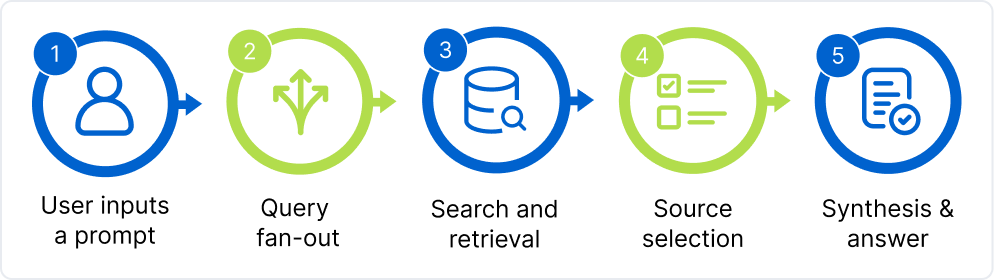
The key steps can be described as follows:
1. User inputs a prompt, which is analyzed by an LLM.
2. If the answer to the query requires additional information, the LLM generates fan-out queries relevant to the prompt.
3. The LLM uses web search and sends fan-out queries to retrieve search results.
4. When LLM retrieves sufficient search engine results, it analyzes them and determines which can be used as sources for generating the final answer.
5. Using information from the selected sources, the AI synthesizes the answer and cites the sources.
As you can see, query fan-out enables LLMs to actively retrieve current, relevant information from the web before composing a response, making it an essential part of the data discovery and source selection process.
At the same time, it’s important not to confuse query fan-out with reasoning, which is another process of LLM response generation. Reasoning is an internal, step-by-step thought process that some models can perform before or during response synthesis. It doesn’t involve external web searches. Instead, the model evaluates the problem and works with it using its existing knowledge. The reasoning chain is usually visible to a user in an LLM interface. Query fan-out, on the other hand, is an external information gathering process, and generated fan-out queries are not displayed to the user.
In a nutshell, the key principles and features of a query fan-out are as follows:
1. Fan-out queries are extensions of the original user prompt, used to gather external data for providing a more comprehensive response.
2. A query fan-out isn’t triggered randomly. It may activate when the query contains specific constraints or an LLM lacks sufficient information.
3. Fan-out queries may be generated only when the web search is enabled in an LLM.
4. Fan-out queries are used to retrieve actual search engine results.
5. The result of a query fan-out is a list of search results, from which an LLM selects relevant sources to be included in the response generation.
6. A query fan-out is different from reasoning. Reasoning is a model’s step-by-step thought process that doesn’t involve external data retrieval.
Overall, fan-out queries represent an advanced aspect of AI search behavior, bridging the gap between AI models and actual search engine data to enrich AI responses. That means the results of a query fan-out can influence the final output an LLM provides to a user, especially when the response relies on retrieved web sources to answer accurately. Being discovered by fan-out queries may be the first step for businesses toward entering the AI source citation process.
However, what is the real impact of fan-out queries on AI search optimization? We will demonstrate it in a data-driven way, drawing on findings from our in-house study and a practical use case.
Implications for AI search optimization: case of keyword research
Fan-out queries introduce new changes and opportunities for generative search optimization that can’t be overlooked. Now you need to optimize not only for user prompts relevant to your industry, but also for hidden queries that no human ever types. This change is strongly reflected AI keyword research. What makes fan-out queries so relevant for AI keyword research that they require special attention?
We’ll answer this question using insights from our new, detailed research on how LLMs use fan-out queries to navigate the Web. For this research, we analyzed 100,000 ChatGPT prompts and 100,249 fan-out queries, randomly picked from our extensive database that powers the LLM Responses API. This extensive research dataset provides a bird’s-eye view of how AI models use fan-out queries to explore and cite search results.
Regarding the keyword research, we can outline the following four insights from our research:
1 Nearly half of the user prompts trigger fan-out queries
The starting point of the research was to measure how many prompts from the initial dataset triggered query-fan out in ChatGPT. This was crucial for understanding how frequently query fan-out occurs and whether it is a common or rare event across an LLM.
The analysis of the data demonstrated that 47.5% of user prompts (47,484 prompts out of 100,000) triggered a query fan-out in ChatGPT. You can see the result on the chart below.
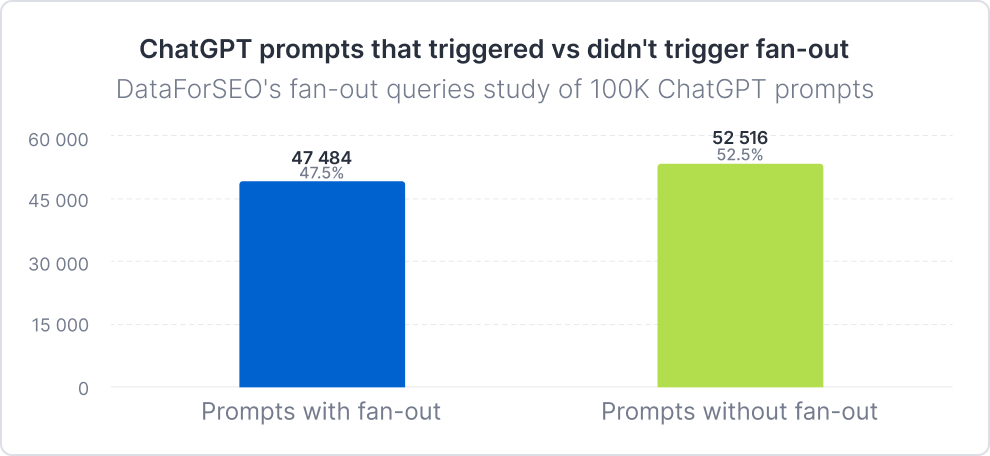
Put simply, nearly half of the time, ChatGPT used fan-out queries to explore additional context and fetch external data for a response rather than instantly answering a user’s query. Thus, fan-out queries generation is not an uncommon behavior of an LLM – it is an essential step in answering a large share of real-world queries.
For GEO and keyword research in particular, this means that fan-out queries create a narrow yet critical opportunity for being discovered by AI search algorithms. If your content is visible for these intermediate-level searches, it increases your chances of appearing in the model’s citation pool. That said, identifying and incorporating fan-out queries relevant to your industry is now a priority alongside standard keyword research.
2 High search volume prompts trigger more query fan-out
Specific queries sent to LLMs are more popular than others, particularly because they cover topics people explore from different angles, such as technology and travel. Such topics require analyzing multiple viewpoints, comparing them, and using up-to-date information. These conditions may prompt AI to use query fan-out to access external data before answering.
We tested this idea by examining the search popularity of the original user prompts and analyzing the relationship between their popularity and ChatGPT’s fan-out rate. To understand how frequently prompts are used, we looked at their AI search volume – a proprietary metric calculated by our internal algorithm. AI search volume represents the estimated number of times a query is used within AI search environments.
Here is the graph showing the correlation between prompts’ AI search volume and fan-out rates.
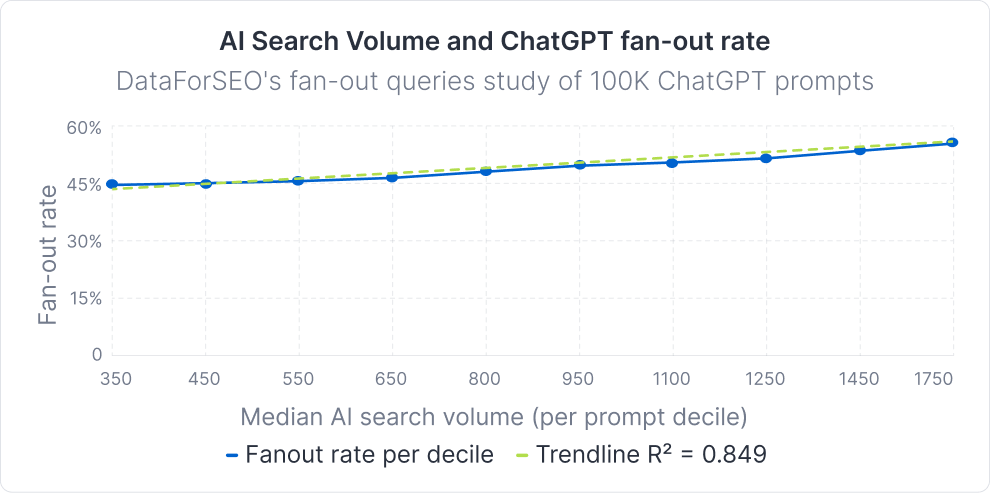
The result proves our idea by demonstrating a positive relationship between search volume and ChatGPT fan-out rate. In particular, high AI search volume prompts trigger query fan-out about 51-55% of the time. That means the higher the AI search volume, the greater the likelihood of fan-out queries.
The key insight for GEO is that targeting high-demand topics can bring more retrieval opportunities. That means during keyword research, you should focus on exploring high AI search volume terms and relevant fan-out queries, and naturally incorporate them into your content.
3 Long-tail terms are still relevant for AI visibility
Fan-out queries are not only additional search terms generated by AI, but also an extension of the original user prompts. That means fan-out queries may include additional words or phrases that can help to address a wider range of user needs and search contexts.
To understand how AI can expand original user prompts, we compared the prompt lengths and the fan-out queries generated. The graph below illustrates the results.
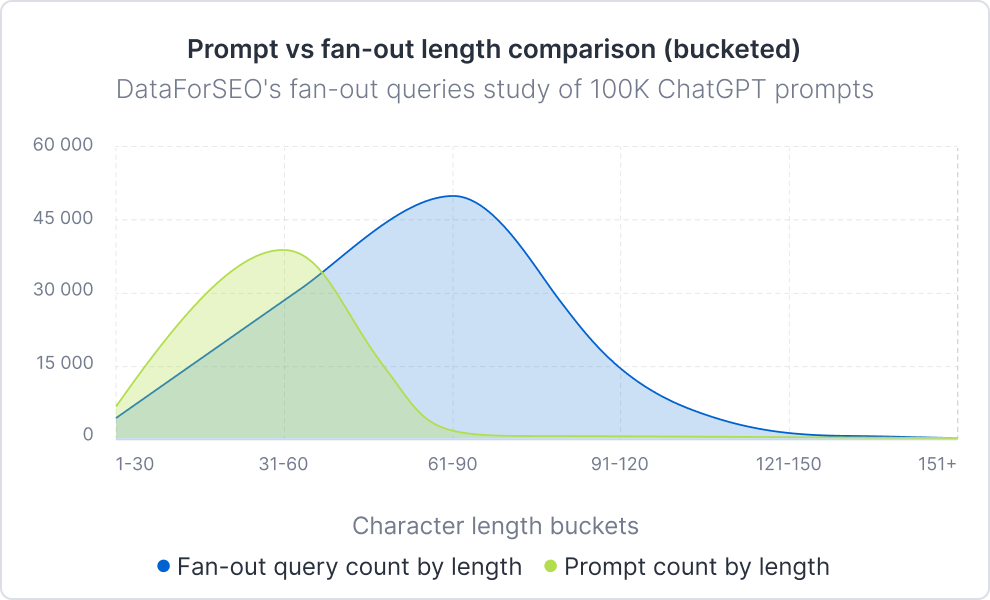
As we can see, most user prompts are within the 31-60 character range, whereas the majority of fan-out queries are longer, ranging from 61 to 90 characters. This proves that ChatGPT tends to enlarge user prompts when generating fan-out queries. At the same time, the AI doesn’t generate extensive queries often, keeping them compact and naturally phased.
For AI-focused keyword optimization, this means that targeting only short, head-term keywords may not align with the more specific queries ChatGPT generates during fan-out. Since fan-out queries tend to be longer and more detailed than the original prompt, it’s important not to overlook long-tail variations during keyword research.
4 Fan-out queries are highly similar to search results titles and descriptions
When we know that fan-out queries are generated as an extension of the user prompt, we don’t know how similar they are to the original query or to the content they retrieve.
That’s why we decided to measure this similarity by calculating word overlap, comparing the wording of fan-out queries with the original prompt, the descriptions, and the titles of search results and source pages.
Before delving into the results, it is important to clarify the difference between search results and sources. Search results are all web search outputs that the model retrieved when looking up information, whereas sources are the results the model actually cited and used in its response.
Now, let’s look at the chart below illustrating the average world overlap between fan-out queries and the analyzed elements.
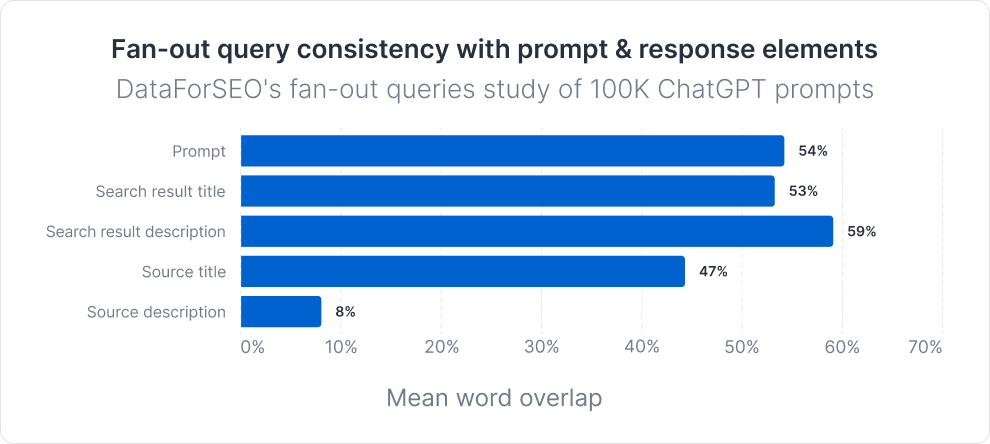
The chart clearly shows that fan-out queries are generally similar to the prompt, sharing 54% of their words. What’s more interesting is that generated queries are highly similar to search results titles and descriptions, sharing 53% and 59% of words, respectively. At the same time, the word overlap percentage with source titles is 44%, and for source descriptions, it drops to only to 8%
This demonstrates that fan-out queries closely align with how information is presented in the search. However, the final decision on the sources to be cited is made based on the content quality and usefulness. The key takeaway for GEO in this case is that titles, headings, and descriptions still matter and should align with relevant fan-out queries. Nevertheless, while aligning metadata with fan-out queries may make you more visible, the quality of your content remains a major precondition for being cited by AI.
To summarize, these insights, which represent only a fraction of our study, show the significant role fan-out queries play in AI search and their direct impact on keyword research in particular. At the same time, the crucial question emerges: how can you optimize for queries that you and users can’t even see normally? At DataForSEO, we have the tools and data to help you uncover this hidden layer of AI and optimize for it.
Use case: keyword research focused on fan-outs for ChatGPT
Compared to traditional keyword research, which is relatively straightforward, fan-out oriented keyword research involves essential extra steps, without which it is no more than just guesswork.
First, you need to form a list of seed keywords or user prompts relevant to your industry. Then, you need to explore LLM responses for which a query fan-out was triggered, and fetch all generated fan-out queries.
The next step is assessing the popularity of the queries you found in AI searches. To do that, you should enrich fan-out queries with respective performance metrics, such as AI search volume. Finally, you should sort queries by relevance and estimated search volume to determine which ones can be used for content optimization.
Now, let’s see which tools you need to implement this keyword research workflow in practice.
Key prerequisites
1. Retrieving relevant fan-out queries is the biggest hurdle to overcome. You can’t manually explore or fetch fan-out queries because they are hidden from users. Additionally, you need to process a lot of responses to get enough queries, as AI doesn’t trigger query fan-out all the time.
Fortunately, DataForSEO has advanced tools to uncover fan-out queries at scale. With the help of the LLM Scraper, LLM Responses, and LLM Mentions APIs of our AI Optimization API suite, you can easily fetch fan-out queries alongside structured AI responses or mentions data.
For this particular use case, the LLM Mentions Search endpoint of the LLM Mentions API is the best choice. In this endpoint, you can directly specify target seed keywords and set the fan_out_queries search scope to pull LLM answers from our database, which already contain relevant fan-out queries. Moreover, LLM Mentions Search can return up to 1000 responses in one call, so you can fetch fan-out queries at a scale.
2. Then, you need a solution to enrich fan-out queries with actual search volume values. The AI Keyword Data Keyword Search Volume endpoint is exactly what you need. This endpoint pulls AI search volume – the estimated number of times a query is used in AI searches. It can get AI search volume values for up to 1000 keywords simultaneously, so you can process an entire list of fan-out queries in one request.
3. The last prerequisite is an environment where you’ll conduct keyword research. Sure, you can manually call APIs, collect fan-out queries, and analyze them. But why would you need that if you can set up an automatic workflow where AI does all the job?
This is where Cursor steps in – an AI-powered code editor with wide integration options to automate complex processes. You can directly connect the DataForSEO APIs to Cursor using our official MCP server and conduct the whole keyword research in this code editor using simple prompts.
Now that we have chosen all the necessary tools, let’s set everything up and proceed with keyword research.
Setting up the workflow
1 First, log in to or create your DataForSEO account. You’ll get a $1 trial credit – enough to test this workflow.
2 Save DataForSEO API login & password from the Dashboard – you’ll need them to connect the DataForSEO MCP Server to Cursor.
3 Download the Cursor code editor and create a connection with the DataForSEO MCP server by following this short Help Center guide.
4 Open Cursor, create a New Agent, and paste the following prompt to run a basic fan-out query keyword research. You can customize the prompt, if necessary.
“Conduct a fan-out-oriented keyword research for the following seed keywords: “pizza”, “iphone”, “marketing”, using DataForSEO MCP Server. First, you must use the ai_opt_llm_ment_search tool to fetch answers from ChatGPT that contain mentions of seed keywords and include relevant fan-out queries. Then, you must run the identified fan-out queries through the ai_optimization_keyword_data_search_volume tool to fetch AI search volume for each query. Then, you must present the results in tables with fan-out queries sorted by AI search volume in descending order. The output must be at least ten fan-out queries with search volume for each seed keyword.”
After that, the Agent will call the LLM Mention Search and AI Keyword Search Volume endpoints and generate a keyword research report.
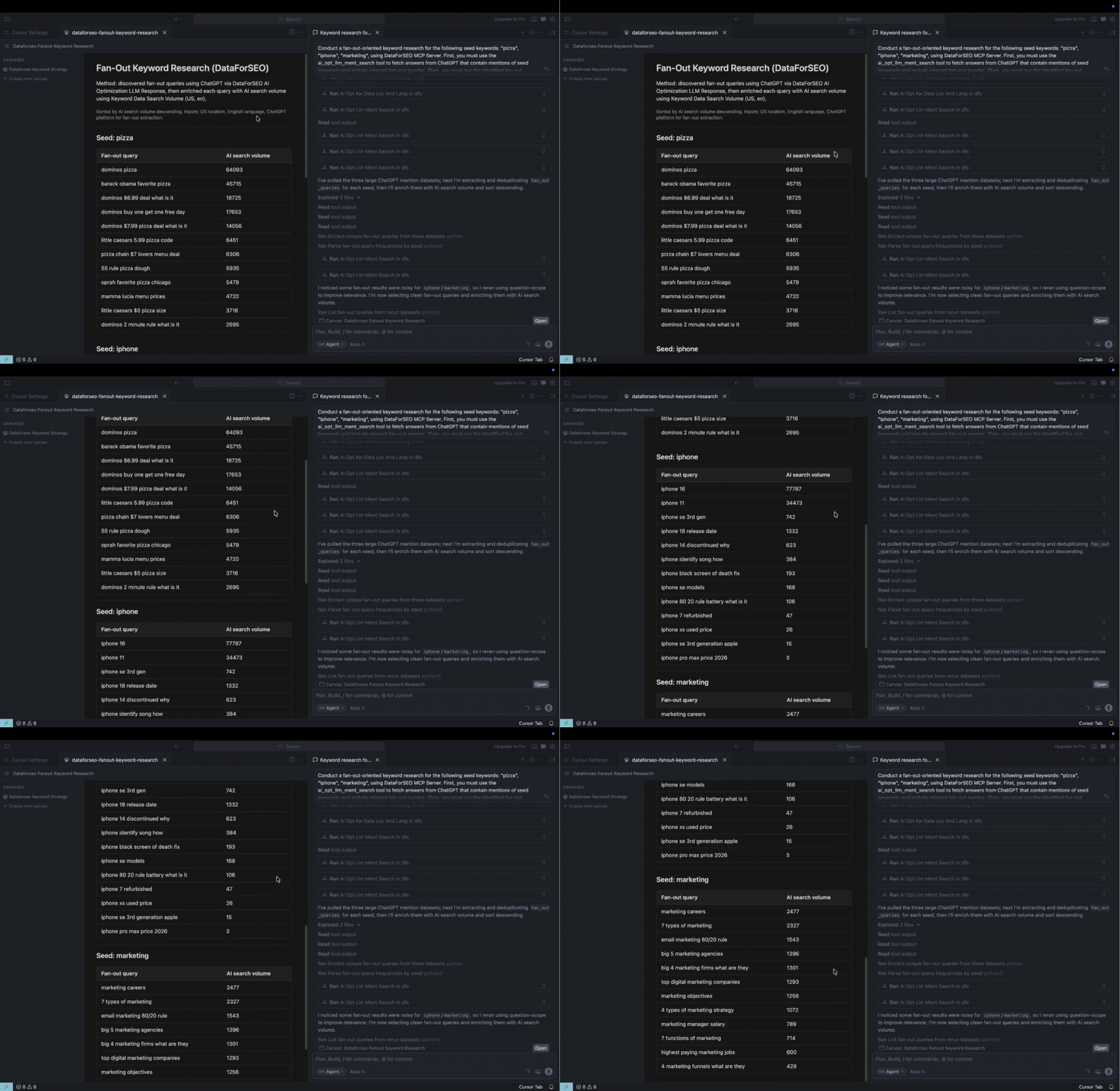
Here is the result. As you can see, using the data from the LLM Mentions Search and AI Keyword Search Volume endpoints, Cursor fetched more than ten relevant fan-out queries with search volume for each seed keyword. The Agent automatically organized queries into a structured report, sorting them by AI search volume.
In just two minutes, you have an organized list of fan-out queries with actual search volume values without a single line of code. Now, you can implement these queries into your content or create dedicated content pages to increase your AI visibility.
Overall, with the help of the DataForSEO MCP server and Cursor, you can effortlessly uncover high-potential fan-out queries ChatGPT uses in searches. No coding and manual effort required.
Wrap-up
Fan-out queries are a hidden but vital part of how AI models retrieve and cite information – and one you should start addressing now. As our study of 100,000 ChatGPT prompts shows, nearly half of them trigger fan-out, and the sub-queries generated in that process directly shape which content gets retrieved and which gets cited. Understanding these patterns gives you a concrete, data-backed way to close the gap between what users type and what AI actually searches for.
To explore the full scope of these findings, download the full study here and see exactly how fan-out shapes AI search behavior at scale.
With the help of the DataForSEO API, you can already put these insights into practice by conducting data-driven fan-out query research. In particular, the DataForSEO AI Optimization API suite gives you direct access to fan-out queries from real ChatGPT responses, so you can build your keyword strategy on structured, first-hand fan-out query data. Register at DataForSEO now and start uncovering the queries AI uses to find content like yours.
