

DataForSEO Competitor Research API
Identify and outsmart your competitors with structured SEO data
Keywords Google
8399382807
Updated last 30d: 5889316537
SERPs Google
551847014
Updated last 30d: 258374067
Structured competitor intelligence data for your SEO tool
The Competitor Research endpoints of DataForSEO Labs API use our proprietary keyword and SERP indexes to identify domains that compete with your target in organic search. By carefully segmenting keywords by search intent and product categories, this API returns industry-specific data that can streamline even the most sophisticated competitor research.
Built for SEO tools and automated marketing agency dashboards. Competitor Research endpoints of DataForSEO Labs API return structured data without any scraping or infrastructure required from your end. Just plug our API into your solution and start receiving accurate competitor research data straight away.
SEE PRICINGData-driven competitor research with a single API
DataForSEO Labs API combines data from Google Ads, SERP, clickstream providers, and leverages proprietary processing algorithms to provide you with a well-rounded overview of your competitors in SERPs and beyond.

DataForSEO Labs API features Google Ads search volume, CPC, and competition data populated across the DataForSEO keyword and SERP indexes.

DataForSEO’s proprietary Keywords Database contains over 4.5 billion keywords, enriched with historical Google Ads metrics and relevant historical SERPs.

Clickstream-derived search volume, estimated traffic, and demographic info will provide your keyword research solution with metrics that are independent of Google Ad’s bucketed ranges.
DataForSEO Labs API endpoints for SERP Competitor Research
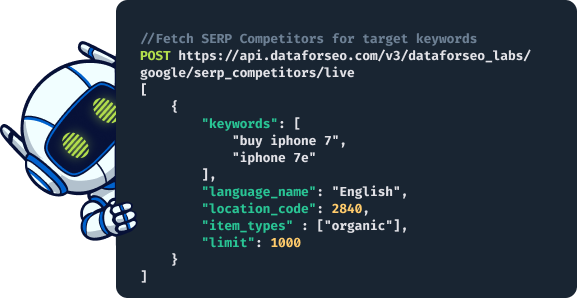
SERP Competitors
This endpoint is designed to provide all the domains that are ranking for specific keywords. What’s more, each domain in the API response comes with its SERP position, rating, estimated traffic volume, and more.
SERP Competitors is a powerful engine for analyzing website visibility. The abundance of data and instant updates make it one of the most sought-after data sources in the market.
Ranked Keywords
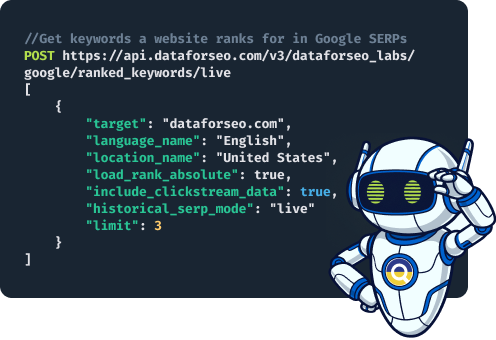
Ranked Keywords endpoint provides data on keywords that any domain is ranking for. In addition to that, each keyword is supplied with a SERP element corresponding to the keyword position and a variety of AdWords metrics related to that keyword.
Having all this data you will be able to build a well-rounded solution for analyzing the search visibility of any website.
Competitors Domain
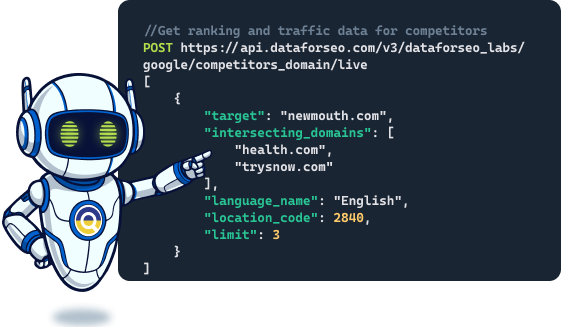
Competitors Domain will provide you with an overview of the ranking and traffic data of competing domains in both organic and paid search.
The ability to analyze the ranking and traffic performance of the rival websites in just a few clicks is the industry-standard feature for any well-rounded SEO software solution. Using this endpoint, you can easily incorporate this functionality into your tool.
Domain Intersection
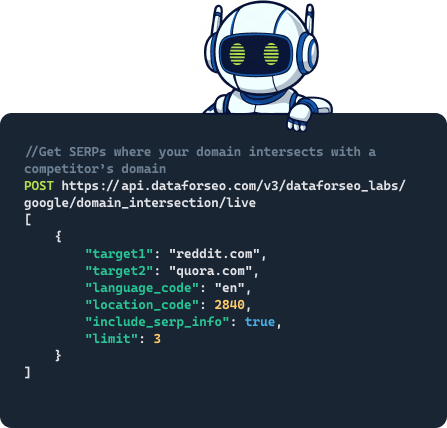
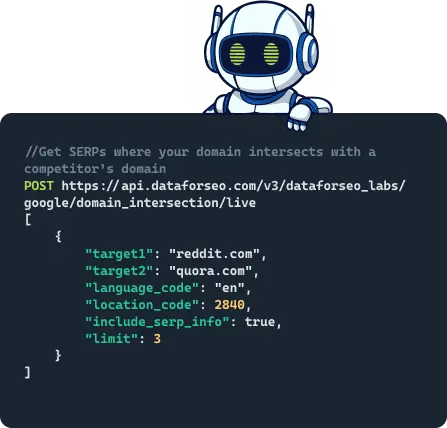
DataForSEO Labs Domain Intersection API has a rather simple working principle: its algorithm analyzes keywords that specific domains are ranking for and provides you with keyword and SERP data for them.
Despite its simple working principle, this endpoint is the most powerful source of competitor research data you’ll ever come across. Whether you’re looking for a solution for quantitative market analysis or building a tool for digital marketing sales pitches, Domain Intersection won’t leave you disappointed.
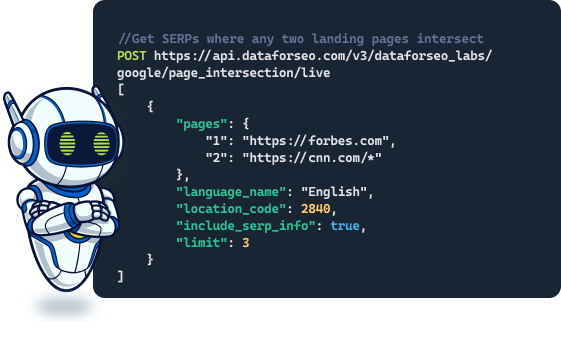
Page Intersection
In a nutshell, Page Intersection is a more detailed and sophisticated version of our Domain Intersection endpoint. The difference is instead of providing data for any two domains, Page Intersection will let you compare the performance of any two pages within the same SERPs and get the relevant SERP and keyword data for both of them.
Data this endpoint provides would be extremely useful for a more detailed market research analysis.
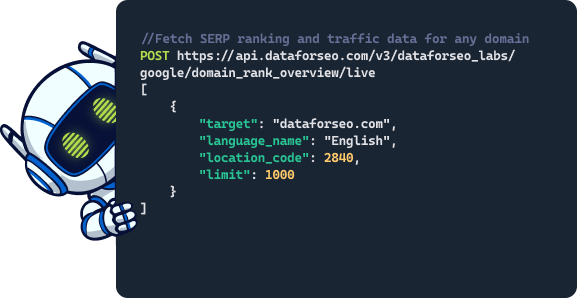
Domain Rank Overview
The Domain Rank Overview is the ultimate tool for getting ranking and traffic data from organic and paid search results for the specified domain.
By using this endpoint you will get not only the domain’s ranking distribution across SERPs, but also essential traffic metrics such as estimated traffic volume and estimated paid traffic cost.
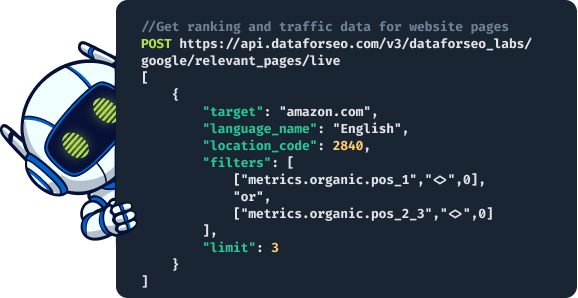
Relevant Pages
The Relevant Pages endpoint of DataForSEO Labs API will help you get rankings and traffic data for every single page of any website.
Incorporating this data into your tool is a great way to make detailed competitive analysis reports and scale up your capabilities.
DataForSEO Labs API endpoints for historical competitor data
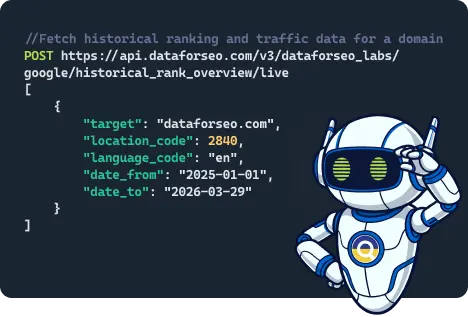
Historical Rank Overview
Historical Rank Overview lets you look back at the historical SERP visibility data for the specified domain.
By using this endpoint you will get historical ranking and traffic estimation data, including ranking distribution, estimated traffic volume and paid traffic cost.
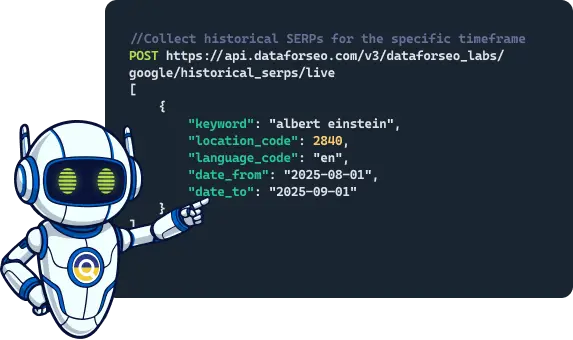
Historical SERPs
Historical Rank Overview lets you look back at the historical SERP visibility data for the specified domain. By using this endpoint you will get historical ranking and traffic estimation data, including ranking distribution, estimated traffic volume and paid traffic cost.
Historical Bulk Traffic Estimation
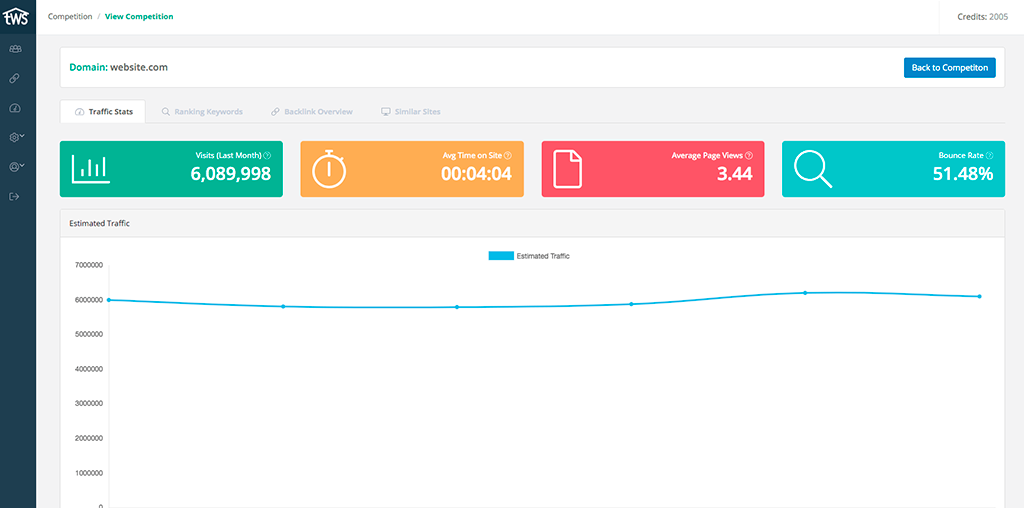
The Historical Bulk Traffic Estimation endpoint is designed to supply you with historical traffic estimation for up to 1000 domains in a single request. Historical traffic data is available from 2020 and based on CTR and search volume of all keywords that specified domains rank for in Google Search.
Cost-efficient solution
for budget-conscious businesses

Real-time results
DataForSEO Labs API features a turnaround time of up to 2 seconds

Pay-as-you-go
Add funds to your account and use them for obtaining data

Integration support
Our 24/7 customer support team is with you every step of the way
Historical rank
Live Mode
Real-time results with a single POST request
Turnaround time
up to 2 seconds on average
Price per task
$0.12
Price per item
$0.0012
$127.2 for 1K domains
Historical serp
Live Mode
Real-time results with a single POST request
Turnaround time
up to 2 seconds on average
Price per SERP
$0.00012
hISTORICAL BULK TRAFFIC ESTIMATION
Live mode
Real-time results with a single POST request
Turnaround time
up to 2 seconds on average
Price per task
$0.12
Price per domain
$0.0012
$1,320 for 1M domains
ALL OTHER ENDPOINTS
Live mode
Real-time results with a single POST request
Turnaround time
up to 2 seconds on average
Price per task
$0.012
Price per item
$0.00012
$132 for 1M keywords/domains
DataForSEO Labs API in Action — Top 1000 Websites by Traffic Trends
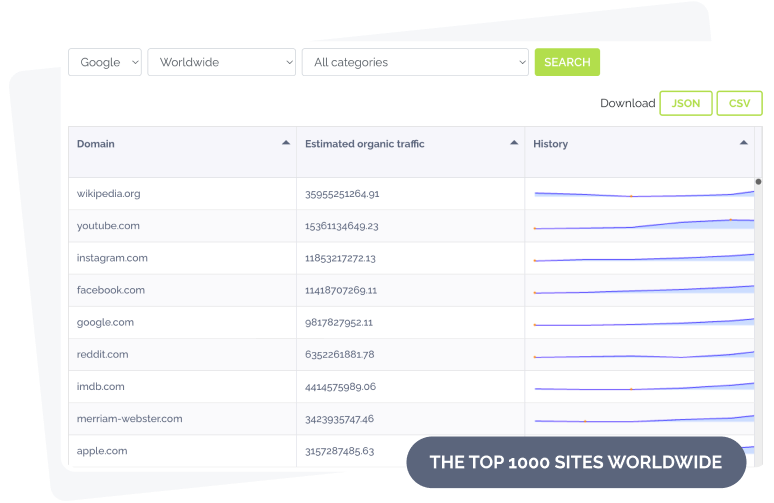
Discover traffic history of the top 1000 sites worldwide
This mini tool relies on the Bulk Traffic Estimation to collect data on the monthly search traffic volume of up to 1000 domains, subdomains, or webpages in bulk. By adding the Historical Rank Overview endpoint to the system. you can go back in time to display SERP rankings and traffic history trends for any domain.

Jumpstart your journey with DataForSEO Labs API

SEO Software Market Analysis
We have explored the SEO software market, including current and emerging product development trends, and accumulated the key insights for you in this White Paper.
LEARN MOREDeep Dive into DataForSEO Databases
Explore the key factors to consider when choosing between DataForSEO APIs and databases.
LEARN MORE
Low-Level Marketing Automations With APIs
Learn to build your own low-level automation solutions and marketing tools with DataForSEO APIs.
LEARN MORE
Data industry leaders trust
Solutions developers praise

Customer success story


Customer success story
How DataForSEO Helps Pathfinder SEO Guide its Customers, One Simple Task at a Time
Learn more

Customer success story
DataForSEO API Helps On the Map Marketing Go Up at the Time of a Downturn
Learn more


Release in days, not weeks
Integrating a new data source can take a lot of time and money. We accelerate this process by providing a user-friendly interface for controlling your API usage and spending.
Well-rounded documentation

DataForSEO offers a detailed documentation for every parameter, field and function you can come across while using our APIs and databases.
VIEWGUI for API usage control

Every DataForSEO user has access to a comprehensive graphic user interface (GUI) and can monitor and control every aspect of data usage.
REGISTERAd hoc integration and deployment support

Our support team is available 24/7 to ensure you get the required assistance and all your requests are addressed promptly and proficiently.
CONTACT USFrequently Asked Questions
Which endpoint should I use to find my organic SERP competitors?
SERP Competitors endpoint starts from a keyword list and tells you which domains rank for those keywords. Competitors Domain starts from your domain and automatically surfaces the domains that share the most keyword overlap with you. Domain Intersection lets you directly compare two or more specific domains to measure their shared SERP presence. Page Intersection does the same thing at the page level rather than the domain level. If you’re building a full competitive landscape, a typical workflow is: start with Competitors Domain to discover rivals, then use Domain Intersection or Page Intersection endpoints to drill into specific head-to-head comparisons.
How is data freshness handled across all DataForSEO Labs API, and how do I know when data was last updated?
All Competitor Research endpoints of DataForSEO Labs API share a single update cycle. The exact timestamp of the most recent update for any given location and language combination is available via the Status endpoint.
- Keyword metrics like search volume, CPC, and competition are updated monthly in line with the Google Ads update cycle.
- Related SERP data is updated on different schedules depending on query volume and location:
- High-volume keywords / popular locations: within a 30-day cycle.
- Low-volume queries / less popular locations: within 60 or 90 days.
What’s more, DataForSEO Labs API responses include last_updated_time for every keyword and relevant SERP element, so you can see when specific data was last refreshed.
Which endpoints support historical data, and what is the difference between historical and non-historical variants?
Three endpoints provide historical data: Historical SERPs returns full past SERP snapshots for a keyword on specific dates; Historical Rank Overview returns a domain’s ranking and traffic metrics across past time periods; Historical Bulk Traffic Estimation does the same for up to 1000 domains and subdomains in a single request. Their non-historical counterparts return only the current state. Before requesting historical data, use the Available History endpoint to check which dates are actually available for a given location and language.
How is Estimated Traffic Volume (ETV) calculated?
Estimated Traffic Volume (ETV) is calculated as the product of the keywords’ search volume and CTR coefficient, which depends on the website’s rank in SERP for this keyword. For example:
- Rank 1: 0.304
- Rank 2: 0.162
- Rank 3: 0.973
- …
- Rank 23 and onward: 0.0021
To learn more about how ETV is calculated, visit our Help Center.
What does keyword intersection mean across these endpoints, and how do the intersection-based endpoints differ?
Keyword intersection refers to keywords for which multiple domains simultaneously appear in the same SERP. For example, the Domain Intersection endpoint reports this at the domain level, e.g., how many keywords two or more domains co-rank for, and their respective metrics on those shared keywords.
How is pricing calculated?
DataForSEO Labs API pricing is based on a combination of a task fee and an item-based fee, so the total cost depends on the specific endpoint and how many keywords, domains, SERPs, or months of historical data you request. For more details, see the pricing page.
Is there a way to test DataForSEO Labs API without spending credits?
You can test DataForSEO Labs API in the Sandbox environment without spending credits. The Sandbox is free for registered users and returns dummy responses with the same structure as the live API, so it’s useful for integration and testing.