
How Rabbit SEO Uses DataForSEO to Turn SEO Data Into Automated Website Optimization
About Rabbit SEO
Rabbit SEO is an SEO automation and AI visibility platform built for website owners, small businesses, Wix users, Shopify stores, ecommerce businesses, agencies, freelancers, and local service providers. The platform was founded by Ron Zavner, CEO of Rabbit SEO, who leads the company’s product strategy, technology development, partnerships, and global growth.
Rabbit SEO helps users audit websites, optimize pages, monitor keywords, research competitors, analyze backlinks, discover link-building opportunities, generate SEO reports, and improve how clearly their websites are understood by search engines and AI-powered discovery systems.
The platform helps users move from SEO uncertainty to clear action. Instead of asking website owners to manually interpret keyword, SERP, backlink, competitor, and audit data across many separate tools, Rabbit SEO connects these signals into practical website optimization workflows.
To support these workflows, Rabbit SEO uses DataForSEO APIs as part of its SEO data infrastructure. DataForSEO provides structured search, keyword, SERP, and backlink data. Rabbit SEO combines that data with its own website audit, page analysis, scoring, recommendation, and automation layer to create practical optimization workflows for users.
About DataForSEO
DataForSEO is the leading provider of SEO data for the marketing technology industry. With an API-led approach to data delivery, DataForSEO is enabling hundreds of software businesses to enhance their products with reliable, accurate, and fresh data. In addition, DataForSEO offers no-code integration options with popular automation services, making it possible to build tailored SEO and marketing solutions without writing a line of code.
The Challenge
SEO is not one task. It is a combination of ongoing activities.
A website owner may need to understand which keywords matter, which pages should be optimized, how competitors appear in search, whether rankings are improving, which backlinks exist, which links were lost, what technical issues affect visibility, and whether the website is clear enough for search engines and AI assistants to understand.
For SEO professionals, these questions are familiar but time-consuming. For non-technical users, they can quickly become overwhelming.
Rabbit SEO needed to simplify this process without oversimplifying the data behind it.
The platform needed reliable SEO data for:
- Keyword research and keyword validation.
- Rank tracking and SERP monitoring.
- Backlink and referring domain analysis.
- Broken or lost backlink detection.
- Link-building research.
- SEO reporting.
- AI visibility recommendations.
Rabbit SEO also needed its own website audit and page analysis layer for:
- Page-level SEO audits.
- Metadata, headings, image SEO, and structured data checks.
- Internal link and broken link checks.
- Page optimization recommendations.
- Website scoring and prioritization.
Building and maintaining every external SEO data system internally would require Rabbit SEO to operate its own SERP collection systems, keyword database, backlink index, and search data infrastructure.
That would take engineering focus away from Rabbit SEO’s core mission: helping website owners move from SEO data to SEO action.
Rabbit SEO needed a scalable SEO data provider that could supply structured search, keyword, SERP, and backlink data through APIs, while allowing the product team to focus on automation, usability, recommendations, reporting, and website optimization workflows.
The Solution: DataForSEO as the External SEO Data Layer
DataForSEO became part of the data foundation behind Rabbit SEO’s automation workflows.
Instead of building every search, keyword, SERP, and backlink data system internally, Rabbit SEO can use DataForSEO APIs to access reliable external SEO data and integrate it into product features for website owners, agencies, freelancers, Wix users, Shopify stores, and ecommerce businesses.
The relationship is simple:
DataForSEO provides structured external SEO data. Rabbit SEO combines that data with its own website audit and optimization engine to create clear website optimization workflows.
This matters because Rabbit SEO users usually do not want raw datasets. They want practical answers:
- Which keyword should I monitor?
- Which page should I improve first?
- Why is a competitor more visible?
- Which backlinks are helping or missing?
- Which link-building opportunities should I review?
- What should I fix on this page?
- Are my titles, descriptions, headings, images, and structured data helping SEO?
- Is my website clear enough for Google and AI assistants?
- What changed since the last report?
DataForSEO helps provide the search, keyword, SERP, competitor, and backlink data needed to answer many of these questions. Rabbit SEO then organizes the information into audits, reports, recommendations, monitoring, backlink workflows, page optimization tasks, and automation flows.
Featured DataForSEO Products Used by Rabbit SEO
Rabbit SEO uses SERP data to support rank tracking, keyword position monitoring, search result analysis, location-specific visibility checks, and competitor comparisons.
This helps users understand how their website appears for important search queries and how visibility changes over time.
For website owners, rank tracking becomes part of a broader workflow instead of a standalone metric. If a page is not improving, Rabbit SEO can connect ranking data with possible causes such as weak metadata, unclear headings, missing content, stronger competitors, backlink gaps, or missing structured data.
DataForSEO Labs API and Keywords Data API
Keyword data helps Rabbit SEO support keyword discovery, keyword validation, search demand analysis, opportunity research, and competitor keyword insights.
Many website owners choose keywords based on assumptions. They may target phrases that are too broad, too competitive, too vague, or not aligned with real search demand.
By using keyword data through DataForSEO, Rabbit SEO can help users make better decisions about which keywords to monitor, which pages to optimize, and which opportunities may be realistic.
This supports workflows for small business websites, ecommerce stores, Shopify collections, Wix pages, local service pages, and agency client projects.
Backlink data helps Rabbit SEO support backlink analysis, referring domain checks, competitor backlink research, lost backlink monitoring, broken backlink discovery, link gap analysis, and link-building workflows.
Backlinks are difficult for many website owners to understand. A user may not know which websites link to them, whether important backlinks were lost, how competitors earned authority, or where new outreach opportunities may exist.
DataForSEO Backlinks API helps Rabbit SEO turn backlink data into more practical insights. Instead of showing backlinks only as a technical list, Rabbit SEO can connect backlink information to competitor comparison, broken backlink checks, link gap discovery, and link-building research.
Rabbit SEO Website Audit and Page Analysis Layer
Rabbit SEO uses its own website audit and page analysis layer to support technical checks, metadata analysis, headings review, image SEO, internal link checks, structured data recommendations, broken link detection, page scoring, and page-level optimization tasks.
This allows Rabbit SEO to combine external SEO signals from DataForSEO with its own on-page analysis. DataForSEO helps provide search, keyword, SERP, competitor, and backlink data, while Rabbit SEO evaluates the website itself and turns those signals into clear recommendations.
For example, Rabbit SEO can identify issues related to titles, meta descriptions, headings, internal links, image ALT text, broken pages, indexability, structured data, content clarity, and search appearance.
The result is a more complete workflow: DataForSEO helps show how the site performs in the search ecosystem, while Rabbit SEO analyzes what can be improved on the website itself.
How Rabbit SEO Turns Data Into Automation
Rabbit SEO’s value is not only in collecting SEO data. Its value is in connecting that data to action.
A typical Rabbit SEO workflow can include:
- Scanning a website.
- Identifying important pages.
- Discovering or validating target keywords.
- Monitoring rankings.
- Comparing competitors.
- Reviewing backlinks and referring domains.
DataForSEO helps provide structured search, keyword, SERP, competitor, and backlink data behind many of these workflows. Rabbit SEO then applies its own website analysis, scoring, recommendations, reporting, and automation logic to make the information easier to use.
Instead of asking users to open separate tools for keywords, SERPs, backlinks, competitors, audits, and reports, Rabbit SEO brings these areas into one connected workflow.
The user can see what matters, understand why it matters, and take the next step.
Use Case 1: Keyword Research and Rank Monitoring
Keyword selection is one of the first places where website owners need guidance.
If a website targets the wrong keywords, even strong optimization work may not produce useful results. The page may rank for phrases with weak demand, unclear intent, or unrealistic competition.
With DataForSEO keyword and SERP data, Rabbit SEO can support:
- Keyword discovery.
- Keyword validation.
- Search demand checks.
- Keyword-to-page matching.
- Ranking position tracking.
- Keyword visibility monitoring.
Rabbit SEO turns keyword data into a practical workflow: what to track, what changed, and what should be improved next.
Below is an example of the ranked keyword explorer dashboard, which offers a convenient way to track which keywords the domain ranks for.
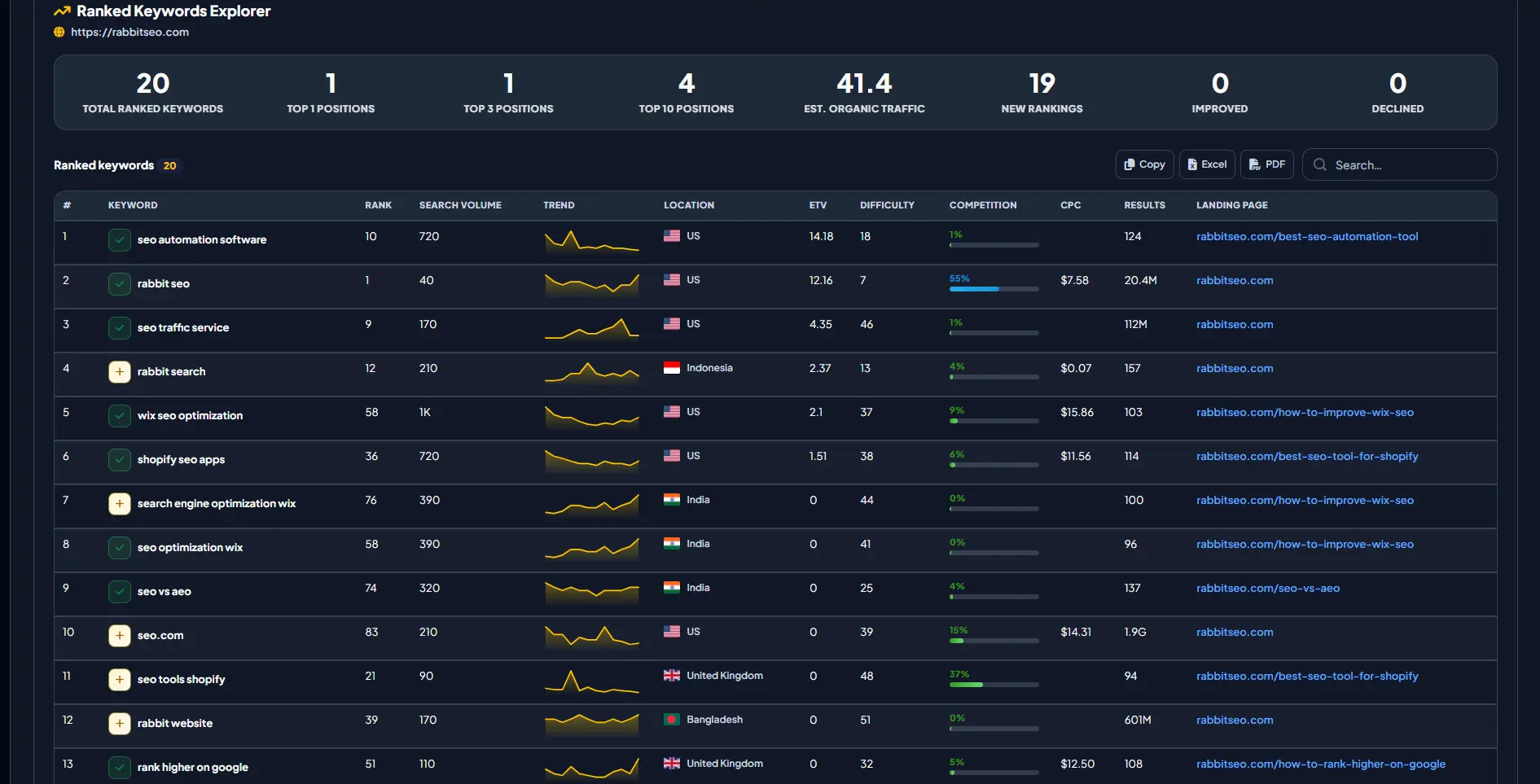
For small businesses, this makes SEO easier to manage. For Shopify stores, it can help prioritize product, collection, and ecommerce keywords. For Wix users, it can help connect website pages with realistic search opportunities. For agencies and freelancers, it reduces time spent preparing manual keyword and ranking updates.
Use Case 2: Competitor and SERP Analysis
SEO performance is always relative to the search results around it.
A website owner may improve a page, but competitors may also update content, build links, add structured data, or publish new pages.
DataForSEO SERP data helps Rabbit SEO support competitor and visibility workflows such as:
- Checking which competitors appear for important keywords.
- Comparing visibility across relevant queries.
- Identifying pages competing with the user’s website.
- Detecting ranking movement.
- Understanding whether a page needs stronger content, metadata, structure, or backlinks.
- Supporting clearer reports for agencies and freelancers.
This helps Rabbit SEO move beyond static audits.
A website audit can show what is wrong with a page. SERP and competitor data help explain why the page may not be winning visibility yet.
Here is how you can explore which kind of SERP features appear for a specific keyword.
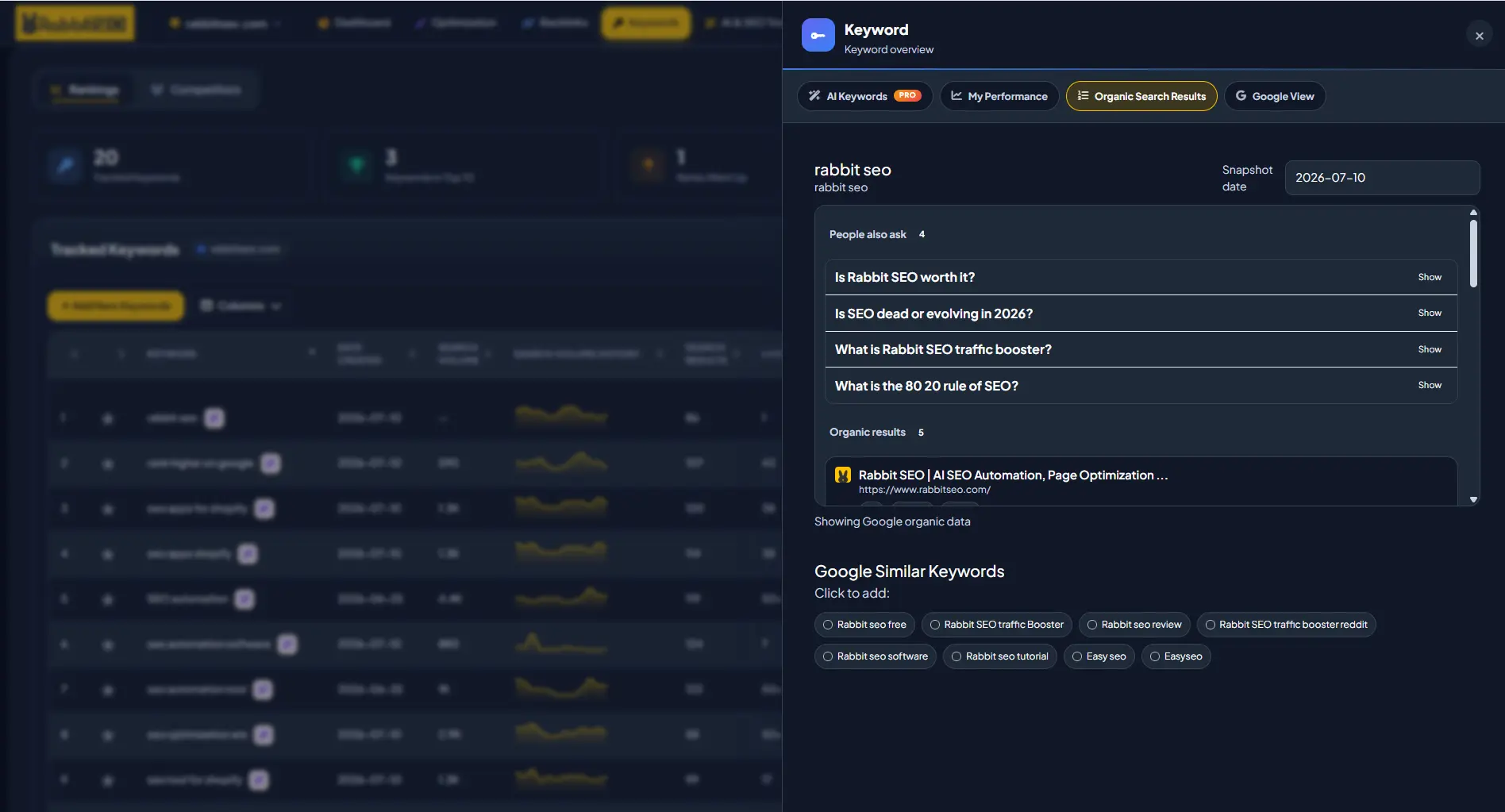
By connecting audit insights with search result data, Rabbit SEO gives users a clearer view of where they stand and what type of improvement may matter most.
Use Case 3: Backlink Research and Link-Building
Backlink work is one of the most confusing areas of SEO for many website owners.
Users may know backlinks are important, but they may not know which backlinks they already have, which links were lost, which competitors have stronger authority signals, or where new link-building opportunities may exist.
With DataForSEO Backlinks API, Rabbit SEO can support:
- Backlink profile review.
- Referring domain analysis.
- New and lost backlink monitoring.
- Broken backlink checks.
- Competitor backlink comparison.
- Link gap discovery.
- Link-building research.
- Outreach opportunity review.
- Backlink insights for SEO reports.
Rabbit SEO’s role is to make this data easier to act on.
For example, a user can understand which pages attract links, which competitors have stronger referring domain coverage, and which backlink opportunities may be worth reviewing.
The key pages that attract links you can explore in the “Backlinks by pages” list, as on the example below.
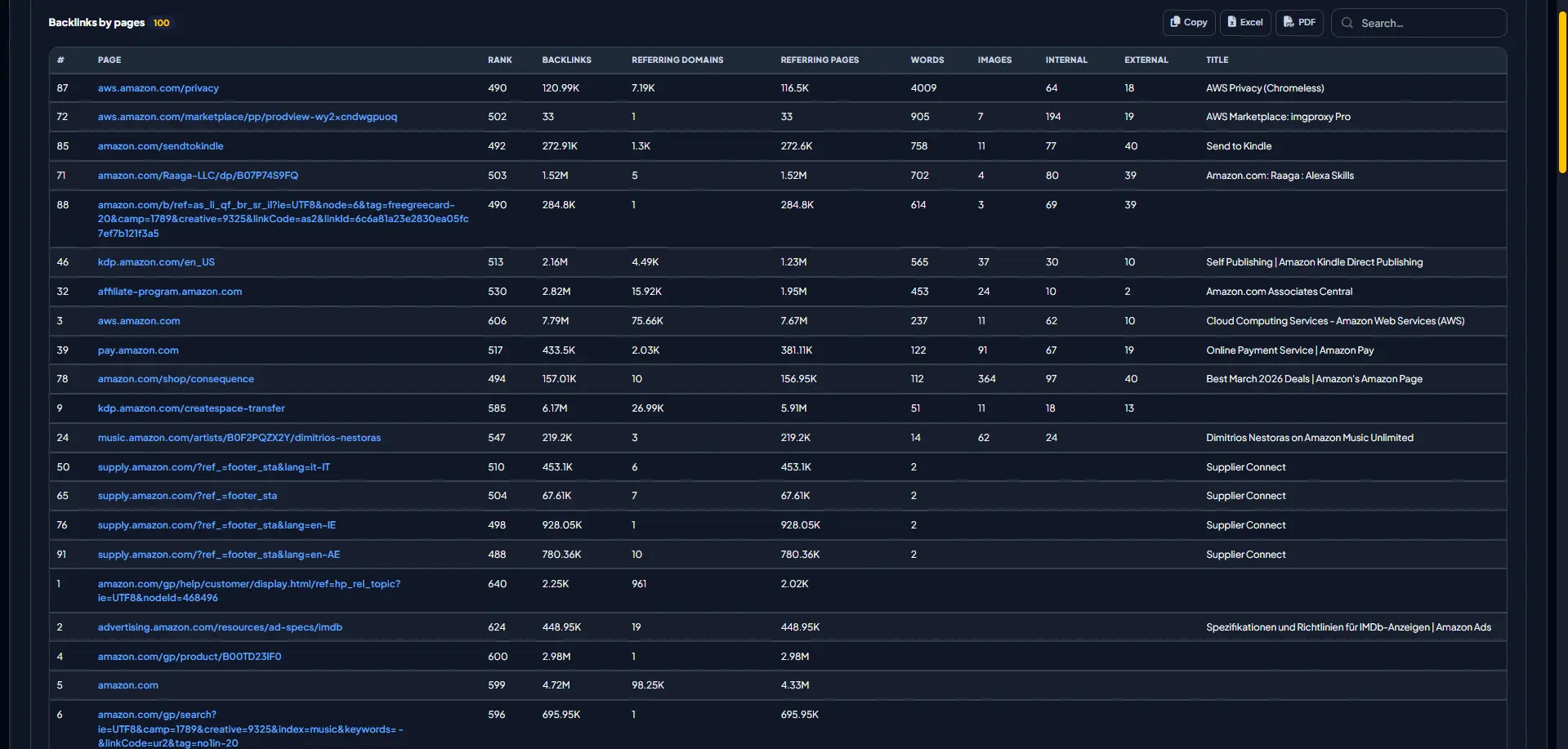
For agencies and freelancers, this also helps explain backlink opportunities to clients in a clearer way. For website owners, it turns backlink research and link-building from a confusing manual process into a more guided workflow.
Use Case 4: Website Audits and Page Optimization
SEO audits are useful only when they lead to action.
Many audit tools generate long lists of warnings. For non-technical users, this can create more confusion instead of clarity.
Rabbit SEO focuses on turning audit signals into page-level optimization tasks.
The platform can help users identify issues related to:
- Page titles.
- Meta descriptions.
- Headings.
- Internal links.
- Broken links.
- Structured data.
- Keyword usage.
- Search appearance.
- AI-readable page structure.
This helps users understand what should be improved on a specific page and why it matters.
If a page targets a service keyword but the title, description, headings, and content do not clearly support that topic, Rabbit SEO can highlight the issue and recommend improvements.
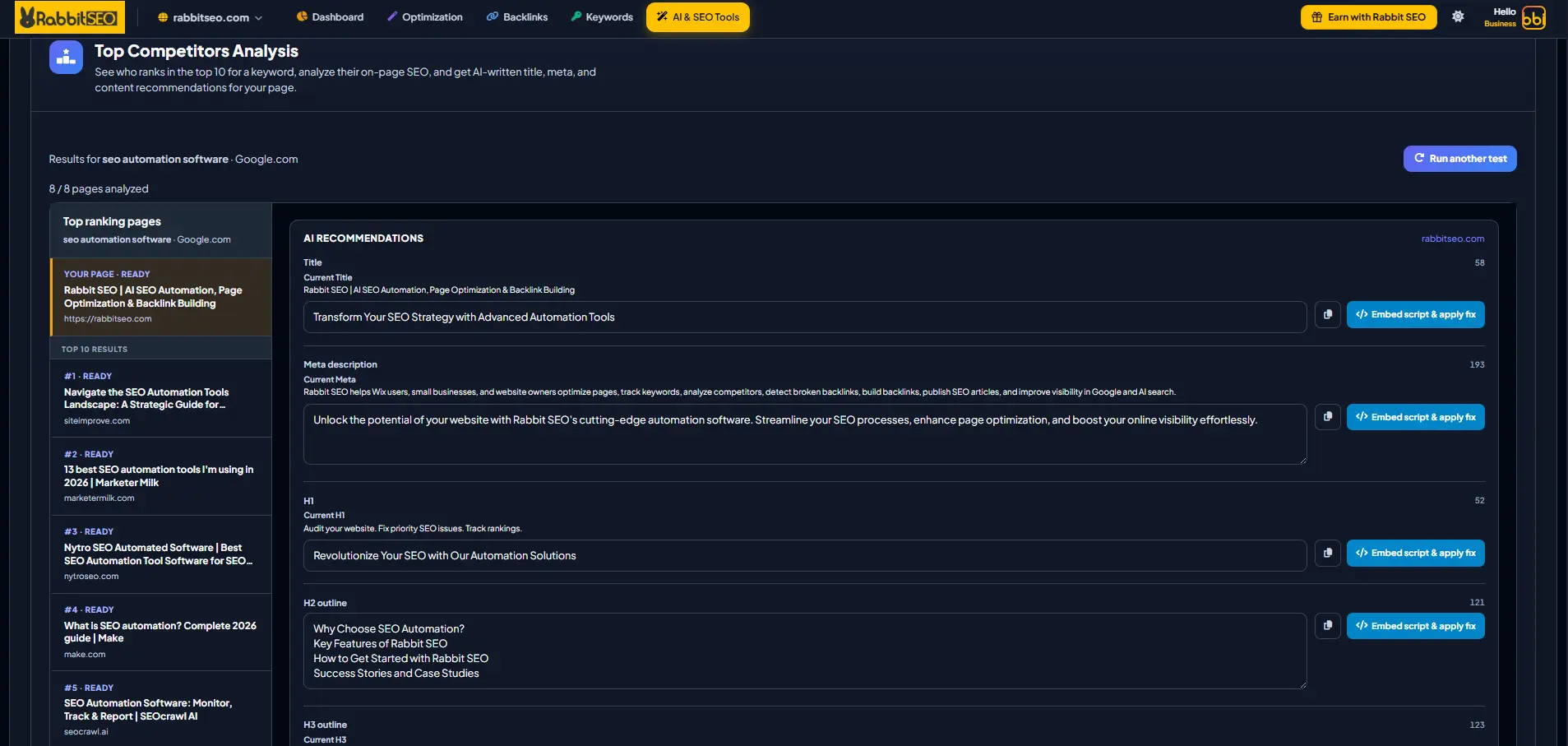
With the integrated AI recommendation features, you can, in minutes, get data-driven advice for improving your page and meta-content.
If important images are missing useful ALT text, the platform can point that out.
If schema markup is missing or incomplete, Rabbit SEO can recommend structured data improvements.
If the page does not clearly explain the business, service, product, location, or topic, Rabbit SEO can help identify the missing clarity signals.
By combining DataForSEO’s external SEO data with Rabbit SEO’s own website audit and optimization engine, the platform can create a more guided optimization experience for users.
Use Case 5: AI Visibility Improvements
Search is changing from classic search results toward AI-powered answers, summaries, and recommendation experiences.
For website owners, this means optimization is no longer only about ranking pages. It is also about making the website easier for search engines and AI systems to understand.
Rabbit SEO supports this by combining traditional SEO signals with AI visibility checks.
The platform can help users review whether pages clearly communicate:
- Who the business is.
- What products or services it offers.
- Which topics it is relevant for.
- Whether titles, descriptions, headings, and content are aligned.
- Whether schema markup supports machine understanding.
- Whether important entities are mentioned consistently.
- Whether the page provides useful answer-style information.
- Whether the website has enough clarity to support AI-powered discovery.
This is important because AI visibility should not rely only on generic AI-generated suggestions.
Strong AI visibility requires clear website structure, relevant keywords, useful content, entity clarity, search visibility, competitor context, backlinks, structured data, and consistent business information.
DataForSEO helps provide the reliable external SEO data foundation that Rabbit SEO can use as part of this broader AI visibility enhancement process.
Rabbit SEO then combines that foundation with its own audit, page analysis, and recommendation layer to help website owners improve how their content, business, products, and services are understood.
Results and Impact
Using DataForSEO as part of its SEO data infrastructure helps Rabbit SEO offer a more connected SEO automation experience.
The main impact includes:
- Rabbit SEO can support keyword monitoring without requiring users to manually check SERPs.
- The product team can focus less on maintaining raw SERP, keyword, and backlink data infrastructure.
- Backlink, competitor, keyword, audit, optimization, and reporting workflows can be connected in one platform.
- Non-technical users can receive clearer SEO recommendations instead of raw datasets.
- Website owners can better understand what to fix next without hiring an agency for every SEO task.
- Agencies and freelancers can prepare audits, reports, and client recommendations faster.
- Wix and Shopify users can work on practical website optimization through a more guided workflow.
- Backlink research and link-building opportunities can become easier to review.
- AI visibility recommendations can be grounded in SEO signals rather than generic AI output.
For Rabbit SEO, DataForSEO helps provide the structured external SEO data needed to scale these workflows while keeping the product focused on automation, usability, and practical recommendations.
For users, the benefit is not only access to SEO data. The benefit is that the data becomes easier to understand and act on.
Why DataForSEO Matters to Rabbit SEO
For Rabbit SEO, DataForSEO is more than a data source. It is part of the infrastructure that allows Rabbit SEO to build scalable SEO automation without maintaining every SERP, keyword, and backlink data pipeline internally.
This allows the Rabbit SEO team to focus on the user-facing layer: automation, prioritization, reports, page optimization, backlink workflows, link-building research, keyword monitoring, competitor insights, and AI visibility recommendations.
Reliable SEO data is the foundation. Rabbit SEO turns that foundation into practical website optimization workflows for users.
Looking Ahead
Rabbit SEO continues to expand its SEO automation and AI visibility capabilities.
As search evolves, website owners will need to optimize for both traditional search results and AI-driven discovery. This means SEO workflows must connect keywords, rankings, competitors, backlinks, website quality, structured data, content clarity, and entity-level signals.
DataForSEO helps support this future by giving Rabbit SEO access to structured search, keyword, SERP, and backlink data through APIs.
Rabbit SEO uses that data alongside its own website audit and optimization engine to help website owners understand their opportunities, improve important pages, monitor progress, research competitors, build stronger authority signals, and make their websites easier for both search engines and AI systems to understand.