
By Anthony Limpert,
Founder of Clickflame, Supercanic & PrePurchaseAuto
Just Two Clicks as of 8 Weeks Ago
Eight weeks ago, our newest auto site had two clicks from Google.
Over those same eight weeks, it took 2,672 clicks and 557,412 impressions in Google Search Console. It brought in 4,377 visits in Google Analytics, 463 of them from AI assistants. It also booked paid pre-purchase auto inspections in states where we don’t have a single employee.
That site is PrePurchaseAuto, our website for pre-purchase auto inspections. It’s the simplest business we have ever run, and right now it’s the highest profit for time spent, because time is what proper automation gives back to us.
One of the foundations that built Clickflame from the ground up is an understanding of the work done by Henry Ford in the auto industry. He broke work into simple, repeating steps. Knowing not just how to automate, but what to automate has become a foundational principle of everything we have built online over decades.
This post covers how we got there, which DataForSEO APIs did the heavy lifting, what the data cost us, and the mistakes we made along the way. Every number comes from our own Search Console, Google Analytics 4, and Shop Desk records, and the date range is provided for each one.
Mobile Mechanics, Auto Repair and Why PPI Is Different
We have been in the auto repair industry for a long time, since the turn of the century. Supercanic is our mobile mechanic company in the Inland Empire. Around it we built a set of auto properties, each with its own job.
Our Auto Properties
| Property | What it does |
|---|---|
| Supercanic | Mobile repair in the Inland Empire. Our mechanics, our customers, our trucks. |
| MechanicRank | A national directory of mobile mechanics and repair shops, graded from public data. |
| mobilemecanico.com | A Spanish first mobile mechanic directory. |
| riversidemechanics.com | A local Riverside mechanic site. |
| Shop Desk | The software that runs the jobs, quotes, texts and payments for all of it. |
| PrePurchase Auto | Pre-purchase inspections for used car buyers, nationwide. |
Repair is a great business, but it’s a heavy one. You need parts, trucks, diagnostic time, warranties, and comebacks. One brake job that goes sideways can easily eat the profit from the next five.
A pre-purchase inspection is the opposite. A buyer finds a used car. They want a mechanic to look at it before they hand over the money. We send a vetted inspector to wherever the car is sitting, whether that’s a dealer lot, a driveway, or an auction yard. The inspector runs our checklist, takes photos, writes the report, and the buyer gets an answer the same day.
The Federal Trade Commission gives buyers the same advice. It says it is always a good idea to pay an independent mechanic to inspect a used car, even one the dealer calls certified. AutoInc., the magazine of the Automotive Service Association, reported on a Lang Marketing study that found mobile repair sales in the US more than doubled from 2016 to 2021.
There are no parts, no warranty work, and no comebacks. A basic car inspection is a flat $225, and during the day the quote goes out automatically within minutes of the request.
The catch is that PPI only works if two conditions are met at once.
- Buyers anywhere in the country can find you at the moment they are looking at a car.
- You have a mechanic near that car who will go look at it.
Both of those turned out to be data problems, and both are where DataForSEO came in.
How We Met DataForSEO
We signed up on September 18, 2026. We weren’t shopping for a keyword tool. We were building a ranking dashboard for our own sites and our clients’ sites, and we needed SERP results, keyword data, and business listings through one REST API we could call from our own code.
We didn’t want to scrape Google ourselves, and we didn’t want five vendors with five bills.
Two days later, Anna, our DataForSEO Customer Success Manager, emailed us twice. The first suggested pairing the SERP API with DataForSEO Labs for a ranking dashboard and offered to help pick endpoints.
Her second email was even better. She had been reading our error log and saw we were posting more than one task per call to live endpoints, which only take one. She told us exactly what was wrong and where to locate the errors in our account. This was a human touch of excellence we had never seen from a provider of such services. Not in over twenty years of working in these fields.
Someone read the log and told us the fix.
The way we pay is just as simple. We top up $50 at a time. Since September 18, we have deposited about $500 in total, and that one balance covers every project in this post. That same balance also covered over 300 websites we built, audited, or sold in the last month. Worth every penny to us.
Our Rule: Use the Data, Name the Source
Before we get to the numbers, here’s our rule. Any time we use DataForSEO data, we say so. That covers quotes to customers, an article on one of our websites, sales pages, and a stat in a pitch. When we tell a shop owner what a keyword is worth or how a dealer’s reviews stack up, the line underneath says the data came from DataForSEO.
It’s how you earn trust with your own customers. A number with a named source is a number people believe. “Pulled from DataForSEO on October 12” closes an argument that “our research shows” could start.
The Eight Week Results
Search Console figures compare August 25 to October 20, 2026 with the 57 days before that, June 29 to August 24. GA4 figures cover the current window only, except where a property has a clean history.
PrePurchase Auto in Google Search Console
| Week (starts Monday) | Clicks |
|---|---|
| Aug 25 to 30 (six days) | 14 |
| Aug 31 to Sep 6 | 25 |
| Sep 7 to 13 | 63 |
| Sep 14 to 20 | 49 |
| Sep 21 to 27 | 48 |
| Sep 28 to Oct 4 | 246 |
| Oct 5 to 11 | 1,045 |
| Oct 12 to 18 | 936 |
| Oct 19 to 20 (two days) | 246 |
For five weeks, the site sat flat at about 50 clicks a week. Then it jumped in late September, starting the week of September 28.
The Other Auto Sites in Google Search Console
| Measure | Jun 29 to Aug 24, 2026 | Aug 25 to Oct 20, 2026 |
|---|---|---|
| Clicks | 2 | 2,672 |
| Impressions | 196 | 557,412 |
| Average position | 19.1 | 12.9 |
Not every line goes up. riversidemechanics.com gained impressions but lost clicks. Its average position across every query slipped from 8.0 to 10.2, though it still holds position 4.3 for the one keyword “mobile mechanic riverside.” We’re leaving it in because a results post with only green arrows isn’t one you should trust.
Google Analytics 4, Sessions by Channel
| Site | Sessions | Organic | Direct | AI assistants | Referral |
|---|---|---|---|---|---|
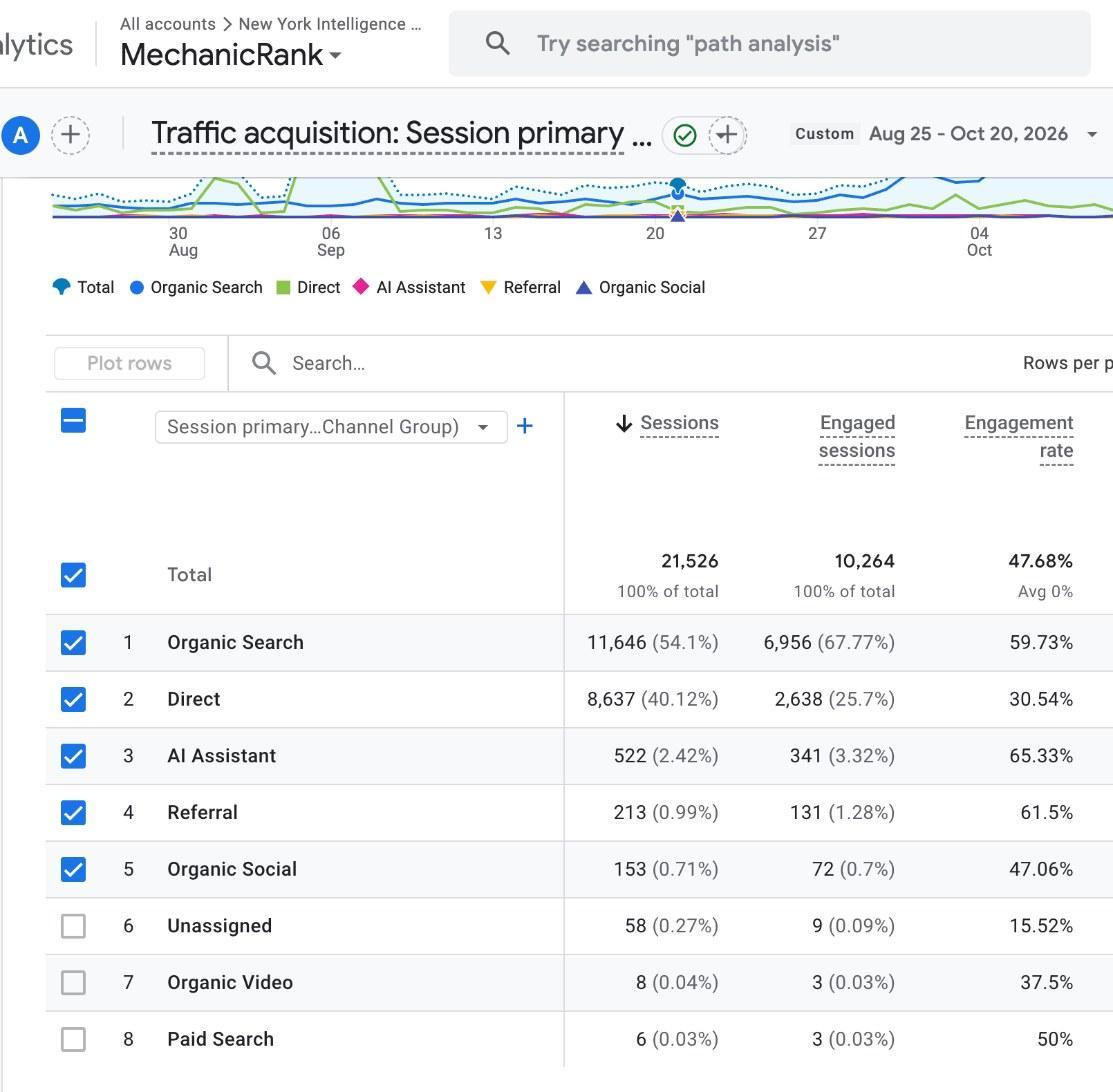
| MechanicRank | 21,387 | 11,648 | 8,625 | 522 | 213 |
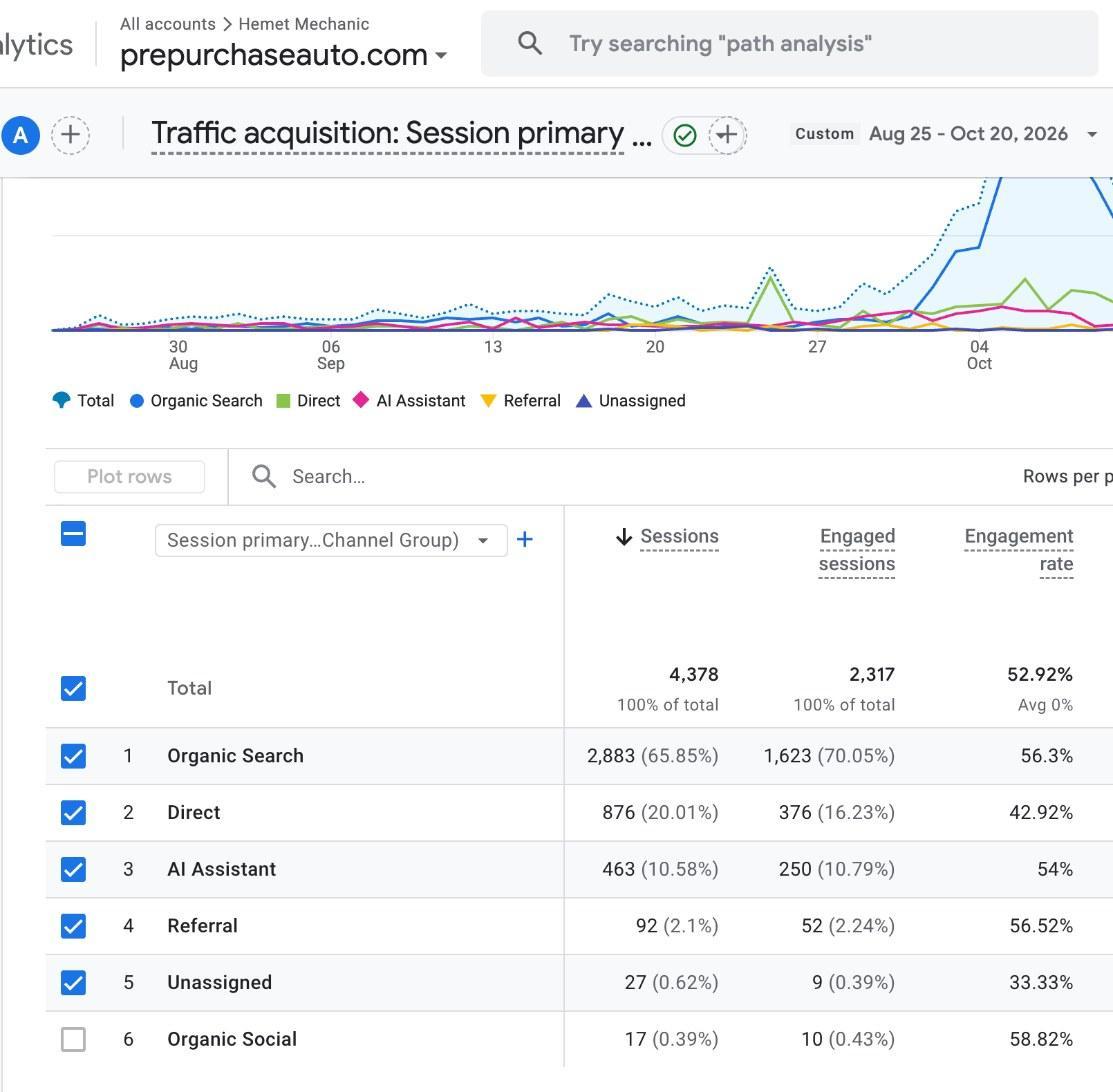
| PrePurchase Auto | 4,377 | 2,845 | 876 | 463 | 92 |
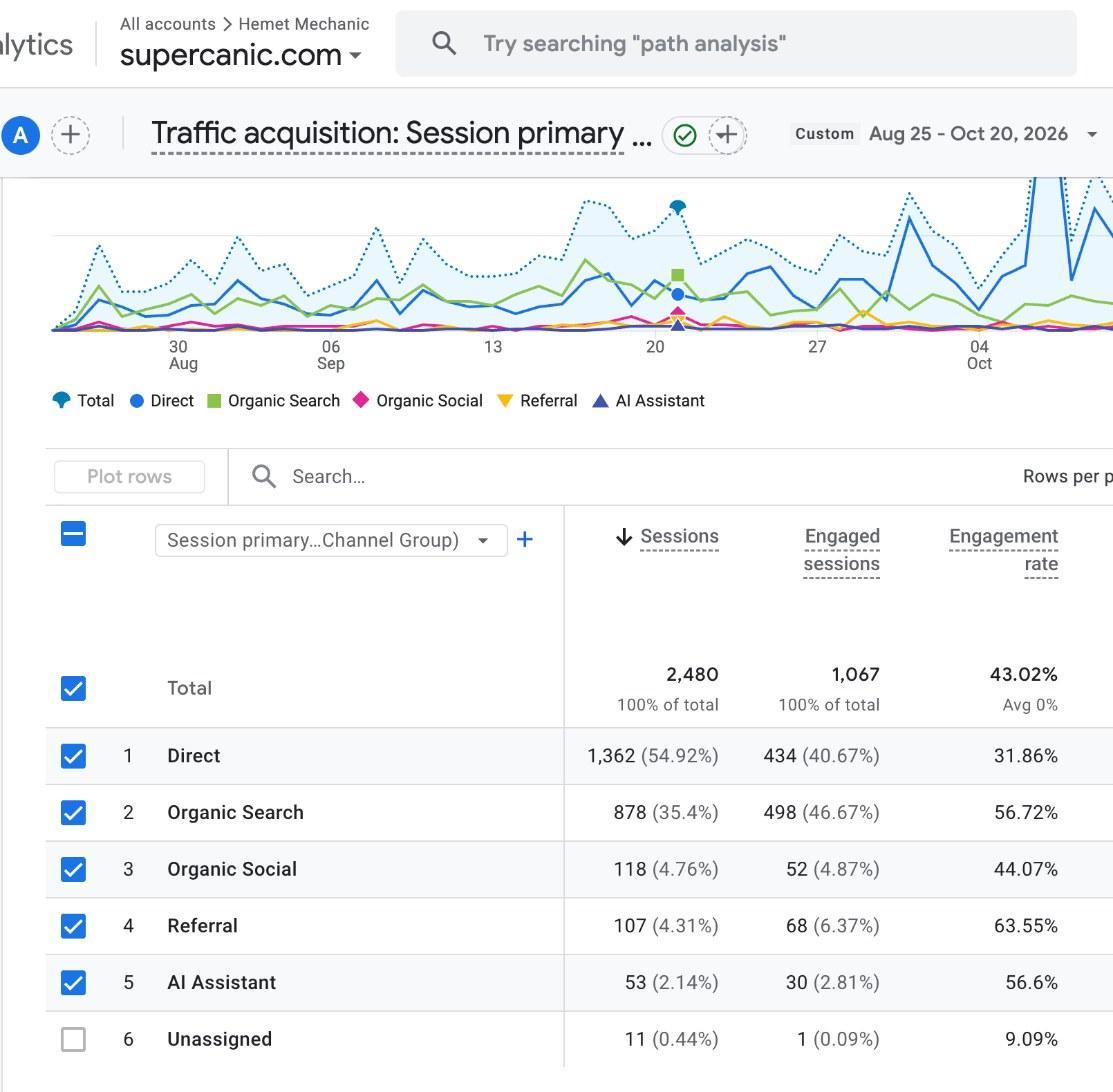
| Supercanic | 2,480 | 878 | 1,362 | 53 | 107 |
| mobilemecanico.com | 379 | 270 | 103 | 0 | 3 |
| riversidemechanics.com | 295 | 142 | 117 | 32 | 4 |
Click the thumbnail to see the image
MechanicRank has the clearest and most complete GA4 history for the previous window. It went from 1,049 sessions to 21,387. Direct traffic went from 463 to 8,625, and AI assistant visits went from 27 to 522.
Watch the direct traffic column. Direct visits are people who typed the address, bookmarked it, or came back from a text or an email. On Supercanic, direct is the biggest channel by a wide margin, at 1,362 of 2,480 sessions. That’s what years of Supercanic service trucks on the road and repeat customers look like in analytics.
The AI assistant column is the one we watch most closely. On PrePurchase Auto, 458 of the 463 AI visits came from ChatGPT. Leads from ChatGPT convert better for us than any other channel. From October 7 to 20, 13% of PrePurchase Auto’s AI assistant visits ended in a phone call, against 2% from organic search, with the same 57% engagement rate. Over those two weeks, 27 of the site’s 126 calls and requests turned into paid inspections.
Key Events, Last Two Weeks
| Site | Key events | Calls | Forms | Other |
|---|---|---|---|---|
| MechanicRank | 2,723 | 1,932 | 405 | Searches 225, quotes 81, claims 49, purchases 31 |
| Supercanic | 148 | 78 | 70 | |
| PrePurchase Auto | 126 | 88 | 3 | Inspection requests 35 |
MechanicRank’s 2,723 key events were up 84% on the two weeks before, September 23 to October 6.
What Changed
What changed in late September was where we put our effort. We moved it to two things.
The first was user-generated content. We interviewed real mobile mechanics, published their videos, and wrote blog posts built from what they told us.
The second was answering the questions people actually ask. We published answers to the FAQs buyers typed into Google and asked us about on calls, and to the pages on what people wanted information about.
Both depend on knowing what people search for and what already ranks. That’s where four DataForSEO APIs came in, each with one job.
Four DataForSEO APIs, One Job Each
1. Business Data API: A Graded Directory of 40,276 Car Dealers
Used car buyers don’t always search for “pre-purchase inspection”. They search for the dealer. They want to know if the lot is any good, if the reviews are real, and what other buyers ran into.
So we built the page they’re looking for. We used DataForSEO’s Business Listings endpoint to pull new and used car dealers within 20 km of the center of each metro we serve. The first build, on September 24, covered 24,650 dealers in 47 metros. By September 30, it covered 40,276 dealers across 109 metros.
We grade every dealer A, B, C or F based on its public reviews. Before grading, we add 25 imaginary 4.3-star reviews to every lot. That balances the scale and keeps the system fair yet weighted, so a brand-new business doesn’t get an unfair ranking or consideration either way. A lot with three perfect reviews can’t outrank a lot with 900 good ones.
The grade is then capped by the share of one- and two-star reviews. A lot needs 20 reviews to get a grade at all. That rule left 20,253 dealers graded, and each one gets its own profile page.
Each dealer page ends with the obvious next step: get this car inspected before you buy it.
The jump in our weekly numbers starts the week after that directory went live.
A few practical notes for developers.
- Slim the response before you store it. Keep only the fields you render.
- Page through big metros. Up to 1,000 records per call, deduplicated on cid.
- Keep the data the source of truth. Fill article numbers from the data at build time.
2. Google Maps Through the SERP API: Finding the Inspectors
The second half of the PPI problem is supply. A buyer in Tulsa is useless to us if no one can get to the car for the pre-purchase inspection.
That’s where MechanicRank and PrePurchase Auto turned out to be the same machine. MechanicRank lists mobile mechanics and repair shops, and every mechanic who claims a listing is a possible inspector.
For California alone, we ran Google Maps searches for “auto repair” and “mobile mechanic” in every city, as standard-queue tasks at depth 100. Each task costs $0.0006. The first batch was 360 tasks for $0.22, and covering the whole state takes about 1,044 tasks, or roughly $0.63. Those two batches added 6,096 and then 8,880 listings to MechanicRank on October 17.
Then we closed the loop. When a mechanic signs up for dispatch on MechanicRank, a box that’s already ticked also files them as a PrePurchase Auto inspector.
As of October 13, inspections had been done in 13 states, with 12 on-call inspectors in 8 states.
That’s the part I like most. The same DataForSEO pull builds the directory that buyers find, ranks MechanicRank nationally for “mobile mechanic near me” (409 clicks at an average national position of 5.3 over the eight weeks), and fills the bench of mechanics who do the inspections.
3. DataForSEO Labs: Picking Fights We Can Win
We don’t write a post until we know two things: does anyone search for it, and can we beat what ranks?
DataForSEO Labs gives us search volume, CPC, and keyword difficulty for every topic in our content queues. The combination we hunt for is low difficulty with a high CPC. It means the market pays real money for the click while the pages ranking for it are weak. That’s a gap, not a niche.
Every PrePurchase Auto blog post starts with the live SERP for its keyword. We read what ranks, then publish something with more real data, more real photos, and a better answer. Credit where it’s due. This is Brian Dean’s Skyscraper Technique, and it’s one of the first things new marketers learn in our office.
Recent posts covered dealers refusing inspections, rolled-back odometers, and CVT failures, each citing its sources.
The FAQ hub works the same way. The questions are ones buyers really search for and ask on calls, and a handful of dated answers get published every day.
4. Backlinks API: Finding Domains That Were Left on the Table
This one surprised us a lot.
A well-known company in the enterprise SEO space, which I won’t name, publishes lists of the citation and directory sites it recommends. It recommends them, it links to them, and it keeps them on the list for years. We’ve all used these lists to build citations and links for local businesses.
Some of those sites died, but the lists still link to them, followed, pointing at domains nobody owns. We reached out, but the links remain.
We pulled every domain off every one of those lists, 1,844 in total, and checked them. About a dozen were up for grabs, either unregistered or about to drop, and still sitting on the lists. We used the Backlinks API to count each dead domain’s referring domains and read its spam score. Most of the cheap ones carried spam scores in the 40s and 50s from a link network. We bought three of these domains.
323area.com was the cleanest. It was the Los Angeles 323 area code business directory, live for about twenty years, and it still had 63 referring domains with a spam score of 11, including those citation lists. Nobody owned it. We registered it for $10.46. Then we used the Business Listings endpoint to fill it with real, current Los Angeles businesses, about $2.20 of data for this rebuild and its sister site, and put it back online as a real directory. Today it has 1,668 listings.
Nobody else was looking. To be fair, the domains sat open to anyone who checked. Checking 1,844 domains by hand isn’t realistic, though. With DataForSEO, it was a few batch calls.
We’re sharing this because it’s one of the hundreds of things we’ve learned to do, and we hope this method helps others find success, too. We share and grow
What It Actually Cost
Here are the real unit costs we paid and logged, so you can plan your own build.
| Job | DataForSEO product | Cost |
|---|---|---|
| Google Maps listing search, depth 100 | SERP API, Google Maps, standard queue | $0.0006 per task |
| Whole state of California, two keywords | Same | about $0.63 |
| Business listings | Business Data API, Business Listings | about $0.012 per request plus $0.00036 per listing |
| Google reviews | Business Data API, Google Reviews | $0.00075 per 10 reviews (standard queue) |
| Keyword volume, CPC and difficulty | DataForSEO Labs | about $0.43 for 15 calls and 2,820 keywords |
| Referring domains and spam score | Backlinks API, bulk | about $0.025 per call, up to 1,000 domains |
| Citation check inside a prospect audit | SERP API | about $0.01 per audit |
| Total deposits since Sept 18, every project | about $500 |
Over the same eight weeks, the Shop Desk records for our Supercanic and PPI Auto accounts show 54 paid inspection jobs between August 25 and October 20. That’s $13,675 in gross payments received, before inspector pay. October alone, through the 20th, brought in $9,550 from 38 jobs, more than double September’s $3,900. In the previous eight weeks, the same query found two jobs, for $450.
To be clear, the $500 wasn’t only for PPI. It paid for the directories, dashboards, research and prospect audits, too. The PPI business just happens to be where the data turned into money fastest.
Mistakes We Made, So You Don’t
We posted batches to live endpoints. Live endpoints take one task per call. Anna caught it on day two and was quick to assist. If you need volume, use the standard queue with a postback URL and let results come to you.
We let the balance hit zero. Our bank locked our card on the first top-up, and the API paused mid-pull more than once. Check the balance before a run and retry later rather than failing silently.
We trusted one search operator too much. We used to check whether a business was listed on major directories with a single Google search using site: filters. Around October 14, that stopped returning reliable results, and for a while our audits showed citations as missing when they weren’t. Now a check that can’t confirm anything says “not checked” instead of “not listed.” Never let a tool’s silence become a claim about a customer.
We built pages before we checked the market. Early pages went up on instinct. The pages that work now are the ones where we pulled the SERP and keyword data first.
What We’d Tell Another Agency
- Build the page the searcher is actually looking for. Our buyers wanted dealer reviews, not an ad for inspections. The inspection is the next step on that page. We had built the last step first.
- Make one data pull do two jobs. Our mechanic listings serve buyers and recruit inspectors. Before you pay for a pull, ask what else it can feed within your goals and network.
- Use the standard queue for volume. Fractions of a cent per task add up to a whole state for under a dollar.
- Name your source every time. It builds trust with customers, and it keeps you honest about where a number came from. This is a major reason we believe AI assistants tend to favor data-enriched projects.
- Watch direct traffic and AI referrals, not just organic. Direct means people remembered you. Learn about Google’s Preferred Sources, which lets readers pick the sites they want to see more of in Top Stories, and the methods we use to get this kind of click above any other. AI referrals mean the assistants trust you enough to send traffic.
- Publish the losers too. A results table with a red line in it is one people believe.
Wrap Up
Eight weeks ago PrePurchase Auto had two clicks. Now it ranks, has sold $225 in inspections across 13 states, and gets a steady stream of visits from ChatGPT, all while remaining the simplest business we run. The other auto properties grew alongside it, and MechanicRank went from about 1,000 sessions to over 21,000 in the same window.
None of it took a big budget. It took the right data, pulled cheaply, used efficiently, and credited at every use.
We’re growing faster than we ever have, and DataForSEO’s toolset is a big part of why.
Want to see more from DataForSEO Expert Exchange in your Google results? Add DataForSEO as a preferred source on Google.