
By Yurii Vasyliev, founder of Structura
Structura picks topics for a website’s blog, then writes and publishes the posts. I build it myself, and before I ask a customer to trust how it picks topics, I run it on my own sites. One of them is Formula Foundry, a formula editor add-on for Excel and Google Sheets that I also build.
By this autumn, the Formula Foundry blog had 67 posts and a pattern I could not explain. The oldest posts, written before I used any keyword data, carried the blog. The newer ones, chosen from a keyword list sorted by search volume, mostly got nothing.
So I back-tested my own topic selection. For every post, I pulled the signals I could have known before writing it, and compared them with what the post went on to earn in Google Search Console. This article covers the method, the DataForSEO endpoints behind it, what I found, and where the evidence stops.
The puzzle
The blog had two eras.
From February to April 2026, Structura wrote 13 posts based on a one-paragraph description of the product. No keyword list, no volume numbers. It wrote about the problems the product solves.
From July onward, the topics came from a list of 50 keywords built from DataForSEO data and worked through in order of search volume, highest first. This is what most keyword-driven content plans look like, and it is what I shipped to customers.
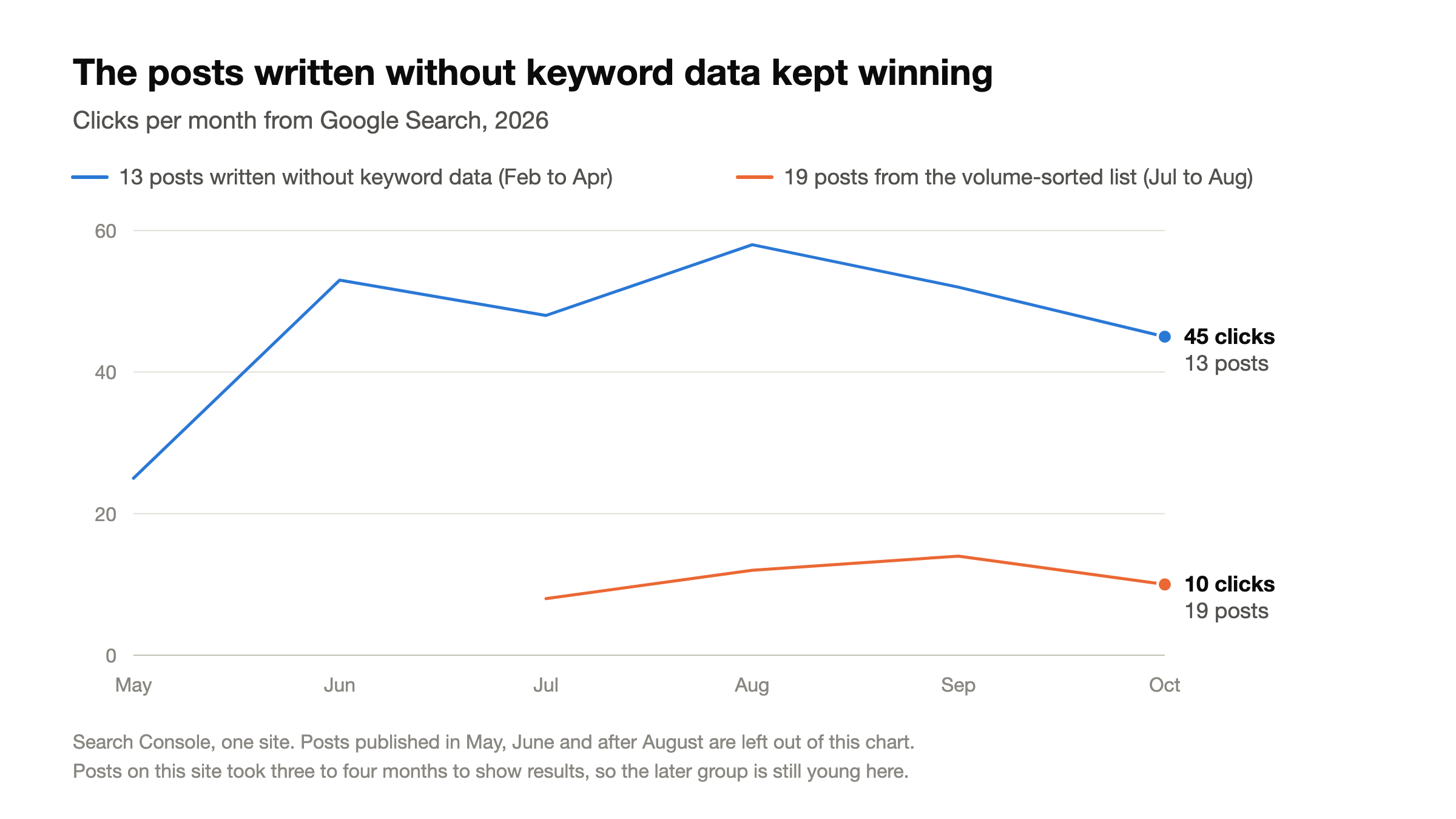
Clicks per month for the 13 early posts and the 19 posts from July and August
The 13 early posts were bringing in 45 to 58 clicks per month by summer. The 19 posts from July and August, picked by volume, reached 8 to 14 a month between them. The later group is younger, and age matters on this site, so the chart alone proves nothing. But the two biggest posts on the blog, one about defining variables in Google Sheets and one about tracing dependents in Excel, were both from the first era, and neither topic was anywhere on the keyword list.
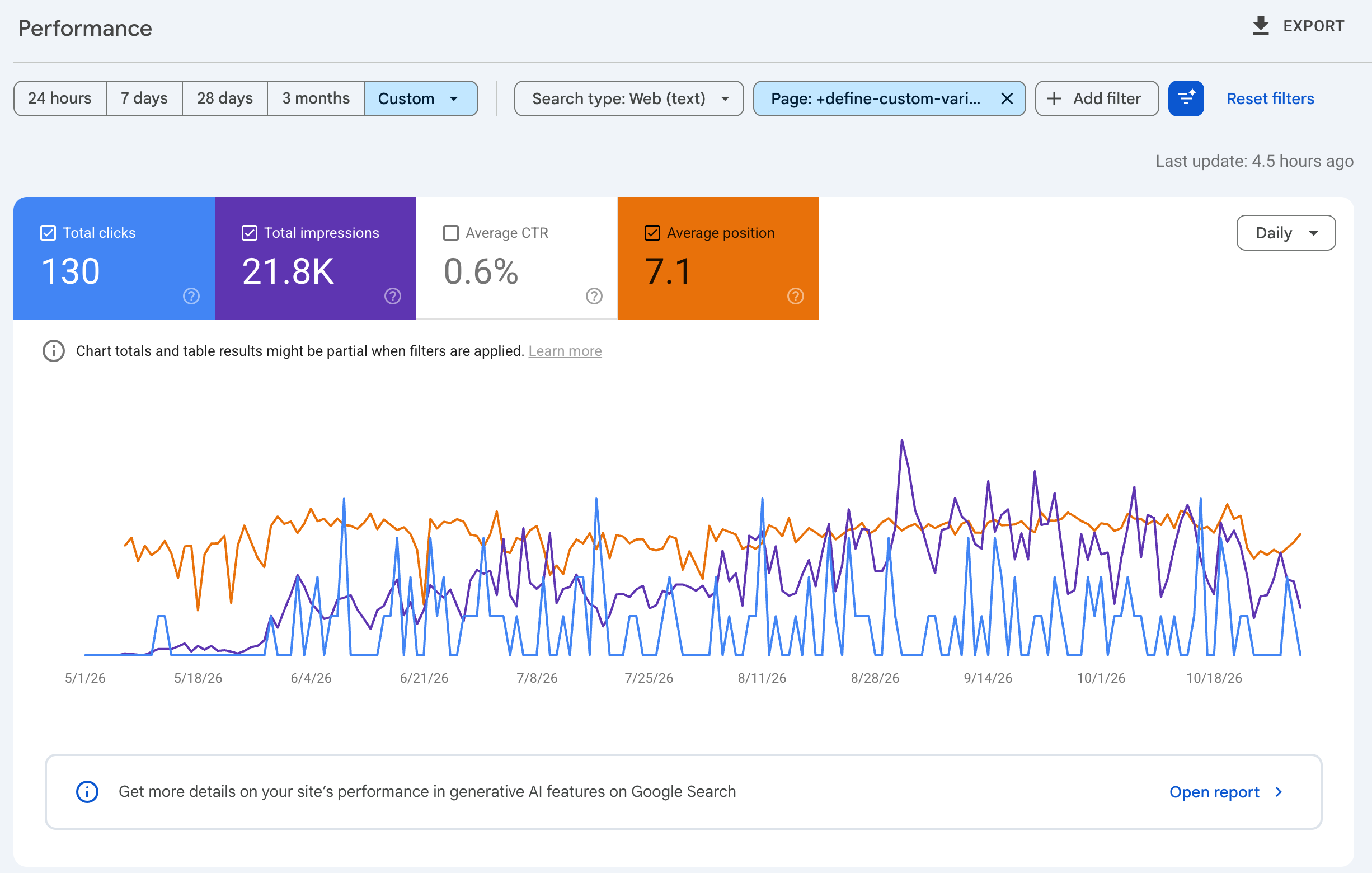
Search Console performance for the variables post, May to October 2026
What the keyword data could not see
The variables post is the clearest case. From May to October, it collected 21,800 impressions and 130 clicks at an average position of 7.1.
I looked up the keywords related to it using the Google Ads search volume endpoint. Six phrasings had a recorded volume, and together they came to between 230 and 290 searches a month in the United States. Three more phrasings, including the post’s own title, had no recorded volume at all.
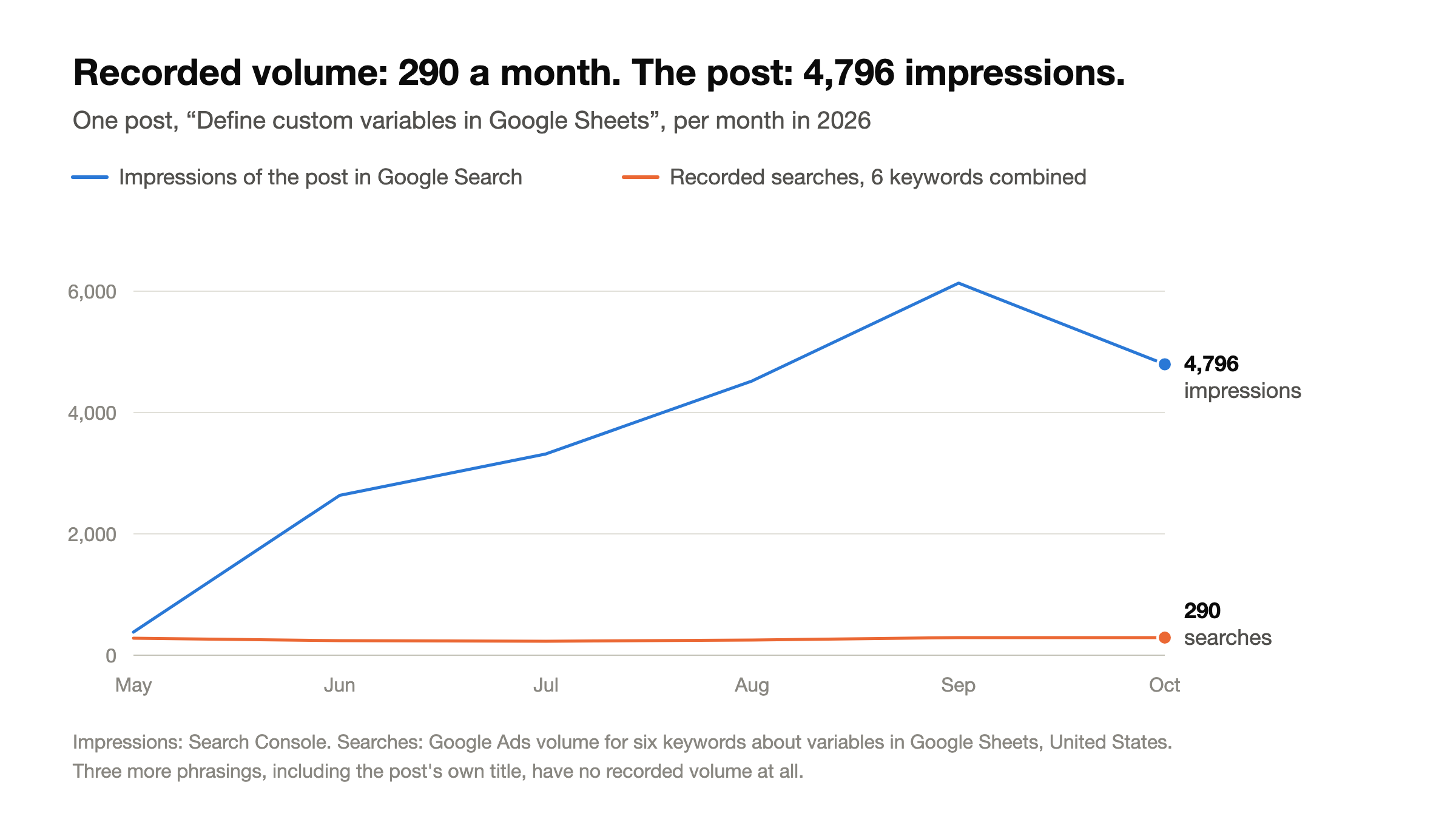
Recorded search volume for six keywords against the post’s monthly impressions
Impressions and searches are not the same metric, but the gap is about fifteen to one, and Search Console shows where it comes from.
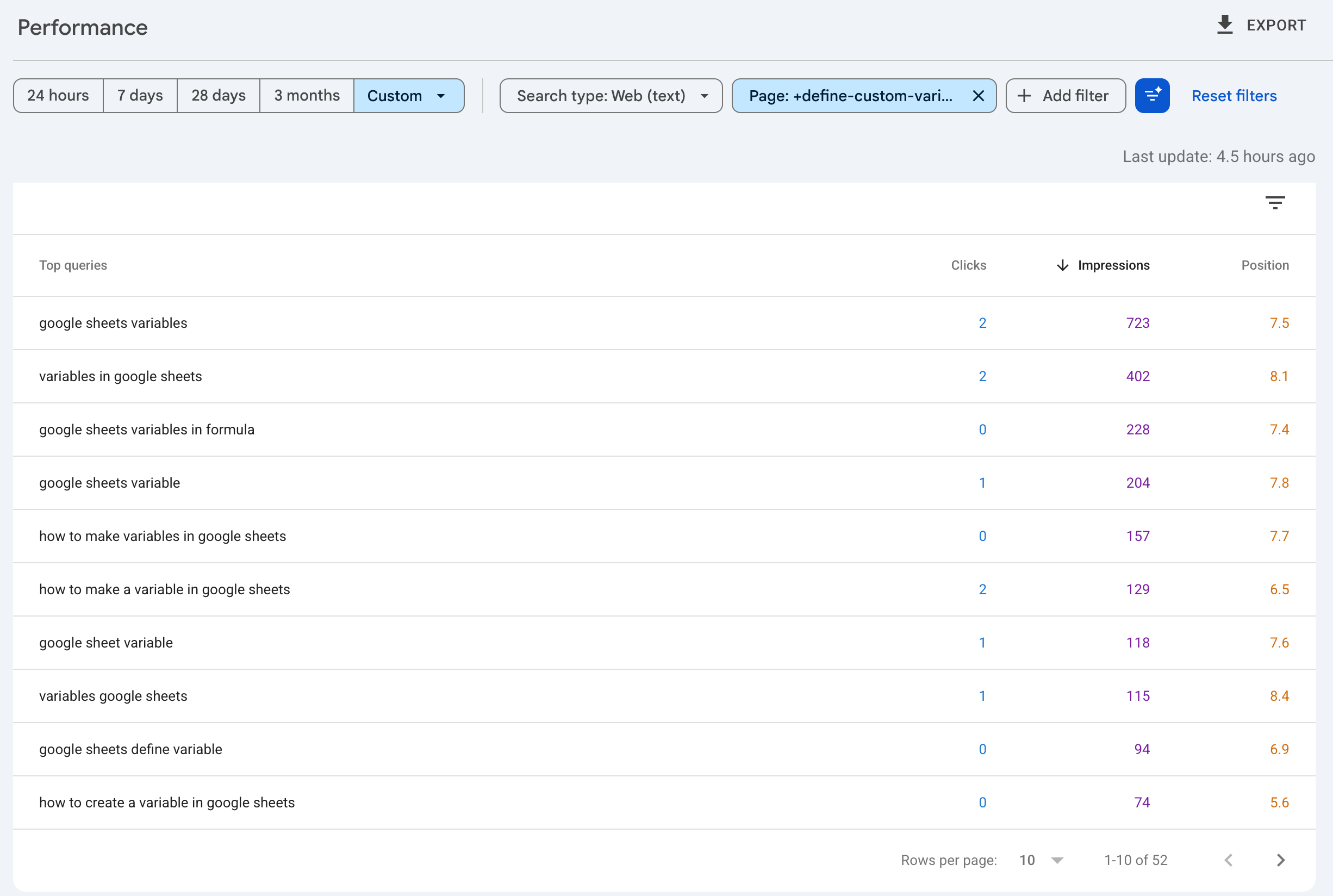
The post’s top ten queries in Search Console
The ten largest queries Search Console lists for this post add up to 2,244 impressions. It lists 52 queries in total. Even if each of the other 42 were as large as the tenth, at least three-quarters of the post’s impressions would come from queries that are not listed: phrasings too rare to be shown one by one.
This is not a fault in the volume data. Search volume counts phrasings that many people repeat. A question that a thousand people ask in a thousand different ways has real demand and a recorded volume of zero. A list sorted by volume cannot see it, and sorting by volume pushes it to the bottom.
The back-test
Which posts count
I pulled signals for all 67 posts. I judged outcomes only for the 42 that were at least three months old on November 6, 2026, because the February posts showed nothing in their first two months and I did not want to call a young post a failure. The 42 include posts written in May and June, between the two sets (the first chart leaves them out), which, like the first set’s posts, were written without a keyword list and sit in the non-recorded volume group. Every percentage below is out of those 42.
A winner is a post with at least 5 clicks or at least 1,500 impressions in Search Console over its lifetime. That is a low bar, on purpose: this is a small site. Twelve of the 42 posts cleared it.
The signals
For each post, I took the phrase in its URL as the candidate query, which is what a topic picker would have evaluated before the post existed. Then I collected:
- Search volume from
keywords_data/google_ads/search_volume/live, one call for all 67 queries. - The top results from
serp/google/organic/task_post, read back withserp/google/organic/task_get/advanced, 20 results deep, United States, desktop. I removed Formula Foundry’s own result and kept the top ten of the rest. - Domain strength for every site in those results, 355 hosts in one call to
backlinks/bulk_ranks/live. - The kind of query. A language model saw only the query and the Formula Foundry homepage text and answered one question: does this searcher want a tool or an answer? “Excel formula generator” wants a tool. “How to read trace dependents in Excel” wants an answer.
From the top results, I derived two things. The first is whether the top ten is beatable: the share of results that are forum threads, Q&A pages, videos, social posts or small domains, with a top ten counted as beatable at 55% or more. The second is whether a forum or Q&A thread in the top ten asks the same question, meaning its title contains at least 60% of the query’s meaningful words.
Getting clean search results
One practical note for anyone repeating this. My first attempt used the Live endpoint, and on the day I ran it, every organic URL came back as a google.com/goto redirect, so I had no domains to classify. I moved to the Standard queue. A plain queued task returned real URLs, but for the Google Sheets variables query, the results were about Google Analytics and Google Ads: the poisoned result sets DataForSEO has written about. Adding resolve_poisoned_results fixed it. Of the 67 result sets, 59 came back with every organic result marked from_web, the flag for a repaired result.
const auth = "Basic " + Buffer.from(`${LOGIN}:${PASSWORD}`).toString("base64");
const api = (path, init = {}) =>
  fetch("https://api.dataforseo.com/v3/" + path, {
    ...init,
    headers: { Authorization: auth, "Content-Type": "application/json" },
  }).then((r) => r.json());

// 1. Queue one task per candidate query.
const posted = await api("serp/google/organic/task_post", {
  method: "POST",
  body: JSON.stringify(
    queries.map((keyword) => ({
      keyword,
      location_code: 2840, // United States
      language_code: "en",
      device: "desktop",
      depth: 20,
      priority: 2,
      resolve_poisoned_results: true,
    })),
  ),
});

// 2. Read each task back. 40602 means it is still in the queue.
for (const { id } of posted.tasks) {
  const task = (await api("serp/google/organic/task_get/advanced/" + id)).tasks[0];
  if (task.status_code !== 20000) continue; // try again later
  const topTen = task.result[0].items
    .filter((item) => item.type === "organic")
    .filter((item) => !item.domain.endsWith("formulafoundry.io"))
    .slice(0, 10);
  // classify topTen: forum thread, small domain, publisher, official docs
}
Eleven of the 67 tasks failed on the first pass and came back on a retry, so build the retry in. The whole study cost under a dollar in API calls.
What I found
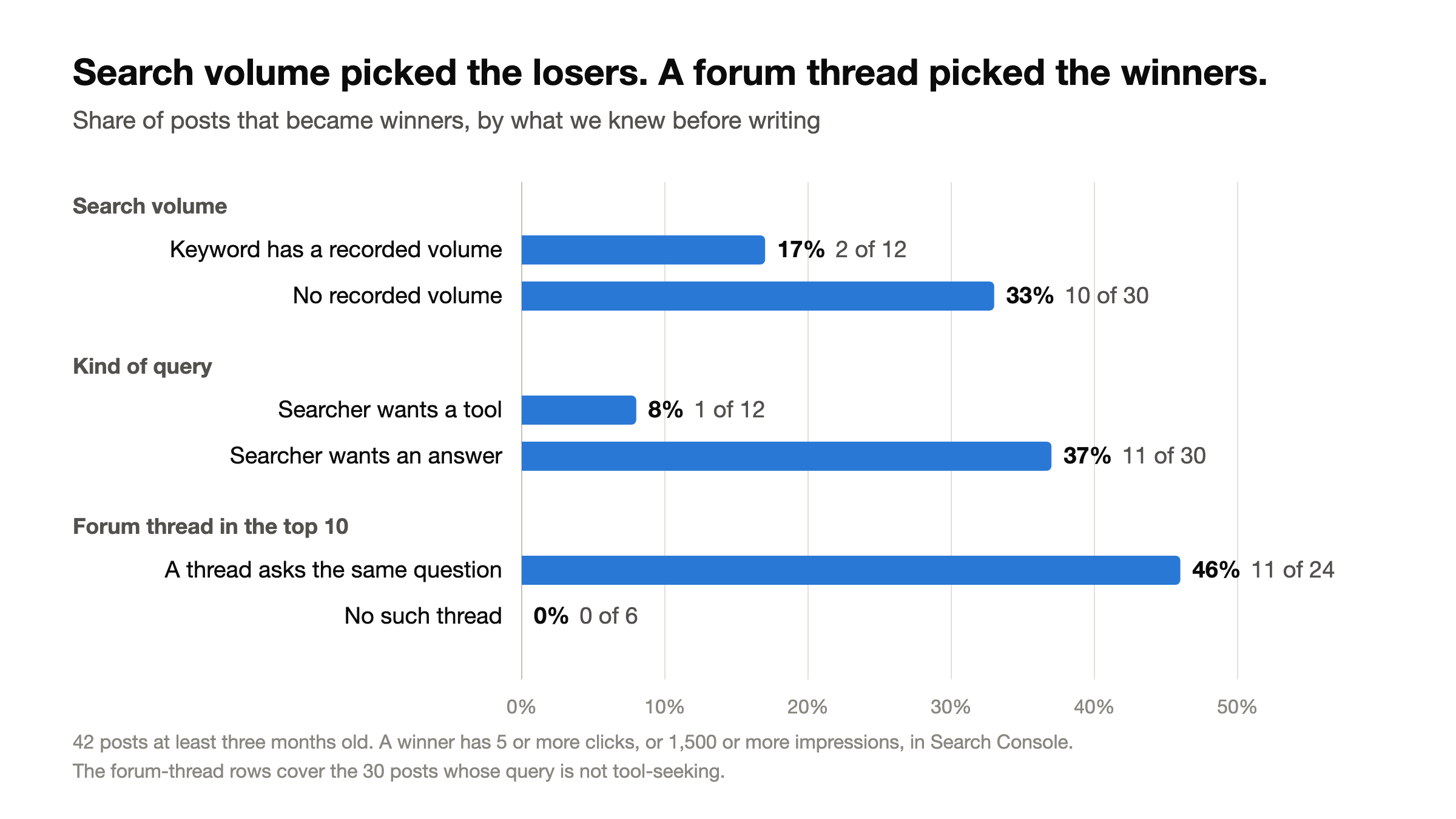
Winner rate by signal
Search volume pointed the wrong way. Of the 12 posts whose queries had a recorded volume, 2 became winners (17%). Of the 30 with no recorded volume, 10 did (33%). Across all 42 posts, volume correlates negatively with clicks per month (rank correlation of −0.23). On this site, the more volume a keyword showed, the less likely the post was to earn anything.
Tool-seeking queries almost never won. Of 12 posts written for a query where the searcher wants a tool, 1 became a winner (8%), against 11 of 30 for the rest (37%). These were the keywords with the best-looking numbers because they describe the product category. The results for them are tool landing pages, and a blog post is the wrong answer to the question.
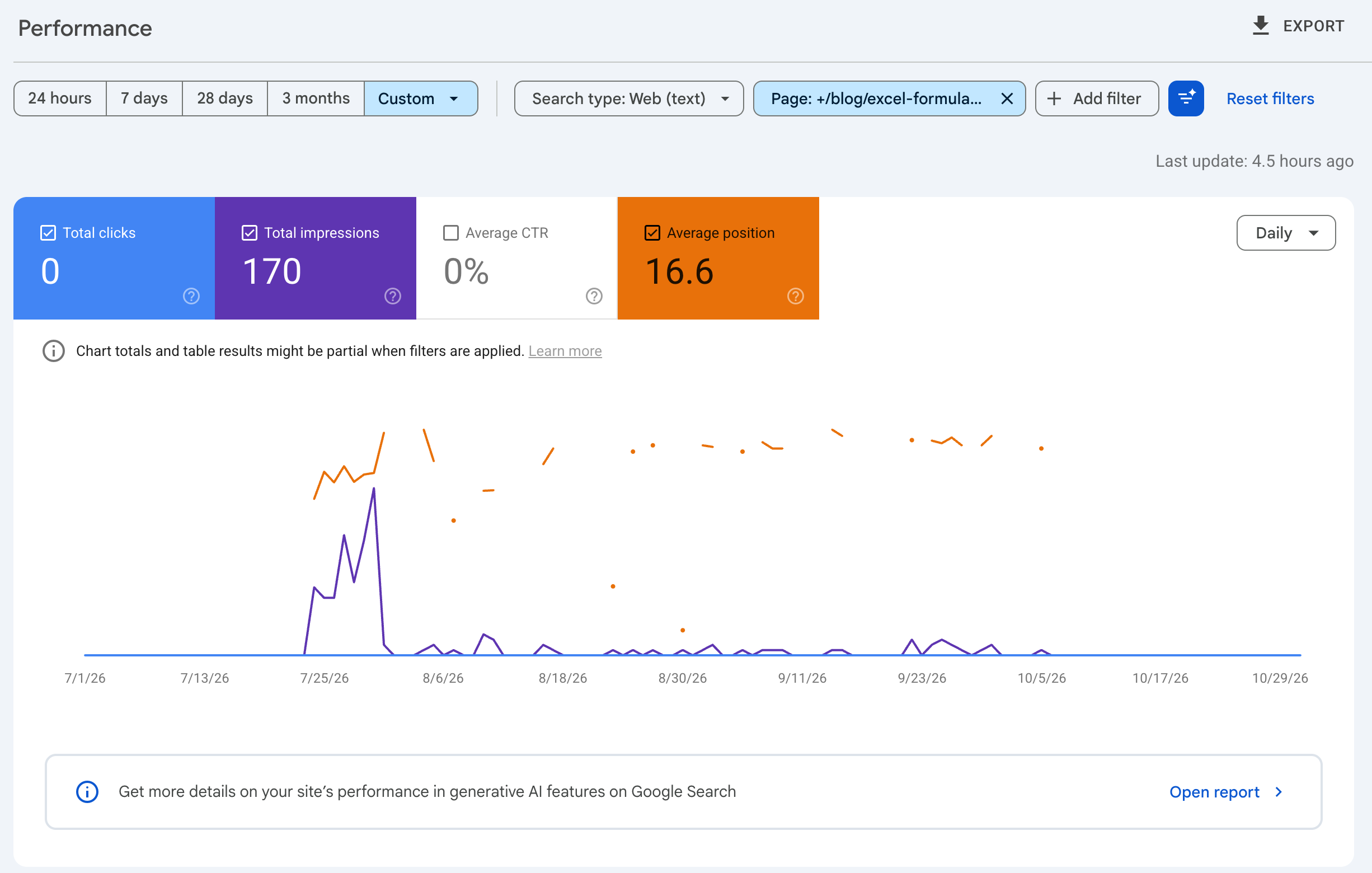
Search Console performance for the post targeting “excel formula ai”
The post above targeted “excel formula ai”, a keyword with a recorded volume. In four months it earned 170 impressions and no clicks. The average position of 16.6 in the screenshot covers every query the page appeared for. For the keyword it was targeting, however, it sits position 40.
A forum thread in the top ten was the best sign. Among the 30 posts that were not tool-seeking, 24 had a forum or Q&A thread in the top ten asking the same question. Eleven of those won (46%). Six had no such thread, and none of them won. A thread ranking in the top ten says two things at once: real people ask this in their own words, and nobody has answered it well enough to push the thread out.
A beatable top ten mattered too. Posts facing a beatable top ten won 34% of the time (11 of 32). Posts facing publishers and official documentation won 10% (1 of 10).
One more finding had nothing to do with search results. The keyword list produced near-duplicates: two posts on inserting a formula for an entire column, a month apart. The first has zero impressions to this day. The second has more than 5,500. Nothing in the pipeline compared a new keyword with what the site had already published.
What it would have changed
I combined the signals into a simple filter: not tool-seeking, a beatable top ten, a fit with the product, and a clear problem behind the query. Eighteen of the 42 posts pass it. Seven of them are winners (39%), and together they hold 232 of the 348 clicks the 42 posts earned.
Then I asked which 15 posts each method would have written first.
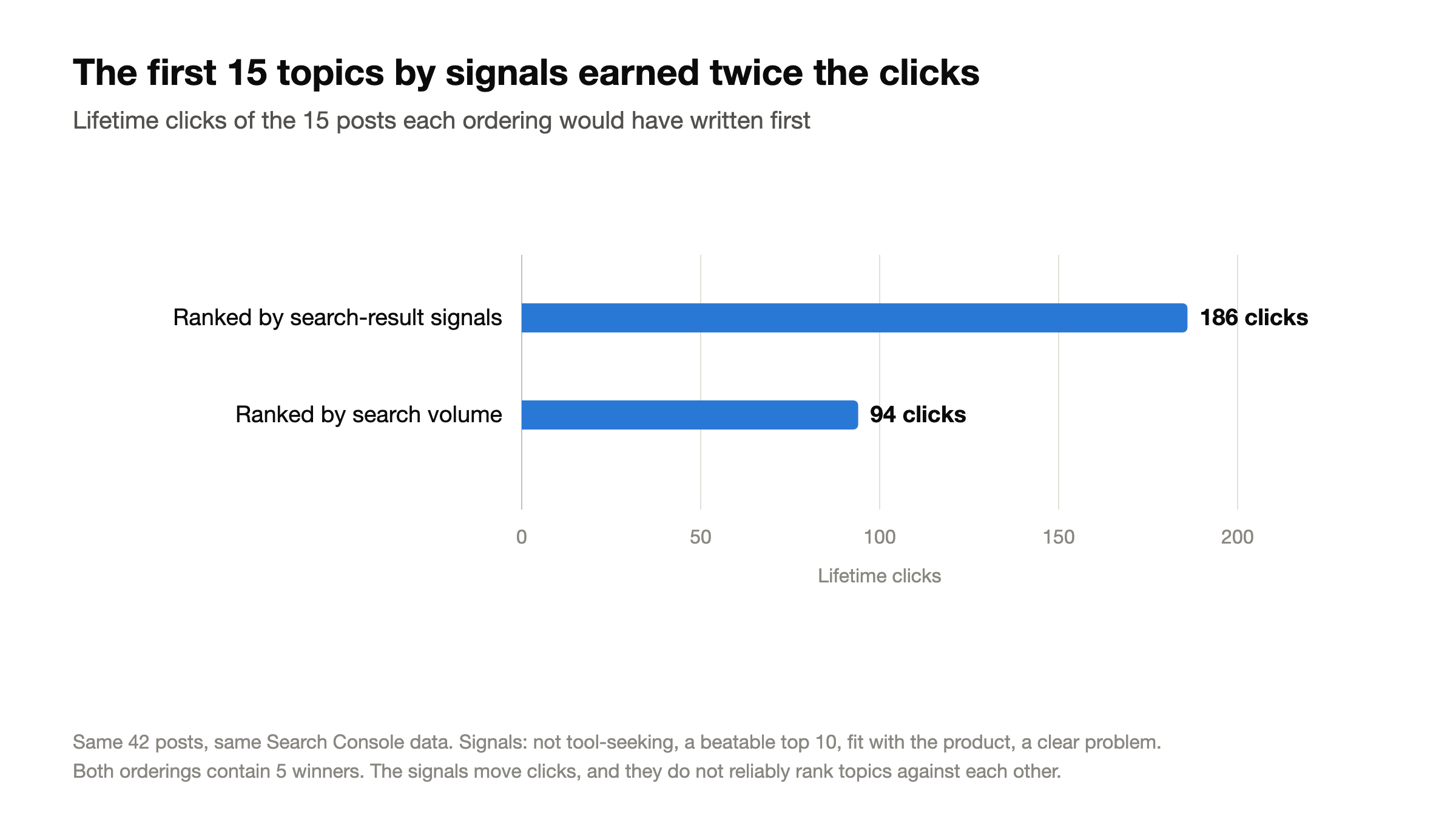
Clicks earned by the first 15 topics under each ordering
The 15 best by the signals earned 186 clicks. The 15 highest by volume earned 94.
What I changed in Structura
I changed topic selection on November 6:
- Queries where the searcher wants a tool no longer go on the blog list. They belong to product pages.
- Structura reads the top ten for each candidate before admitting it. A top ten held by publishers and official documentation is dropped, and open ones are written first.
- Search volume no longer decides the order.
- Every new topic is compared with what the site has already published.
- Candidates no longer come only from keyword databases. Structura also collects the questions readers ask, including those Google shows under People Also Ask.
The limits
There is no traffic chart at the end of this article. On this site, a post takes three to four months to show what it will do, and the change is a few weeks old. The result here is the back-test, and I would rather say so than show a lucky early spike.
Other limits, in order of how much they matter:
- One site, 42 posts, 12 winners. The volume and tool-seeking splits are solid at this size. The forum-thread split, 11 of 24 against 0 of 6, is suggestive.
- The signals filter. They do not rank. Both orderings in the chart above contain 5 winners, and the combined score has no rank correlation with clicks per month. The signals tell you what to skip. Which of the admitted topics will be the big one remains unknown before publication.
- The search results are from November 2026, after the posts were published. I removed the site’s own result to approximate what a picker would have seen, but the pages around it have moved since.
- Search Console counts impressions inside AI answers. Some of the variables post’s impressions are citations, which is one reason its click rate is low for position 7.
Try it on your own site
You need a site with at least 30 posts that are three months old or more, and Search Console access.
- Export clicks and impressions per page from Search Console and pick a winner threshold that fits your traffic.
- For each post, take the query it was written for and pull volume and the top 20 results with the endpoints above.
- Split your posts by each signal and compare winner rates. Start with the two cheapest: is there a recorded volume, and is there a forum thread in the top ten asking the same question?
If volume predicts your winners, keep sorting by it. On my site it predicted the losers. I will run the same test on the new selection in March 2027 and publish what it shows, whichever way it goes.
About the author: Yurii Vasyliev is the founder of Structura, which picks topics, writes and publishes blog posts for your website. He builds it on his own and tests every change on his own sites first. He also runs Xerx, a web, software and AI development agency.