
Generative search changed how users discover information, replacing the list of “10 blue links” with natural language responses. At the same time, it transformed the concept of visibility in search results.
Instead of solely monitoring SERP rankings, companies now must track mentions and citations in Large Language Models and explore in which context the brand shows up. The challenge is clear: How do you measure brand visibility in AI-driven search? Popular LLMs and Google don’t provide open data on AI-based searches and mentions, and manual monitoring across multiple AI services is neither scalable nor reliable.
But there is no need to worry. At DataForSEO, we developed a breakthrough data solution to prepare you for the era of generative search – LLM Mentions API. In this article, we’ll explore how to use this API to pull and track LLM mentions effortlessly. Moreover, we’ll demonstrate how generative search optimization (GEO) experts, tool developers, and brand agencies can transform LLM mentions data into actual insights.
Contents:
DataForSEO LLM Mentions API: a complete toolkit for AI mentions tracking
➤ How do these endpoints work if there is no open data on AI mentions?
➤ Search Mentions endpoint
➤ Target Metrics endpoint
➤ Multi-Target Metrics endpoint
➤ Top Mentioned Domains & Top Mentioned Pages endpoints
Securing success in the generative search era with LLM Mentions API: 3 use cases
➤ Generative search optimization (GEO) experts
➤ Developers of AI visibility tracking tools
➤ Brand marketing and PR agencies
Conclusion
LLM Mentions API: a complete toolkit for tracking AI mentions
LLM Mentions API is a complete API suite for tracking mentions in LLM responses and retrieving relevant mention data. In this article, we’ll take a close look at the following endpoints of this API – Search Mentions, Target Metrics, Multi-Target Metrics, Top Mentioned Domains, and Top Mentioned Pages. Each of these endpoints is designed for collecting mention data grouped by specific parameters.
How do these endpoints work if there is no open data on AI mentions?
We use a sophisticated approach to address this limitation. First, we have formed an extensive database comprising millions of records of Google AI Overviews, sections of “people also ask” questions, and ChatGPT responses. This vast dataset is continuously expanded and regularly updated. Then, we structure the data and calculate all the relevant metrics, such as AI search volume, using our proprietary algorithms. After that, you can access the data instantly using LLM Mentions endpoints. This approach ensures you get complete, reliable AI mentions data whenever needed.
Now, let’s take a closer look at the endpoints and the data they provide.
1. Search Mentions endpoint
The first endpoint, Search Mentions, provides detailed and structured mentions data for target keywords and domains. In particular, it fetches user queries and AI-generated snippets where the target is mentioned, complemented with mention metrics, such as total mention count and AI search volume.
The distinctive feature of the Search Mentions endpoint, as well as other endpoints of the LLM Mentions API, is the highly customizable task-setting process. First, you should specify the target array of up to 10 keyword or domain entities. For each entity in the target array, you can set custom search parameters, such as setting search scope for keyword or domain mentions, or excluding specific keywords from search results. This entity-based targeting approach allows you to narrow down search results precisely, making sure you receive only the most relevant mentions data.
Then, you can choose the platform type to get mentions data from a specific LLM platform (currently, either Google AI Overviews or ChatGPT). Besides, you can further customize the request by specifying location, language, and setting up ordering and filtering parameters. To manage the quantity of returned results, set the limit parameter to the preferred value.
Here is an example of a request to the Search Mentions endpoint:
[
  {
    "language_name": "English",
    "location_code": 2840,
    "target": [
      {
        "domain": "dataforseo.com",
        "search_filter": "include"
      },
      {
        "keyword": "dataforseo",
        "search_scope": [
          "answer"
        ]
      }
    ],
    "platform": "google",
    "filters": [
      [
        "ai_search_volume",
        ">",
        10
      ]
    ],
    "order_by": [
      "ai_search_volume,desc"
    ],
    "offset": 0,
    "limit": 2
  }
]
The response will return results as follows:
{
"version": "0.1.20260610",
"status_code": 20000,
"status_message": "Ok.",
"time": "0.4924 sec.",
"cost": 0.102,
"tasks_count": 1,
"tasks_error": 0,
"tasks": [
{
"id": "07081337-1535-0650-0000-b15b449e9e20",
"status_code": 20000,
"status_message": "Ok.",
"time": "0.4634 sec.",
"cost": 0.102,
"result_count": 1,
"path": [
"v3",
"ai_optimization",
"llm_mentions",
"search_mentions",
"live"
],
"data": {
"api": "ai_optimization",
"function": "search_mentions",
"language_name": "English",
"location_code": 2840,
"target": [
{
"domain": "dataforseo.com",
"search_filter": "include"
},
{
"keyword": "dataforseo",
"search_scope": [
"answer"
]
}
],
"platform": "google",
"filters": [
[
"ai_search_volume",
">",
10
]
],
"order_by": [
"ai_search_volume,desc"
],
"offset": 0,
"limit": 2
},
"result": [
{
"total_count": 149,
"offset": 0,
"search_after_token": "eyJDdXJyZW50T2Zmc2V0IjoyLCJSYXdSZXF1ZXN0Ijp7InRhcmdldCI6W3sidHlwZSI6ImRvbWFpbiIsImRvbWFpbiI6ImRhdGFmb3JzZW8uY29tIiwic2VhcmNoX3Njb3BlIjpbImFueSJdLCJzZWFyY2hfdHlwZSI6ImluY2x1ZGUiLCJpbmNsdWRlX3N1YmRvbWFpbnMiOmZhbHNlfSx7InR5cGUiOiJrZXl3b3JkIiwia2V5d29yZCI6ImRhdGFmb3JzZW8iLCJzZWFyY2hfc2NvcGUiOlsiYW5zd2VyIl0sInNlYXJjaF90eXBlIjoiaW5jbHVkZSIsImVudHJ5X3R5cGUiOiJ3b3JkX21hdGNoIn1dLCJwbGF0Zm9ybSI6Imdvb2dsZSIsImxhbmd1YWdlIjoiZW4iLCJsb2NhdGlvbiI6Mjg0MCwibGltaXQiOjIsIm9mZnNldCI6MCwib3JkZXJfYnkiOnsib3JkZXJfZmllbGQiOiJhaV9zZWFyY2hfdm9sdW1lIiwib3JkZXJfdHlwZSI6ImRlc2MifSwicXVlcnkiOnsiZmllbGQiOiJhaV9zZWFyY2hfdm9sdW1lIiwidHlwZSI6Imd0IiwidmFsdWUiOjEwfSwic2VhcmNoX2FmdGVyX3Rva2VuIjpudWxsLCJhaWQiOjE1MzV9LCJTZWFyY2hBZnRlckRhdGEiOnsiVmVyc2lvbiI6MSwiU2VhcmNoQWZ0ZXJWYWx1ZXMiOnsiYWlfc2VhcmNoX3ZvbHVtZSI6MTAwMCwiZGF0ZSI6IjIwMjYtMDYtMzBUMTc6MzA6MzMrMDA6MDAiLCJoYXNoIjotOTAwMDQxMjc5MDY3ODMxNDY5MX0sIlRva2VuUmVhbE9mZnNldCI6MH19",
"items_count": 2,
"items": [
{
"platform": "google",
"model_name": "google_ai_overview",
"location_code": 2840,
"language_code": "en",
"question": "api for google trends",
"answer": "Google launched an **official Google Trends API** in an alpha testing phase in mid-2025 , which is available to a limited number of testers. Access requires applying for the alpha program.[[1]](https://developers.google.com/search/apis/trends#:~:text=Get%20early%20access%20to%20the,as%20we%20develop%20the%20API?)[[2]](https://developers.google.com/search/blog/2025/07/trends-api)\n\nOfficial Google Trends API[[1]](https://www.relevantaudience.com/general-topics/google-trends-api-access-search-data-programmatically/#:~:text=Google%20just%20announced%20Google%20Trends%20API%2C%20however,status%20and%20not%20yet%20opened%20to%20everyone.)\n\nThe official API provides programmatic access to search interest data, offering several advantages over manual data retrieval or unofficial scraping methods.[[1]](https://developers.google.com/search/blog/2025/07/trends-api)[[2]](https://kiwicommerce.co.uk/how-to-use-google-trends-api-to-findwhats-hot-before-your-competitors-do/)\n\n- **Access:** Currently in an alpha test, you must [apply for early access to the Google Trends API alpha](https://developers.google.com/search/apis/trends) via Google's application form.\n- **Key Features:** \n\t- Consistently scaled data across requests, allowing for better comparisons over time.\n\t- Access to a rolling window of the last five years of data.\n\t- Data aggregation in daily, weekly, monthly, and yearly intervals.\n\t- Geographical breakdowns by region and sub-region.\n\t- Ability to compare more keywords at once than the five-term limit on the public website.\n- **Usage:** Once access is granted, you can use a Google Cloud project with the \"Search Analytics API\" enabled to make requests using API keys or OAuth credentials. Google provides official SDKs, including support for Python, to interact with the API.[[1]](https://developers.google.com/search/apis/trends#:~:text=Get%20early%20access%20to%20the,as%20we%20develop%20the%20API?)[[2]](https://developers.google.com/search/blog/2025/07/trends-api)[[3]](https://kiwicommerce.co.uk/how-to-use-google-trends-api-to-findwhats-hot-before-your-competitors-do/)[[4]](https://www.italiadesigns.nyc/post/unlock-search-insights-at-scale-google-trends-api-empowers-smarter-strategy#:~:text=One%20of%20the%20longstanding%20frustrations,over%20time%20without%20recalibration%20headaches.)[[5]](https://medium.com/@muruganantham52524/google-trends-api-in-2025-a-python-guide-to-tracking-real-search-demand-and-writing-better-content-2db202fa7465)\n\nThird-Party APIs and Unofficial Libraries\n\nFor immediate access to Google Trends data without joining the official alpha program, several third-party services and unofficial libraries that scrape the public website are available.[[1]](https://brightdata.com/blog/web-data/how-to-scrape-google-trends#:~:text=Google%20Trends%20doesn't%20offer%20official%20APIs%20for,you%20automatically%20download%20reports%20from%20Google%20Trends.)[[2]](https://hasdata.com/blog/how-to-scrape-google-trends#:~:text=Option%202:%20Using%20a%20Web%20Scraping%20API,can%20provide%20you%20with%20Google%20Trends%20data.)[[3]](https://www.scrapingbee.com/scrapers/google-trends-scraper/#:~:text=Google%20does%20not%20provide%20an%20official%20public,and%20historical%20data%20into%20applications%20or%20reports.)\n\n- **Third-Party Services:** Companies like [SerpApi](https://serpapi.com/google-trends-api), [Apify](https://apify.com/api/google-trends-api) , and [DataForSEO](https://dataforseo.com/apis/google-trends-api) offer dedicated APIs that provide structured Google Trends data. These services handle the complexities of web scraping and anti-blocking measures, typically operating on a freemium or pay-per-request model.\n- **Unofficial Libraries:** Open-source libraries like [pytrends](https://github.com/GeneralMills/pytrends) for Python and google-trends-api for Node.js use unofficial endpoints to fetch data by simulating a browser's requests to the Google Trends website. These are generally free but can be less reliable and are subject to rate limits or sudden breaks if Google changes its website structure.[[1]](https://dataforseo.com/apis/google-trends-api#:~:text=Try%20DataForSEO%20Trends%20API,thousands%20of%20requests%20per%20minute.)[[2]](https://apify.com/api/google-trends-api#:~:text=This%20Google%20Trends%20API%20gives,free%2C%20no%20credit%20card%20required.)[[3]](https://kiwicommerce.co.uk/how-to-use-google-trends-api-to-findwhats-hot-before-your-competitors-do/)[[4]](https://medium.com/@muruganantham52524/google-trends-api-in-2025-a-python-guide-to-tracking-real-search-demand-and-writing-better-content-2db202fa7465)[[5]](https://python.plainenglish.io/automate-google-trends-data-scraping-with-python-turn-search-trends-into-actionable-insights-6ba07f1cbe9f)[[6]](https://meetglimpse.com/google-trends-api/#:~:text=The%20Best%20Google%20Trends%20API,series%20and%20undermines%20your%20analysis.)",
"sources": [
{
"snippet": "Introducing the Google Trends API (alpha): a new way to access Search Trends data * On this page. * Data available. Consistently s...",
"source_name": "Google for Developers",
"thumbnail": null,
"markdown": null,
"rank": 1,
"title": "Introducing the Google Trends API (alpha): a new way to access ...",
"domain": "developers.google.com",
"url": "https://developers.google.com/search/blog/2025/07/trends-api",
"publication_date": null
},
{
"snippet": "What Is the Google Trends API? Google Trends has long been a go-to tool for understanding what people are searching for. But now, ...",
"source_name": "Kiwicommerce",
"thumbnail": null,
"markdown": null,
"rank": 2,
"title": "How to Use Google Trends API to FindWhat's Hot Before Your ...",
"domain": "kiwicommerce.co.uk",
"url": "https://kiwicommerce.co.uk/how-to-use-google-trends-api-to-findwhats-hot-before-your-competitors-do/",
"publication_date": null
},
{
"snippet": "Get early access to the Google Trends API alpha. The Google Trends API enables programmatic access to data from Google Trends, hel...",
"source_name": "Google for Developers",
"thumbnail": null,
"markdown": null,
"rank": 3,
"title": "Google Trends API Alpha | Google Search Central | Documentation",
"domain": "developers.google.com",
"url": "https://developers.google.com/search/apis/trends#:~:text=Get%20early%20access%20to%20the,as%20we%20develop%20the%20API?",
"publication_date": null
},
{
"snippet": "How to use Python and Google's new Trends API to discover high-traffic topics, understand real-time audience demand, and write con...",
"source_name": "Medium",
"thumbnail": null,
"markdown": null,
"rank": 4,
"title": "Google Trends API in 2025: A Python Guide to Tracking Real ...",
"domain": "medium.com",
"url": "https://medium.com/@muruganantham52524/google-trends-api-in-2025-a-python-guide-to-tracking-real-search-demand-and-writing-better-content-2db202fa7465",
"publication_date": null
},
{
"snippet": "Keyword Data: Google Trends API * Get actionable keyword data hassle-free. Data mining can be complicated. Getting popularity tren...",
"source_name": "DataForSEO",
"thumbnail": null,
"markdown": null,
"rank": 5,
"title": "Keyword Data: Google Trends API – Capture Search Interest",
"domain": "dataforseo.com",
"url": "https://dataforseo.com/apis/google-trends-api#:~:text=Try%20DataForSEO%20Trends%20API,thousands%20of%20requests%20per%20minute.",
"publication_date": null
},
{
"snippet": "There's No Google Trends API. Looking for the official Google Trends API? It won't be publicly available for another year. In fact...",
"source_name": "Glimpse",
"thumbnail": null,
"markdown": null,
"rank": 6,
"title": "Google Trends' API isn't Public – Use This Instead - Glimpse",
"domain": "meetglimpse.com",
"url": "https://meetglimpse.com/google-trends-api/#:~:text=The%20Best%20Google%20Trends%20API,series%20and%20undermines%20your%20analysis.",
"publication_date": null
},
{
"snippet": "Google Trends API. This Google Trends API gives you programmatic access to Google's trend data that isn't available through any of...",
"source_name": "Apify",
"thumbnail": null,
"markdown": null,
"rank": 7,
"title": "Google Trends API - Apify",
"domain": "apify.com",
"url": "https://apify.com/api/google-trends-api#:~:text=This%20Google%20Trends%20API%20gives,free%2C%20no%20credit%20card%20required.",
"publication_date": null
},
{
"snippet": "Unlock Search Insights at Scale: Google Trends API Empowers Smarter Strategy * One of the longstanding frustrations with Google Tr...",
"source_name": "Italia Designs",
"thumbnail": null,
"markdown": null,
"rank": 8,
"title": "Unlock Search Insights at Scale: Google Trends API Empowers ...",
"domain": "www.italiadesigns.nyc",
"url": "https://www.italiadesigns.nyc/post/unlock-search-insights-at-scale-google-trends-api-empowers-smarter-strategy#:~:text=One%20of%20the%20longstanding%20frustrations,over%20time%20without%20recalibration%20headaches.",
"publication_date": null
},
{
"snippet": "How to Automate Google Trends Scraping in Python. We'll be using the pytrends library - an unofficial API for Google Trends - to f...",
"source_name": "Python in Plain English",
"thumbnail": null,
"markdown": null,
"rank": 9,
"title": "Automate Google Trends Data Scraping with Python",
"domain": "python.plainenglish.io",
"url": "https://python.plainenglish.io/automate-google-trends-data-scraping-with-python-turn-search-trends-into-actionable-insights-6ba07f1cbe9f",
"publication_date": null
}
],
"search_results": null,
"ai_search_volume": 1600,
"monthly_searches": [
{
"year": 2026,
"month": 2,
"search_volume": 1900
},
{
"year": 2026,
"month": 1,
"search_volume": 1600
},
{
"year": 2025,
"month": 12,
"search_volume": 1300
},
{
"year": 2025,
"month": 11,
"search_volume": 1300
},
{
"year": 2025,
"month": 10,
"search_volume": 1600
},
{
"year": 2025,
"month": 9,
"search_volume": 1600
},
{
"year": 2025,
"month": 8,
"search_volume": 1900
},
{
"year": 2025,
"month": 7,
"search_volume": 1900
},
{
"year": 2025,
"month": 6,
"search_volume": 1600
},
{
"year": 2025,
"month": 5,
"search_volume": 1600
},
{
"year": 2025,
"month": 4,
"search_volume": 1900
},
{
"year": 2025,
"month": 3,
"search_volume": 1900
}
],
"first_response_at": "2026-01-28 15:43:29 +00:00",
"last_response_at": "2026-03-15 07:19:42 +00:00",
"brand_entities": null,
"fan_out_queries": null,
"is_web_search_based": true
},
{
"platform": "google",
"model_name": "google_ai_overview",
"location_code": 2840,
"language_code": "en",
"question": "rank tracking api",
"answer": "A **Rank Tracker API** `programmatically retrieves search engine result page (SERP) positions for specified keywords, domains, and locations` . It eliminates manual search checks by delivering structured data (usually JSON) directly into your custom SEO dashboards, internal BI systems, or client reporting applications.[](https://keyword.com/rank-tracker-api/) [[1]](https://keyword.com/rank-tracker-api/)[[2]](https://api.market/blog/skycraft/retrieve-page-rank/best-rank-tracking-apis)[[3]](https://iproyal.com/blog/best-rank-tracker-apis/)[[4]](https://www.olostep.com/blog/best-rank-tracking-api)\n\nChoosing the right API depends heavily on your system architecture, data scale, and tracking frequency.[](https://www.olostep.com/blog/best-rank-tracking-api) [[1]](https://www.olostep.com/blog/best-rank-tracking-api)\n\nTypes of Rank Tracking APIs\n\n- **Live Wrapper APIs** : Run a search query and return parsed results synchronously in real-time (e.g., [SearchAPI](https://www.searchapi.io/docs/google-rank-tracking-api), [SerpApi](https://www.scrapingbee.com/blog/best-rank-tracker-apis/) ). Best for instant, on-demand checks where a user is waiting for a dashboard screen to load.[](https://www.searchapi.io/docs/google-rank-tracking-api) [[1]](https://www.searchapi.io/docs/google-rank-tracking-api)[[2]](https://www.scrapingbee.com/blog/best-rank-tracker-apis/)[[3]](https://www.olostep.com/blog/best-rank-tracking-api)\n- **Dedicated Rank APIs** : Use asynchronous endpoints optimized for scheduling thousands of daily keyword tracks across multiple locations (e.g., [DataForSEO](https://dataforseo.com/solutions/rank-tracking-app), [Keyword.com](https://keyword.com/rank-tracker-api/) ). Best for high-volume data warehouses and agency reporting pipelines.[](https://keyword.com/rank-tracker-api/) [[1]](https://keyword.com/rank-tracker-api/)[[2]](https://www.scrapingbee.com/blog/best-rank-tracker-apis/)[[3]](https://www.olostep.com/blog/best-rank-tracking-api)\n- **Proxy / Structured Data APIs** : Provide raw web-scraping infrastructure, handling proxy rotation and CAPTCHA solving while giving developers absolute control over raw HTML parsing (e.g., ScrapingBee , Olostep). Best for extracting non-traditional metrics or customized AI layouts.[](https://www.scrapingbee.com/blog/best-rank-tracker-apis/) [[1]](https://www.scrapingbee.com/blog/best-rank-tracker-apis/)[[2]](https://www.olostep.com/blog/best-rank-tracking-api)\n- **SEO Tools with API Access** : Big SaaS platforms that expose their existing database programmatically (e.g., Semrush, SE Ranking). Best for pre-normalized data that plugs easily into Looker Studio, though they carry more rigid usage limits.[](https://www.scrapingbee.com/blog/best-rank-tracker-apis/) [[1]](https://www.scrapingbee.com/blog/best-rank-tracker-apis/)[[2]](https://www.olostep.com/blog/best-rank-tracking-api)\n\n\n---\n\nComparison of Top Providers The following providers are highly rated by developers and enterprise teams based on specific extraction needs:| Provider[[1]](https://www.scrapingbee.com/blog/best-rank-tracker-apis/)[[2]](https://dataforseo.com/solutions/rank-tracking-app)[[3]](https://www.searchapi.io/docs/google-rank-tracking-api)[[4]](https://www.olostep.com/blog/best-rank-tracking-api)[[5]](https://keyword.com/rank-tracker-api/)[[6]](https://brightdata.com/products/serp-api/rank-tracking) | Core Strength | Key Features |\n|---|---|---|\n| **DataForSEO** | **High-volume tracking** | Extremely flexible endpoints; tracks Google, Bing, Yahoo; built for agency dashboards. |\n| **ScrapingBee** | **Custom data control** | Flawless proxy rotation and CAPTCHA solving; delivers raw HTML or parsed JSON. |\n| **SearchAPI** | **Real-time execution** | Lightweight synchronous wrapper; pulls organic positions and rich snippets instantly. |\n| **Keyword.com** | **Agency automation** | REST API providing position, search volume, and CPC directly into BI software. |\n| **[Bright Data](https://brightdata.com/products/serp-api/rank-tracking)** | **Enterprise scaling** | Massive proxy infrastructure; global city-level tracking; raw HTML or JSON output. |\n\n\n---\n\nKey Selection Criteria\n\n- **Location Granularity** : Ensure the API supports targeted tracking at the country, region, or specific city level to mimic genuine user experiences.[](https://brightdata.com/products/serp-api/rank-tracking) [[1]](https://brightdata.com/products/serp-api/rank-tracking)[[2]](https://www.scrapingbee.com/blog/best-rank-tracker-apis/)\n- **SERP Layout & AI Support** : Verify that the provider parses modern SERP features, including featured snippets, Local Packs, \"People Also Ask\" blocks, and AI search snapshots.[](https://www.searchapi.io/docs/google-rank-tracking-api) [[1]](https://www.searchapi.io/docs/google-rank-tracking-api)[[2]](https://www.olostep.com/blog/best-rank-tracking-api)[[3]](https://www.seoreviewtools.com/rank-tracker-api/)\n- **Device Emulation** : Accurate rank tracking requires separating desktop and mobile user agents, as layouts and rankings differ significantly between them.[](https://developers.similarweb.com/docs/rank-tracking-api-introduction) [[1]](https://developers.similarweb.com/docs/rank-tracking-api-introduction)[[2]](https://support.similarweb.com/hc/en-us/articles/7391037561873-Rank-Tracking-API)\n- **Cost Efficiency** : Standardize your pricing calculations by evaluating the total formula: Keywords × Frequency × Locations × Devices to avoid unexpected monthly bills.[](https://www.olostep.com/blog/best-rank-tracking-api) [[1]](https://www.olostep.com/blog/best-rank-tracking-api)",
"sources": [
{
"snippet": "Rank Tracker API * Easy integration to collect organic and Google Ads keyword rankings. * View real-time SERP results in any count...",
"source_name": "Bright Data",
"thumbnail": null,
"markdown": null,
"rank": 1,
"title": "Rank Tracking API - Bright Data",
"domain": "brightdata.com",
"url": "https://brightdata.com/products/serp-api/rank-tracking",
"publication_date": null
},
{
"snippet": "The Daily Rank Tracking API provides access to daily website ranking data based on specified parameters. The Rank Tracker API prov...",
"source_name": "Similarweb",
"thumbnail": null,
"markdown": null,
"rank": 2,
"title": "Introduction - the Similarweb API Documentation",
"domain": "developers.similarweb.com",
"url": "https://developers.similarweb.com/docs/rank-tracking-api-introduction",
"publication_date": null
},
{
"snippet": "Keyword.com's Rank Tracker API is a REST API that provides programmatic access to Google keyword ranking data. It returns position...",
"source_name": "Keyword.com",
"thumbnail": null,
"markdown": null,
"rank": 3,
"title": "Keyword.com Rank Tracker API – Build dashboards, automate ...",
"domain": "keyword.com",
"url": "https://keyword.com/rank-tracker-api/",
"publication_date": null
},
{
"snippet": "Rank Tracking Dashboard. Rank Tracker is the primary tool used by website owners and SEO professionals to monitor search engine ra...",
"source_name": "DataForSEO",
"thumbnail": null,
"markdown": null,
"rank": 4,
"title": "Rank Tracking App - DataForSEO",
"domain": "dataforseo.com",
"url": "https://dataforseo.com/solutions/rank-tracking-app",
"publication_date": null
},
{
"snippet": "Search Query The search_api_query is a direct query rank on-demand API method that returns parsed search results for a keyword and...",
"source_name": "Similarweb Knowledge Center",
"thumbnail": null,
"markdown": null,
"rank": 5,
"title": "Rank Tracking API - Similarweb Knowledge Center",
"domain": "support.similarweb.com",
"url": "https://support.similarweb.com/hc/en-us/articles/7391037561873-Rank-Tracking-API",
"publication_date": null
},
{
"snippet": "The Google Rank Tracking API provides a lightweight solution for tracking search result rankings on Google. It's optimized for fas...",
"source_name": "SearchApi",
"thumbnail": null,
"markdown": null,
"rank": 6,
"title": "Google Rank Tracking API",
"domain": "www.searchapi.io",
"url": "https://www.searchapi.io/docs/google-rank-tracking-api",
"publication_date": null
},
{
"snippet": "Get access to real-time ranking data with the SEO Review Tools rank tracker API. The API returns data in JSON format which can be ...",
"source_name": "SEO Review Tools",
"thumbnail": null,
"markdown": null,
"rank": 7,
"title": "Google Rank Checker API {JSON} → SEO Review Tools",
"domain": "www.seoreviewtools.com",
"url": "https://www.seoreviewtools.com/rank-tracker-api/",
"publication_date": null
},
{
"snippet": "Kevin Sahin | 21 January 2026 | 13 min read * 1. ScrapingBee – for Custom Rank Tracking. * 2. SerpAPI – High-Speed Rank Tracking A...",
"source_name": "ScrapingBee",
"thumbnail": null,
"markdown": null,
"rank": 8,
"title": "Best Rank Tracking APIs for Developers & Agencies",
"domain": "www.scrapingbee.com",
"url": "https://www.scrapingbee.com/blog/best-rank-tracker-apis/",
"publication_date": null
},
{
"snippet": "What is a Rank Tracker API? A rank tracker API helps developers pull ranking data from a search engine automatically. Instead of c...",
"source_name": "IPRoyal.com",
"thumbnail": null,
"markdown": null,
"rank": 9,
"title": "Best Rank Tracker APIs in 2026: Top Picks and Features",
"domain": "iproyal.com",
"url": "https://iproyal.com/blog/best-rank-tracker-apis/",
"publication_date": null
},
{
"snippet": "Best Rank Tracking APIs: Cost, AI Visibility, Architecture. The ideal provider depends entirely on your system architecture. DataF...",
"source_name": "Olostep",
"thumbnail": null,
"markdown": null,
"rank": 10,
"title": "Best Rank Tracking APIs: Cost, AI Visibility, Architecture - Olostep",
"domain": "www.olostep.com",
"url": "https://www.olostep.com/blog/best-rank-tracking-api",
"publication_date": null
},
{
"snippet": "1. What is a Rank Tracker API? A rank tracker API is a programmatic interface that retrieves a website's search engine ranking for...",
"source_name": "API.market",
"thumbnail": null,
"markdown": null,
"rank": 11,
"title": "9 Best Rank Tracking APIs in 2026: Features, Pricing, and Real Use ...",
"domain": "api.market",
"url": "https://api.market/blog/skycraft/retrieve-page-rank/best-rank-tracking-apis",
"publication_date": null
}
],
"search_results": null,
"ai_search_volume": 1000,
"monthly_searches": [
{
"year": 2026,
"month": 5,
"search_volume": 140
},
{
"year": 2026,
"month": 4,
"search_volume": 110
},
{
"year": 2026,
"month": 3,
"search_volume": 3600
},
{
"year": 2026,
"month": 2,
"search_volume": 4400
},
{
"year": 2026,
"month": 1,
"search_volume": 210
},
{
"year": 2025,
"month": 12,
"search_volume": 210
},
{
"year": 2025,
"month": 11,
"search_volume": 90
},
{
"year": 2025,
"month": 10,
"search_volume": 480
},
{
"year": 2025,
"month": 9,
"search_volume": 1300
},
{
"year": 2025,
"month": 8,
"search_volume": 480
},
{
"year": 2025,
"month": 7,
"search_volume": 390
},
{
"year": 2025,
"month": 6,
"search_volume": 880
}
],
"first_response_at": "2025-11-11 05:04:48 +00:00",
"last_response_at": "2026-06-30 17:30:33 +00:00",
"brand_entities": null,
"fan_out_queries": null,
"is_web_search_based": true
}
]
}
]
}
]
}
In the items array of results, you will receive objects that contain mention data for the relevant target. These objects include a user question and an LLM answer in which the target was mentioned, a list of sources quoted by AI in the response, and all websites the model retrieved when looking up the information. Additionally, you get the current and monthly ai_search_volume values for the target keyword or domain. This data is especially beneficial for exploring how and in which context keywords and domains are mentioned in AI responses.
2. Target Metrics endpoint
The next endpoint, Target Metrics, gives you a consolidated overview of key mention metrics across different dimensions, such as location, language, AI platform, and source domains.
The task-setting process for this endpoint is similar to that for the Search Mentions endpoint. Set the target array with the target keyword or domain entities and specify the location and language. Then, select the platform to retrieve the results from and define the filtering parameters.
The request may be structured like this:
[
  {
    "language_code": "es",
    "location_code": 2840,
    "platform": "google",
    "target": [
      {
        "domain": "en.wikipedia.org",
        "search_filter": "exclude"
      },
      {
        "keyword": "bmw",
        "search_scope": [
          "answer"
        ]
      }
    ],
    "initial_dataset_filters": [
      [
        "ai_search_volume",
        ">",
        10
      ]
    ],
    "internal_list_limit": 3
  }
]
The response will return the following results:
{
  "version": "0.1.20260610",
  "status_code": 20000,
  "status_message": "Ok.",
  "time": "2.2530 sec.",
  "cost": 0.101,
  "tasks_count": 1,
  "tasks_error": 0,
  "tasks": [
    {
      "id": "07081342-1535-0651-0000-07b5e66dbad1",
      "status_code": 20000,
      "status_message": "Ok.",
      "time": "2.2391 sec.",
      "cost": 0.101,
      "result_count": 1,
      "path": [
        "v3",
        "ai_optimization",
        "llm_mentions",
        "target_metrics",
        "live"
      ],
      "data": {
        "api": "ai_optimization",
        "function": "target_metrics",
        "language_code": "es",
        "location_code": 2840,
        "platform": "google",
        "target": [
          {
            "domain": "en.wikipedia.org",
            "search_filter": "exclude"
          },
          {
            "keyword": "bmw",
            "search_scope": [
              "answer"
            ]
          }
        ],
        "initial_dataset_filters": [
          [
            "ai_search_volume",
            ">",
            10
          ]
        ],
        "internal_list_limit": 3
      },
      "result": [
        {
          "total_count": 0,
          "offset": 0,
          "items_count": 0,
          "aggregated_metrics": {
            "location": [
              {
                "key": 2840,
                "mentions": 3137,
                "ai_search_volume": 21584180
              }
            ],
            "language": [
              {
                "key": "es",
                "mentions": 3137,
                "ai_search_volume": 21584180
              }
            ],
            "platform": [
              {
                "key": "google",
                "mentions": 3137,
                "ai_search_volume": 21584180
              }
            ],
            "sources_domain": [
              {
                "key": "www.youtube.com",
                "mentions": 2236,
                "ai_search_volume": 16303680
              },
              {
                "key": "www.reddit.com",
                "mentions": 938,
                "ai_search_volume": 6064790
              },
              {
                "key": "www.edmunds.com",
                "mentions": 675,
                "ai_search_volume": 4374100
              }
            ],
            "search_results_domain": [],
            "brand_entities_title": [],
            "brand_entities_category": [],
            "total": {
              "mentions": 3137,
              "ai_search_volume": 21584180
            }
          },
          "items": []
        }
      ]
    }
  ]
}
The API returns a response with the aggregated mention metrics grouped by specified location, language, LLM platform, and more. The metrics include current ai_search_volume,and total mentions count. Besides, the mention data is additionally grouped by all relevant domains found in the AI responses. With this endpoint, you can quickly assess the overall traffic potential of your target mentions and identify which domains consistently appear in related AI responses.
3. Multi-Target Metrics endpoint
The Multi-Target Metrics endpoint also provides consolidated mention metrics, but with a key difference. In this endpoint, you can specify multiple target mentions to get the data for. It features a separate targets array, where you can set up multiple target domains or keywords grouped under aggregation keys. For each individual target, you can set up a search scope and filtering parameters. The rest of the request parameters, such as location, language, and initial_dataset_filters, are specified similarly to the way it works in the Target Metrics endpoint. This setup allows you to compare mention metrics across multiple targets within a single request.
For instance, you want to compare how frequently different phone models like iPhone, Samsung, Google Pixel, and Xiaomi appear alongside the keyword “best camera” in AI responses. To do that, you can send the following request to the Multi-Target Metrics endpoint:
[
  {
    "language_code": "en",
    "location_code": 2840,
    "platform": "google",
    "targets": [
      {
        "key": "iphone",
        "target": [
          {
            "keyword": "best camera",
            "search_filter": "include"
          },
          {
            "keyword": "iphone",
            "search_filter": "include"
          }
        ]
      },
      {
        "key": "samsung",
        "target": [
          {
            "keyword": "best camera",
            "search_filter": "include"
          },
          {
            "keyword": "samsung",
            "search_filter": "include"
          }
        ]
      },
      {
        "key": "google pixel",
        "target": [
          {
            "keyword": "best camera",
            "search_filter": "include"
          },
          {
            "keyword": "google pixel",
            "search_filter": "include"
          }
        ]
      },
      {
        "key": "xiaomi",
        "target": [
          {
            "keyword": "best camera",
            "search_filter": "include"
          },
          {
            "keyword": "xiaomi",
            "search_filter": "include"
          }
        ]
      }
    ],
    "initial_dataset_filters": [
      [
        "ai_search_volume",
        ">",
        10
      ]
    ],
    "internal_list_limit": 2
  }
]
As a result, you will get a response like this one below:
{
  "version": "0.1.20260610",
  "status_code": 20000,
  "status_message": "Ok.",
  "time": "9.4689 sec.",
  "cost": 0.104,
  "tasks_count": 1,
  "tasks_error": 0,
  "tasks": [
    {
      "id": "07081354-1535-0652-0000-4c7413398f69",
      "status_code": 20000,
      "status_message": "Ok.",
      "time": "9.4140 sec.",
      "cost": 0.104,
      "result_count": 1,
      "path": [
        "v3",
        "ai_optimization",
        "llm_mentions",
        "multi_target_metrics",
        "live"
      ],
      "data": {
        "api": "ai_optimization",
        "function": "multi_target_metrics",
        "language_code": "en",
        "location_code": 2840,
        "platform": "google",
        "targets": [
          {
            "key": "iphone",
            "target": [
              {
                "keyword": "best camera",
                "search_filter": "include"
              },
              {
                "keyword": "iphone",
                "search_filter": "include"
              }
            ]
          },
          {
            "key": "samsung",
            "target": [
              {
                "keyword": "best camera",
                "search_filter": "include"
              },
              {
                "keyword": "samsung",
                "search_filter": "include"
              }
            ]
          },
          {
            "key": "google pixel",
            "target": [
              {
                "keyword": "best camera",
                "search_filter": "include"
              },
              {
                "keyword": "google pixel",
                "search_filter": "include"
              }
            ]
          },
          {
            "key": "xiaomi",
            "target": [
              {
                "keyword": "best camera",
                "search_filter": "include"
              },
              {
                "keyword": "xiaomi",
                "search_filter": "include"
              }
            ]
          }
        ],
        "initial_dataset_filters": [
          [
            "ai_search_volume",
            ">",
            10
          ]
        ],
        "internal_list_limit": 2
      },
      "result": [
        {
          "total_count": 4,
          "offset": 0,
          "items_count": 4,
          "aggregated_metrics": {
            "location": [
              {
                "key": 2840,
                "mentions": 68284,
                "ai_search_volume": 45192840
              }
            ],
            "language": [
              {
                "key": "en",
                "mentions": 68284,
                "ai_search_volume": 45192840
              }
            ],
            "platform": [
              {
                "key": "google",
                "mentions": 68284,
                "ai_search_volume": 45192840
              }
            ],
            "sources_domain": [
              {
                "key": "www.youtube.com",
                "mentions": 50404,
                "ai_search_volume": 33170240
              },
              {
                "key": "www.reddit.com",
                "mentions": 23544,
                "ai_search_volume": 12920160
              }
            ],
            "search_results_domain": [],
            "brand_entities_title": [],
            "brand_entities_category": [],
            "total": {
              "mentions": 68284,
              "ai_search_volume": 45192840
            }
          },
          "items": [
            {
              "key": "iphone",
              "location": [
                {
                  "key": 2840,
                  "mentions": 44732,
                  "ai_search_volume": 28667640
                }
              ],
              "language": [
                {
                  "key": "en",
                  "mentions": 44732,
                  "ai_search_volume": 28667640
                }
              ],
              "platform": [
                {
                  "key": "google",
                  "mentions": 44732,
                  "ai_search_volume": 28667640
                }
              ],
              "sources_domain": [
                {
                  "key": "www.youtube.com",
                  "mentions": 33748,
                  "ai_search_volume": 20137440
                },
                {
                  "key": "www.reddit.com",
                  "mentions": 16044,
                  "ai_search_volume": 8681720
                }
              ],
              "search_results_domain": [],
              "brand_entities_title": [],
              "brand_entities_category": [],
              "total": {
                "mentions": 44732,
                "ai_search_volume": 28667640
              }
            },
            {
              "key": "samsung",
              "location": [
                {
                  "key": 2840,
                  "mentions": 28752,
                  "ai_search_volume": 19530400
                }
              ],
              "language": [
                {
                  "key": "en",
                  "mentions": 28752,
                  "ai_search_volume": 19530400
                }
              ],
              "platform": [
                {
                  "key": "google",
                  "mentions": 28752,
                  "ai_search_volume": 19530400
                }
              ],
              "sources_domain": [
                {
                  "key": "www.youtube.com",
                  "mentions": 19616,
                  "ai_search_volume": 14012920
                },
                {
                  "key": "www.reddit.com",
                  "mentions": 8992,
                  "ai_search_volume": 4168800
                }
              ],
              "search_results_domain": [],
              "brand_entities_title": [],
              "brand_entities_category": [],
              "total": {
                "mentions": 28752,
                "ai_search_volume": 19530400
              }
            },
            {
              "key": "google pixel",
              "location": [
                {
                  "key": 2840,
                  "mentions": 11784,
                  "ai_search_volume": 9527000
                }
              ],
              "language": [
                {
                  "key": "en",
                  "mentions": 11784,
                  "ai_search_volume": 9527000
                }
              ],
              "platform": [
                {
                  "key": "google",
                  "mentions": 11784,
                  "ai_search_volume": 9527000
                }
              ],
              "sources_domain": [
                {
                  "key": "www.youtube.com",
                  "mentions": 7868,
                  "ai_search_volume": 7184040
                },
                {
                  "key": "www.reddit.com",
                  "mentions": 3812,
                  "ai_search_volume": 2447040
                }
              ],
              "search_results_domain": [],
              "brand_entities_title": [],
              "brand_entities_category": [],
              "total": {
                "mentions": 11784,
                "ai_search_volume": 9527000
              }
            },
            {
              "key": "xiaomi",
              "location": [
                {
                  "key": 2840,
                  "mentions": 3968,
                  "ai_search_volume": 1504760
                }
              ],
              "language": [
                {
                  "key": "en",
                  "mentions": 3968,
                  "ai_search_volume": 1504760
                }
              ],
              "platform": [
                {
                  "key": "google",
                  "mentions": 3968,
                  "ai_search_volume": 1504760
                }
              ],
              "sources_domain": [
                {
                  "key": "www.youtube.com",
                  "mentions": 2884,
                  "ai_search_volume": 958040
                },
                {
                  "key": "www.reddit.com",
                  "mentions": 1408,
                  "ai_search_volume": 335280
                }
              ],
              "search_results_domain": [],
              "brand_entities_title": [],
              "brand_entities_category": [],
              "total": {
                "mentions": 3968,
                "ai_search_volume": 1504760
              }
            }
          ]
        }
      ]
    }
  ]
}
In the response, locate the items array. It contains mention metrics for each individual target, grouped under aggregation keys. Thus, you can clearly see how often different phone models are mentioned in AI responses alongside the keyword “best camera”. Besides, the response features a separate aggregated_metrics object with combined metrics of all targets.
4. Top Mentioned Domains & Top Mentioned Pages endpoints
Finally, the last two endpoints, Top Mentioned Domains and Top Mentioned Pages, help you identify which domains and pages appear most frequently in AI responses containing your specific keyword or domain mention. The task-setting process for these endpoints is essentially the same as in the Target Metrics endpoint, but here you can specify the additional links_scope parameter. This parameter allows you to select which types of links from AI responses will be used to extract domain or page data. You can choose between two link types:
sources– links quoted directly in the AI response;search_results– all the links the LLM found during web search.
Here is an example request to the Top Mentioned Domains endpoint:
[
  {
    "language_code": "en",
    "location_code": 2840,
    "platform": "chat_gpt",
    "target": [
      {
        "keyword": "bmw",
        "search_scope": [
          "answer"
        ]
      },
      {
        "keyword": "auto",
        "search_scope": [
          "question"
        ],
        "match_type": "partial_match"
      }
    ],
    "links_scope": "sources",
    "initial_dataset_filters": [
      [
        "ai_search_volume",
        ">",
        10
      ]
    ],
    "limit": 2,
    "internal_list_limit": 2
  }
]
The response will return results as follows:
{
  "version": "0.1.20260610",
  "status_code": 20000,
  "status_message": "Ok.",
  "time": "0.9153 sec.",
  "cost": 0.102,
  "tasks_count": 1,
  "tasks_error": 0,
  "tasks": [
    {
      "id": "07081442-1535-0653-0000-db789e944063",
      "status_code": 20000,
      "status_message": "Ok.",
      "time": "0.8535 sec.",
      "cost": 0.102,
      "result_count": 1,
      "path": [
        "v3",
        "ai_optimization",
        "llm_mentions",
        "top_mentioned_domains",
        "live"
      ],
      "data": {
        "api": "ai_optimization",
        "function": "top_mentioned_domains",
        "language_code": "en",
        "location_code": 2840,
        "platform": "chat_gpt",
        "target": [
          {
            "keyword": "bmw",
            "search_scope": [
              "answer"
            ]
          },
          {
            "keyword": "auto",
            "search_scope": [
              "question"
            ],
            "match_type": "partial_match"
          }
        ],
        "links_scope": "sources",
        "initial_dataset_filters": [
          [
            "ai_search_volume",
            ">",
            10
          ]
        ],
        "limit": 2,
        "internal_list_limit": 2
      },
      "result": [
        {
          "total_count": 610,
          "offset": 0,
          "items_count": 2,
          "aggregated_metrics": {
            "location": [
              {
                "key": 2840,
                "mentions": 970,
                "ai_search_volume": 57942
              }
            ],
            "language": [
              {
                "key": "en",
                "mentions": 970,
                "ai_search_volume": 57942
              }
            ],
            "platform": [
              {
                "key": "chat_gpt",
                "mentions": 970,
                "ai_search_volume": 57942
              }
            ],
            "sources_domain": [
              {
                "key": "www.reddit.com",
                "mentions": 163,
                "ai_search_volume": 20946
              },
              {
                "key": "en.wikipedia.org",
                "mentions": 56,
                "ai_search_volume": 2947
              }
            ],
            "search_results_domain": [
              {
                "key": "www.sitesimilar.net",
                "mentions": 27,
                "ai_search_volume": 21995
              },
              {
                "key": "www.prnewswire.com",
                "mentions": 27,
                "ai_search_volume": 932
              }
            ],
            "brand_entities_title": [
              {
                "key": "Performance auto parts retailer",
                "mentions": 12,
                "ai_search_volume": 1356
              },
              {
                "key": "Online auto parts retailer",
                "mentions": 12,
                "ai_search_volume": 1356
              }
            ],
            "brand_entities_category": [
              {
                "key": "company",
                "mentions": 250,
                "ai_search_volume": 13402
              },
              {
                "key": "local_business",
                "mentions": 73,
                "ai_search_volume": 1633
              }
            ],
            "total": {
              "mentions": 970,
              "ai_search_volume": 57942
            }
          },
          "items": [
            {
              "domain": "www.reddit.com",
              "location": [
                {
                  "key": 2840,
                  "mentions": 53,
                  "ai_search_volume": 4250
                }
              ],
              "language": [
                {
                  "key": "en",
                  "mentions": 53,
                  "ai_search_volume": 4250
                }
              ],
              "platform": [
                {
                  "key": "chat_gpt",
                  "mentions": 53,
                  "ai_search_volume": 4250
                }
              ],
              "sources_domain": [
                {
                  "key": "www.reddit.com",
                  "mentions": 53,
                  "ai_search_volume": 4250
                },
                {
                  "key": "www.fcpeuro.com",
                  "mentions": 8,
                  "ai_search_volume": 2845
                }
              ],
              "search_results_domain": [
                {
                  "key": "apextechnation.com",
                  "mentions": 5,
                  "ai_search_volume": 191
                },
                {
                  "key": "edurank.org",
                  "mentions": 5,
                  "ai_search_volume": 141
                }
              ],
              "brand_entities_title": [
                {
                  "key": "Ann Arbor automotive engineering program",
                  "mentions": 4,
                  "ai_search_volume": 127
                },
                {
                  "key": "Germany automotive engineering",
                  "mentions": 4,
                  "ai_search_volume": 72
                }
              ],
              "brand_entities_category": [
                {
                  "key": "company",
                  "mentions": 11,
                  "ai_search_volume": 436
                },
                {
                  "key": "organization",
                  "mentions": 10,
                  "ai_search_volume": 271
                }
              ],
              "total": {
                "mentions": 53,
                "ai_search_volume": 4250
              }
            },
            {
              "domain": "en.wikipedia.org",
              "location": [
                {
                  "key": 2840,
                  "mentions": 36,
                  "ai_search_volume": 2382
                }
              ],
              "language": [
                {
                  "key": "en",
                  "mentions": 36,
                  "ai_search_volume": 2382
                }
              ],
              "platform": [
                {
                  "key": "chat_gpt",
                  "mentions": 36,
                  "ai_search_volume": 2382
                }
              ],
              "sources_domain": [
                {
                  "key": "en.wikipedia.org",
                  "mentions": 36,
                  "ai_search_volume": 2382
                },
                {
                  "key": "www.reddit.com",
                  "mentions": 3,
                  "ai_search_volume": 62
                }
              ],
              "search_results_domain": [
                {
                  "key": "www.linkedin.com",
                  "mentions": 5,
                  "ai_search_volume": 133
                },
                {
                  "key": "www.prnewswire.com",
                  "mentions": 5,
                  "ai_search_volume": 114
                }
              ],
              "brand_entities_title": [
                {
                  "key": "Ford Motor Company",
                  "mentions": 3,
                  "ai_search_volume": 316
                },
                {
                  "key": "Japanese automaker",
                  "mentions": 2,
                  "ai_search_volume": 1334
                }
              ],
              "brand_entities_category": [
                {
                  "key": "company",
                  "mentions": 20,
                  "ai_search_volume": 1908
                },
                {
                  "key": "brand",
                  "mentions": 3,
                  "ai_search_volume": 47
                }
              ],
              "total": {
                "mentions": 36,
                "ai_search_volume": 2382
              }
            }
          ]
        }
      ]
    }
  ]
}
In the aggregated_metrics object of the result, you will find aggregated mention metrics of all the top mentioned domains (or pages) found for the specified target. The detailed metrics of each found domain or page are located in separate objects of the items array. Each object features the domain or page fields that contain the top domain name or top page URL. In addition, for every found domain or page, you will receive the current ai_search_volume and the total number of mentions. With this data, you can easily explore which domains or pages have the best AI visibility in your target market.
How much does it cost to use the LLM Mentions API? This API follows a pay-as-you-go pricing model with unified rates across all endpoints. You pay $0.1 to set a task and $0.001 per item in the result. For example, if you get a response with five data items, you will pay $0,105 in total. You can limit the number of items in the result using the limit or items_list_limit parameter. For more information about data costs, see our Pricing page.
Now you understand what makes the LLM Mentions API an advanced toolkit for collecting precise and structured LLM mention data. However, what are the best possible ways to leverage this data, and who can benefit from it the most? Let’s explore three real-world use cases that demonstrate the practical applications.
Securing success in the generative search era with LLM Mentions API: 3 use cases
The DataForSEO LLM Mentions API removes the curtain of uncertainty in tracking mentions in fluid conversational AI responses. It provides diverse digital industry professionals with vast opportunities to excel in the generative search era. Especially, the LLM Mentions API is the best solution for:
- Generative search optimization (GEO) experts, who want to enhance AI visibility of their customers’ businesses;
- Software developers who want to build a new generation of tools for tracking generative search performance;
- Brand agencies that want to assess and improve brands’ perception and share of voice in LLM searches.
Let’s see how they can utilize the LLM mentions insights to achieve their goals most effectively.
1. Generative search optimization (GEO) experts
For the new generation of GEO experts, who guide the companies through the unexplored land of generative search, access to LLM mentions data is a cornerstone of success. Without such data, it’s neither possible to evaluate a business’s AI visibility nor find ways to improve it.
However, with the LLM Mentions API, GEO experts can effortlessly perform the most complex generative search optimization tasks. In particular, they can do the following:
➤ Explore the company’s competitors in generative LLM search by key mentions. With the help of the Search Mentions, Top Mentioned Domains, and Top Mentioned Pages endpoints, you can quickly assess what companies already dominate the AI results by key industry mentions. For instance, the Search Mentions endpoint can provide a clear picture of the AI-generated results, where competitors rank for industry-specific keywords. Besides, you can analyze the sources array of each AI response. It contains URLs of all websites mentioned by AI and respective text snippets included in the response, providing you an understanding of the types of sources the LLM considers authoritative.
With the Top Mentioned Domains and Top Mentioned Pages endpoints, you can conduct broader competitor research and assess competitors’ overall share of voice in the LLMs. By examining the mentions count and ai_search_volume of the top mentioned websites, it is possible to determine which competitors consistently capture the most AI attention and traffic in your industry.
➤ Analyze traffic potential and impression rate of target mentions in LLMs. Understanding how much traffic mentions can generate for a website is as important as tracking its AI visibility. Suppose your website is frequently mentioned in LLMs, but the share of AI traffic remains low. That’s the signal to explore new keyword mentions with better traffic potential. For this purpose, you can use Target Metrics and Multi Target Metrics endpoints.
By using the Target Metrics endpoint, you can quickly find out how much AI traffic your target keywords can potentially bring to the website. This endpoint provides current ai_search_volume and impressions values for the keyword, grouped by multiple dimensions, such as location, language, and AI platform. You can run this analysis for various keywords and figure out which ones appear prominently in LLMs and attract significant traffic. To facilitate the research even more, you can use the Multi-Target Metrics endpoint. In this endpoint, you can specify multiple target keywords and get search volume and impressions data for them in a single request. By comparing the keywords’ metrics side-by-side, you can quickly identify the ones with the highest potential.
➤ Monitor changes in the company’s AI visibility over time. Consistent tracking of a website’s AI visibility and key mention metrics is crucial for measuring the effectiveness of generative search optimization strategies. By regularly pulling mentions data with the LLM Mentions API, you can precisely monitor changes in mention frequency, AI traffic volume, and establish KPIs to track the optimization progress. Based on the monitoring data, you can create comprehensive reports that clearly demonstrate the changes in the website’s AI presence and possible ways to fine-tune your optimization strategy.
As you can see, with the help of the LLM Mentions API, GEO experts can easily perform the most complex AI visibility optimization tasks in a data-driven way.
2. Developers of AI visibility tracking tools
For developers of search optimization tools, access to the actual and structured LLM mentions data is vital. With this data, they can incorporate advanced AI visibility tracking features into existing tools or build next-generation GEO solutions from scratch.
Let’s review the most practical and valuable examples of new features that you can build with the LLM Mentions API.
1. LLM queries and responses explorer. First, you can build a customizable LLM queries and responses explorer, like the one in the Ahrefs Brand Radar. By using such an explorer, users can search for AI responses and queries containing specific keyword mentions.

Image source: Ahrefs Blog
Most of the elements present in the explorer can be built with the data from the Search Mentions endpoint:
- For the “AI Overview” element, which displays the generated answer and list of quoted links, you can use data from the answer field and sources array of API response.
- The respective AI Overview queries (“Keyword” element) can be fetched from the question fields in the response.
- Fields
total_countandai_search_volumecan be used to display the total mentions count and the traffic volume, respectively.
2. AI visibility overview dashboard. The next feature you can build is an interactive dashboard for tracking changes in your and your competitors’ AI visibility over time. This dashboard can include bar charts and a graph to display the current AI share of voice of tracked websites and historical changes in key mention metrics.

The Multi-Target Metrics endpoint is perfect for building this dashboard. With this endpoint, you can track multiple domains simultaneously and receive mention metrics for each. As a result, it is possible to create graphs and charts that compare metrics of domains side by side.
In particular, you can do the following:
- Pull
ai_search_volume, andtotal_countof mentions for different domains for cross-comparison. - Consistently collect and track mentions data to visualise historical changes.
- Retrieve data for different AI platforms for a comprehensive overview of AI visibility
Overall, with the Multi-Target Metrics endpoint, you can design a functional and user-friendly dashboard that will track and visualise the slightest changes in websites’ AI visibility.
3. Top mentioned domains and pages lists. Using data from the Top Mentioned Domains and Top Mentioned Pages endpoints, you can create lists showing the most frequently mentioned domains and pages in LLMs. This table enables users to investigate which domains or pages have the most significant visibility in AI results by target queries.
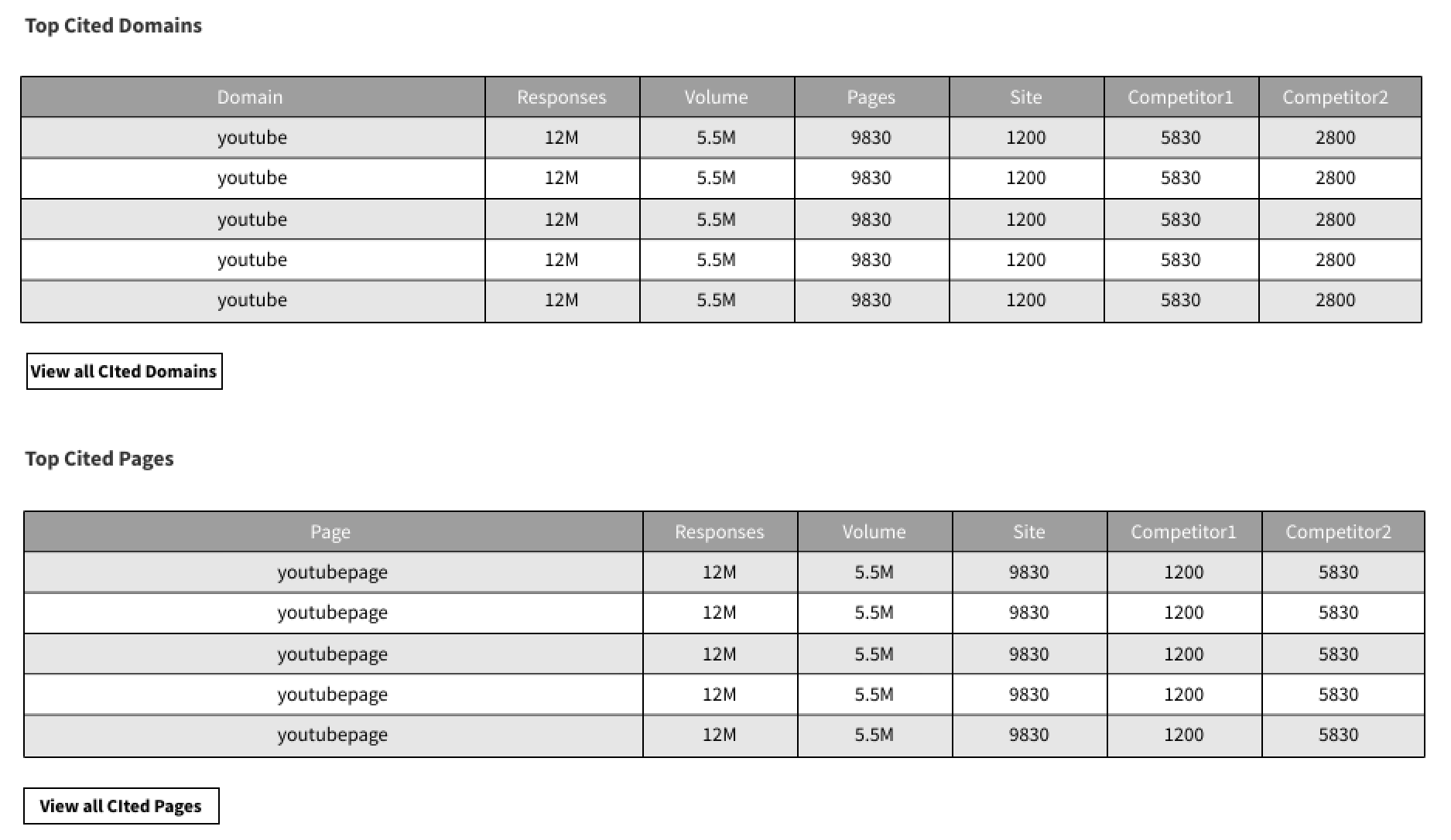
Aside from exploring top domains and page URLs, users can also see how many mentions, and AI search volume each domain/page has in LLM responses. All of these metrics can be pulled straight from the Top Mentioned Domains/Top Mentioned Pages endpoints’ responses and displayed in the table. Additionally, users can compare the top mentioned domains with selected industry competitors by the number of mentions or other metrics.
These tables can be handy for assessing how fierce competition is in AI searches within a specific industry. Besides, you can evaluate whether it is worth targeting specific mentions in AI responses, considering the competition level.
Overall, the LLM Mentions API allows developers to design powerful AI visibility tracking features or build standalone GEO tools, providing immense value to customers.
3. Brand marketing and PR agencies
The shift to generative search influences brand marketing and PR, too. Now, AI emerges as a separate channel for brand monitoring because users can consider AI-generated responses as authoritative sources. That means the way LLM mentions your brand in the response, the context AI gives to the mention can determine users’ actions towards your brand. In this situation, tracking the AI responses for brand mentions and analyzing their context and sentiment is crucial for brand strategies.
Fortunately, with the LLM Mentions API, brand agencies can instantly access all required AI mentions data. For example, by using the Search Mentions endpoint, they can collect numerous snippets of LLM responses for specific brand or product mentions. Then, the agency can perform a deep sentiment analysis of relevant responses. This analysis will allow us to determine the sentiment the brand receives the most, how frequently, and in which context the brand appears in AI responses. With detailed sentiment insights, the brand agency can develop data-driven recommendations for improving brand positioning and the company’s value proposition in content marketing and communications.
Beyond sentiment analysis, brand agencies must also focus on shaping how AI models understand and represent their clients’ brands. This can be done by supplying LLMs with relevant information that positions brands favorably through authoritative channels. In this context, the Search Mentions and Top Mentioned Domains endpoints can help to explore such channels quickly. For instance, in the Search Mentions endpoint, marketers can explore the sources arrays in relevant responses to see which types of sources are favored by AI. Suppose there are websites such as Quora, Reddit, or thematic forums among the sources. In that case, it may be worth considering increasing the brand presence on such resources through communication or content campaigns.
Similarly, marketers can use the Top Mentioned Domains endpoint to see if there are any relevant channels among the top domains by mentions. They can also estimate the traffic potential from relevant domains by considering ai_search_volume and mentions. As a result, a brand marketing agency can map out the best potential channels for an AI brand positioning strategy to make it successful.
In short, these three use cases demonstrate that the LLM Mentions API is a versatile solution that helps many professionals remain confident in the era of generative search. From building advanced mention tracking tools to shaping the brand image for AI, the LLM Mentions API serves as a reliable and quality data foundation.
Conclusion
The generative search era surprised many of us, bringing uncertainty with AI visibility tracking and optimization issues. But the times of uncertainty are over. With the DataForSEO LLM mentions API, AI visibility tracking is no longer guesswork, but a data-driven process. This API transforms conversational responses into structured mentions data that can help various professionals who want to secure success in generative search.
In particular, the power of the LLM Mentions API allows you to:
- Carry out complex generative search optimization tasks, like competitor research, mention monitoring, and AI keyword research;
- Develop advanced AI visibility tracking tools;
- Collect clear and structured AI response data for brand marketing and sentiment analysis.
Register at DataForSEO now and step into the generative search era with the best data solution on the market!