
Picking a local business is rarely a one-step decision. Customers check reviews, weigh prices, and compare two or three options before they commit. A lot of that work now happens inside an LLM. When someone asks ChatGPT to recommend a restaurant or hotel, the model doesn’t always respond to the user’s prompt right away. It may send a handful of its own queries about reviews, prices, hours, and location, and build the answer from the results.
Our study of 100,249 fan-out queries drawn from 100,000 ChatGPT prompts shows how aggressive this gets in local-business categories. Food, travel, and hospitality prompts trigger up to 33% more fan-out queries than the dataset baseline. That means more derived queries to compete for and a wider retrieval surface to cover. In this article, we’ll explore this LLM search behavior in more detail, explain how the gaps open up in local content, and how you can audit local business AI visibility with DataForSEO APIs.
Contents:
How LLMs interpret queries about local businesses: key insights from the research
1. “Where” question prompts trigger fan-out 67% of the time
2. Prompts with local amplifiers generate up to 33% more fan-out queries
3. The core takeaways from the research results
The AI search optimization for local businesses: key content gaps to address
Closing the gaps: optimizing local business content for AI with DataForSEO
1. Exploring relevant fan-out queries
2. Business listings data analysis
3. Tracking optimization progress
Conclusion
How LLMs interpret queries about local businesses: key insights from the research
The way LLMs treat local business queries can best be understood through the features of the LLM response-generation process. For example, let’s analyze how Google Maps and ChatGPT respond to the same location-based query: “Where can I eat the best pizza in London?”
Here’s the Google Maps result.
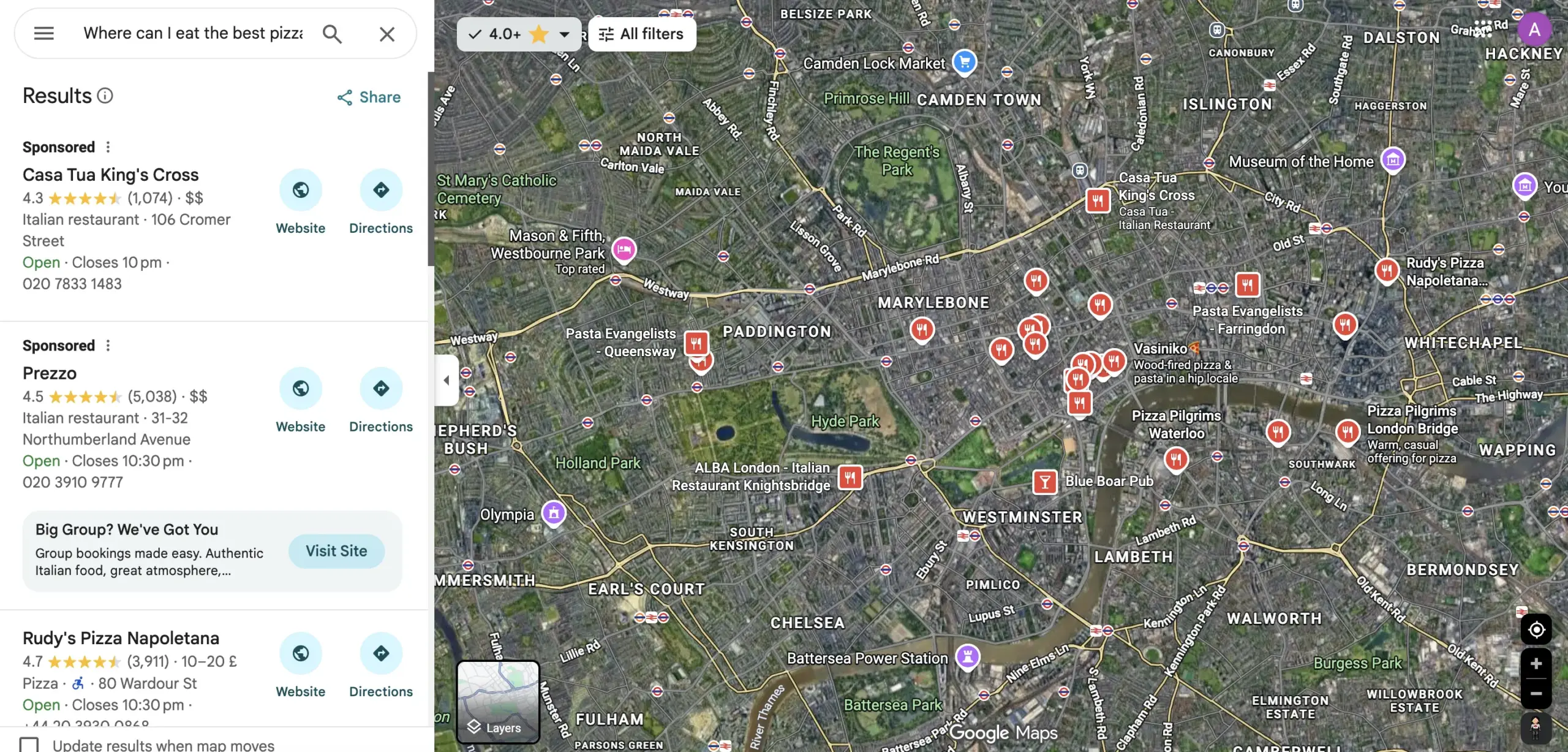
Google Maps response isn’t different from usual. It displays relevant restaurants in the city as points of interest on the map, along with a ranked list of places on the left. Overall, Google Maps visually highlights the locations of relevant businesses and provides a basic understanding of their ratings and popularity. The service ranks them by relevance to the query, reviews, proximity, and whether the result is sponsored.
ChatGPT, though, is a different story.
ChatGPT also displays a map of relevant restaurants, but it’s only a fragment of the response. The bulk of it is a detailed guide to the restaurants with the best pizza in London. The guide includes place descriptions, contact info, and suggestions for choosing the best option. In comparison, ChatGPT provides users with all the relevant information needed to make a decision, rather than just a list of options like Google Maps.
ChatGPT’s behavior is defined by the features of the user query. The AI doesn’t treat a prompt as a single request and may expand it into additional searches to collect more contextual information. The prompt “Where can I eat the best pizza in London?” calls for local, up-to-date information, which may trigger ChatGPT to generate additional searches, such as “best pizza restaurants in London reviews”, “famous pizzerias in central London rating,” and so on. They are called “fan-out queries” – search queries generated by an LLM to access third-party information and synthesize a more relevant response.
Fan-out queries are not randomly generated – they are relevant to the main user query and may appear when it introduces specific constraints, such as location, time, or type of service. The local business query “Where can I eat the best pizza in London?” exactly includes constraints that may trigger a query fan-out. That means, to be recommended by the AI, you should optimize and rank not only for the main query but also for the searches LLMs run under the hood.
When conducting our extensive query fan-out research, we decided to examine whether certain words or questions are more likely to trigger query fan-out. The results demonstrate a strong positive relationship between local business terms, question words, and the frequency of query fan-out. Let’s take a look at the key numbers that demonstrate this.
1 “Where” question prompts trigger fan-out 67% of the time
The key finding of our research was that, on average, 47% of ChatGPT prompts trigger query fan-out. That number is an average, though, and the next step was to find out what moves it up or down. One of the variables we tested was the question word at the start of the prompt.
For the analysis, we used 47% as a baseline and compared it against the fan-out rates of prompts with question words (“Who”, “What”, “Where”, “Which”, “Why”, and “How”) and non-question prompts. The results are illustrated below:
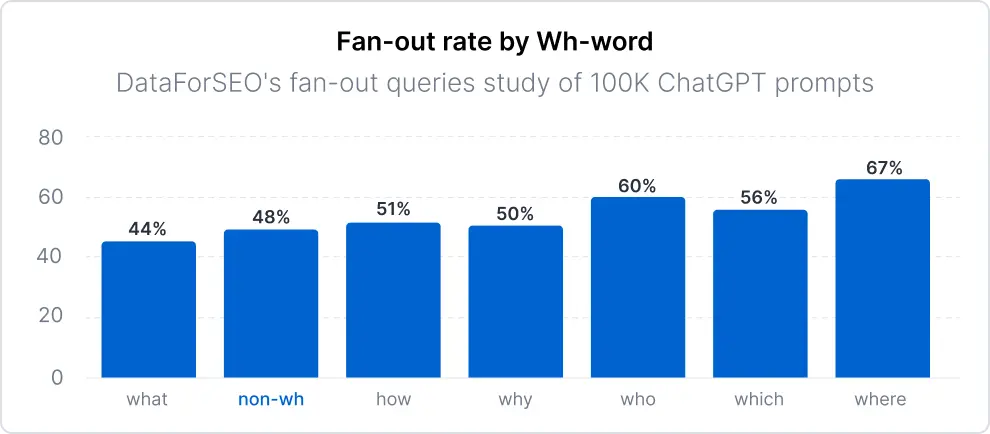
Compared to the baseline, prompts using different question words show varying fan-out rates. The “What” prompts are below average (44%), whereas “Who” and “Which” are much higher (60% and 56%, respectively). However, the “Where” prompts stand out, with a remarkable 67% fan-out rate.
After that, we went one level deeper and measured the average number of fan-out queries generated per prompt. The chart below shows the results:
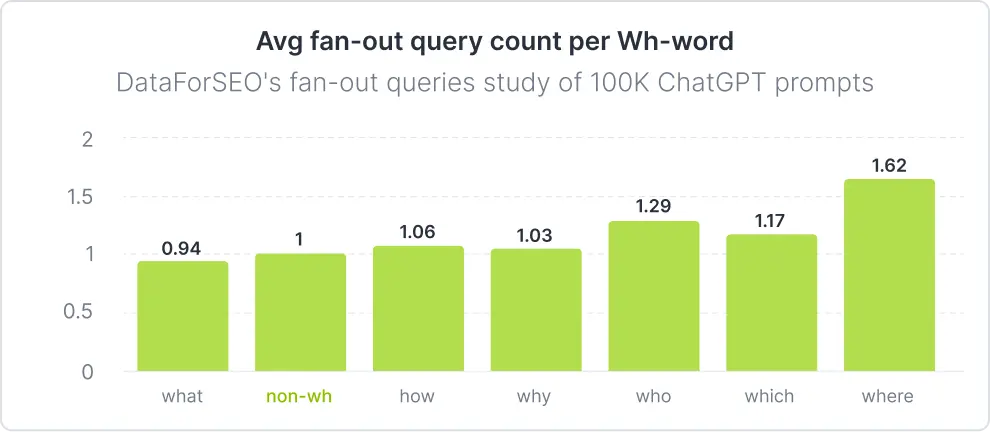
As we can see, the number of fan-out queries generated correlates with the fan-out rates of question words. That means prompts that trigger query fan-out more often also tend to generate more sub-queries. The “Where” question prompts stand out again with 1.62 sub-queries generated per prompt.
The results make it clear that specific question words used at the beginning of a prompt influence the fan-out behavior of an LLM and may contribute to a higher fan-out rate. What’s more interesting is the big positive gap between the “Where” question word and others – 67% fan-out rate and 1.62 fan-out queries per prompt on average. That means that “Where” question prompts are significantly more likely to trigger fan-out in ChatGPT. Because “Where” questions aim to elicit information about locations and places, we can conclude that the LLM may require broader information retrieval to answer them properly.
2 Prompts with local amplifiers generate up to 33% more fan-out queries
The question words at the beginning of the prompt certainly influence the fan-out behavior, but they are only part of the prompt. Other words that appear throughout the prompt may also shape the LLM’s information retrieval and clearly indicate the user’s intent. The two example prompts below explain it the best:
Where is the Colosseum?
Where can I eat the best local food in Rome?
The first prompt is a single fact lookup with little ambiguity, which the model can easily answer straight away. The second one introduces additional constraints, such as location (Rome) and a specific action (to eat the best local food), so it requires comparison and access to actual information.
Thus, we decided to analyze all words in the user prompts and identify the ones that consistently appear in prompts that trigger more fan-out queries. In particular, we analyzed the following data for each given word:
- The number of times a word is used in the prompts;
- The total number of fan-out queries triggered by a word;
- The average number of fan-out queries for the prompts containing that word;
- Whether a word increases fan-out intensity against the baseline (1 fan-out query), and to what extent.
We put the words with the most distinctive results into the ranked table below:
| # | Word | Used count | Fan-out count | Average fan-out intensity when the word is present | Fan-out intensity increase |
| 1 | dish | 130 | 364 | 2.8 | 33% |
| 2 | menu | 158 | 419 | 2.65 | 26% |
| 3 | kind | 174 | 452 | 2.6 | 23% |
| 4 | today | 309 | 761 | 2.46 | 17% |
| 5 | pizza | 176 | 428 | 2.43 | 15% |
| 6 | where | 978 | 2 365 | 2.42 | 15% |
| 7 | restaurant | 343 | 824 | 2.4 | 14% |
| 8 | food | 460 | 1 092 | 2.37 | 12% |
| 9 | at | 1 722 | 4 045 | 2.35 | 11% |
| 10 | hotel | 204 | 480 | 2.35 | 11% |
| 11 | eat | 262 | 614 | 2.34 | 11% |
| 12 | popular | 661 | 1 543 | 2.33 | 10% |
| 13 | known | 186 | 426 | 2.29 | 9% |
| 14 | game | 356 | 812 | 2.28 | 8% |
| 15 | place | 278 | 629 | 2.26 | 7% |
| 16 | city | 228 | 515 | 2.26 | 7% |
| 17 | largest | 257 | 579 | 2.25 | 7% |
| 18 | watch | 174 | 392 | 2.25 | 7% |
| 19 | church | 163 | 367 | 2.25 | 7% |
| 20 | code | 256 | 572 | 2.23 | 6% |
As shown in the table, the largest increase in fan-out intensity occurs around words related to local businesses (particularly restaurants and cafes), travel, and comparisons. Taking the word “dish” as an example, the prompts with local business-related words can generate up to 33% more fan-out queries on average.
That clearly demonstrates that prompts related to food, travel, and local context require more thorough searches with multiple fan-out queries. In scenarios like “Where is the best hotel in…”, “Help me choose a restaurant…”, the model strongly relies on up-to-date third-party information and benefits from exploring multiple sources for generating the most relevant response.
3 The core takeaways from the research results
Based on these two examples from our research, we can clearly conclude that fan-out is not evenly distributed across user prompts. The ones that require information on local businesses, travel, and food recommendations and comparison generate more overall fan-out queries. Such prompts encourage LLM to fetch and analyze more search results before generating an answer.
Obviously, to find restaurants with the best pizza in London, ChatGPT has to search through dozens of places, evaluate, and include them into the response. Given the large quantity of local business entities, the competition to win the LLM retrieval naturally becomes high.
But what information from local businesses would an LLM need to evaluate before showcasing them in a response? It certainly depends on the context of a query, but eventually can be narrowed down to the following attributes:
- Local business offers. This includes restaurant menus, hotel accommodation options, availability of specific services, and more.
- Customer reviews. Analyzing feedback and ratings for a local business is a crucial step in the evaluation process.
- Pricing information. Retrieving pricing information is essential for comparing and suggesting local business options based on the user’s financial preferences (best-value dining, fine dining, affordable hotels).
- Business location and working hours. This data is required to suggest options that meet users’ time and location constraints (specific time of day, part of the city, etc.).
For each of the attributes mentioned, the LLM may run additional searches to fetch relevant business entities and select those that best meet all the criteria. For example, the query “Where is the best French restaurant in Chicago?” can be decomposed into two or three relevant sub-queries about menu, price, and reviews. The LLM will then send these queries to search engines, gather the results, and pick restaurants it considers “the best” in terms of menu, pricing, reviews, and other factors.
Overall, the behavior of LLMs against local business queries can be summarized as follows:
1. Prompts related to food, travel, and hospitality, formulated as questions and comparisons, introduce constraints for an LLM (time, location, type of service). To answer such constrained prompts, an LLM must fetch additional external information.
2. To fetch information, the LLM generates fan-out queries relevant to the main query. According to our research, the likelihood of query fan-out and the number of additional queries are significantly higher for local business-related queries.
3. Fan-out queries allow LLMs to fetch and inspect actual information on local businesses, such as menus, prices, reviews, and more.
4. The search results that appear most relevant across multiple signals are then included in the final response.
All of this has significant practical implications for developing GEO strategies focused on local businesses. To appear prominently in AI searches, local businesses must go beyond simple descriptions on Google Maps and landing pages. In the next section, we’ll explain which content gaps you need to address to be seen by AI and how to do that with DataForSEO’s assistance.
The AI search optimization for local businesses: key content gaps to address
Now that we know how LLMs handle local business prompts and look up relevant business entities, we can better understand how to structure a local business’s content so that it actually appears in the queries the model runs.
When analyzing the content of search results to cite in the response, LLMs evaluate it not only against essential SEO best practices, such as content relevance, trustworthiness, and website health, but also against additional criteria. In particular, AI checks the content for comprehensiveness, up-to-date information, and supporting evidence such as ratings, reviews, and structured business data.
That means, for retrieval and citation, the content must be actual, comprehensive, and multi-layered to cover all possible gaps. For the food, travel, and local services content, four gap patterns emerge that may keep local businesses out of AI answers. Let’s analyze these content gaps in more detail:
1. Head-term focused content, no long-tail variants. It is not uncommon for local businesses to build content pages that target only their industry’s head terms. While this approach may help to gain some organic traffic, it is of no use for AI search optimization.
That’s true because LLMs try to cover all possible angles of a user’s query with their answer. They seek results that have sufficient depth to address multiple angles simultaneously.
To retrieve such results, LLMs need to expand the initial user prompt into a set of fan-out queries that address more specific pain points. Within the framework of our research, we compared the prompt lengths and the fan-out queries generated to see how AI extends user prompts. The graph below demonstrates the results.
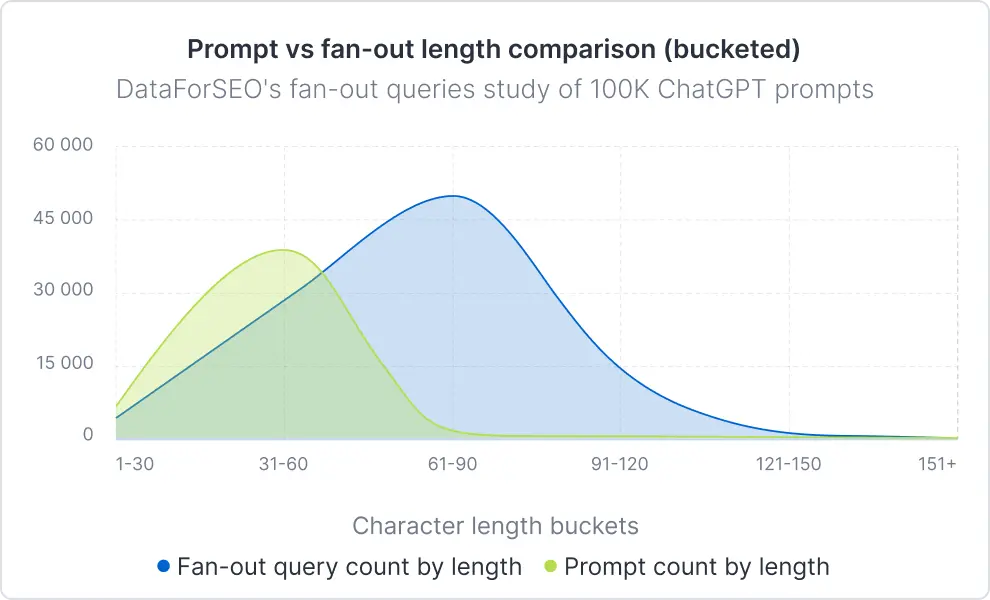
From the graph, we can see that most user prompts are 31-60 characters, whereas fan-out queries are longer, averaging 61-90 characters. This shows that ChatGPT expands original user prompts when generating fan-out queries. However, ChatGPT doesn’t go overboard, keeping the fan-out queries within an appropriate length and naturally phrased.
That means fan-out queries reflect the user’s potential long-tail intent. For example, the fan-out queries “best fine dining Italian restaurants in downtown Chicago reviews”, “Where are the best Italian restaurants in Chicago for a family dinner?” can be an expansion of a user’s query “best Italian restaurants in Chicago”. Thus, to be featured in LLMs, local business content must address a wide range of long-tail user intents.
2. No comparison or “best of” layer. This content gap is closely related to the absence of long-tail focused content, as it also makes the business content less comprehensive for LLMs. As we discussed before, the local business prompts are strongly associated with finding the best option among different business entities and comparing their offers and quality.
In this case, it is important to signal to the LLM that your business is the best in the target category, location and that it meets the demands of the target audience. That can be done by introducing comparison or explanatory sections that local businesses usually overlook in their content.
For example, a local house cleaning chain may introduce a structured “our business vs competitors” table to highlight the benefits of its services. Likewise, a new hotel in the city may include a “Why stay at our hotel…?” section that explains why it is the best option and describes key services and benefits, such as a luxurious spa and closeness to the city center. Eventually, the LLM can fetch such structured sections and include them directly in the response.
3. Missing or stale structured business data. This gap is one of the most basic, as it relates to the routine task of keeping a Google My Business profile and key business data on the website up to date. Unstructured and irrelevant business data is likely the first flag the LLMs consider when assessing business relevance. Put simply, if you don’t specify the contact info or correct open hours, the AI may not even consider checking your business.
That’s why maintaining an up-to-date Google My Business profile and the current “About us” and contact sections on your website are essential. Moreover, the business data must include all services offered, dedicated FAQ sections, and structured answer blocks. The more actual and structured the data is, the easier it is for LLMs to parse and evaluate it. Monitoring and responding to reviews and comments is crucial because it shows the LLM that the business is engaged and attentive to users’ feedback.
4. Missing specific location details in the content. This gap may seem minor, but it can strongly influence the LLM’s decision-making process. A business can specify the city and exact address on the website and in the business profile, but not mention detailed location information elsewhere in the content. For example, a plumbing company operating in Streatham, London, may position itself as “best plumbing services in London” instead of the more specific “best plumbing services in Streatham.”
For location-specific queries, this difference may cause businesses to fall out of the AI retrieval pool. LLMs expect the neighborhood or district to appear across service pages, blog posts, and metadata, not only on the contact page. In this case, it is important to build location specificity into the content layer itself and create dedicated pages for each area the business actually serves.
In summary, AI search optimization for local businesses requires addressing at least four key content gaps related to content comprehensiveness, structure, and freshness. Filling in content gaps can take your business one step closer to being featured in the LLM retrieval and citation pool.
What kind of toolkit is necessary to effectively conduct a local AI visibility audit, identify content opportunities, and track the results of optimization? That’s where DataForSEO APIs come in, providing the necessary solutions and data for result-driven optimization.
Closing the gaps: optimizing local business content for AI with DataForSEO
In its core, the basic optimization of local business content for AI searches can consist of the following steps:
1. Identifying relevant fan-out queries and evaluating them for content optimization.
2. Analyzing niche business listings to complete your local profile.
3. Tracking the results of content optimization.
To complete each of these steps, DataForSEO provides an advanced, data-driven toolkit. With the LLM Mentions API from our AI Optimization Data API suite and the Business Data API, you can explore fan-out queries, track a business’s AI visibility, and analyze business listings with ease. Let’s explore in more detail how these DataForSEO APIs can be used to cover each of the three mentioned steps.
1 Exploring relevant fan-out queries
Finding fan-out queries LLMs use within your industry is the initial and, at the same time, most crucial step. However, these queries are not displayed directly to the user, making it almost impossible to retrieve them from an LLM interface.
The LLM Search Mentions endpoint directly addresses this limitation. This endpoint allows you to specify target search terms in your industry to fetch LLM answers that contain the exact fan-out queries you need. Besides, the Search Mentions endpoint can return up to 1000 LLM responses in one call, so you can explore and analyze fan-out queries in bulk.
But gathering fan-out queries is not enough for effective content optimization. You need to identify which queries have potential and are worth optimizing. The AI Keyword Data Keyword Search Volume is what you are looking for. This endpoint enriches queries with AI search volume, our proprietary metric that estimates how often a query is used in AI searches. Using this endpoint, you can fetch AI search volume values for up to 1000 queries at once.
By using both endpoints, you can easily explore relevant fan-out queries with data-driven popularity metrics. What is even better is that you can do that without writing a single line of code or understanding complex API matters. You can plug in DataForSEO APIs right to AI assistants and tools using our official MCP server. With the MCP server connection, your AI tool can call the DataForSEO API endpoints directly and provide data-driven answers.
For example, let’s do the fan-out queries research in Claude. Following our simple guide, connect the MCP server to Claude Desktop, start the chat with the preferred model, and send the following prompt.
Claude will then call the Search Mentions and AI Keyword Data endpoints and generate the answer.
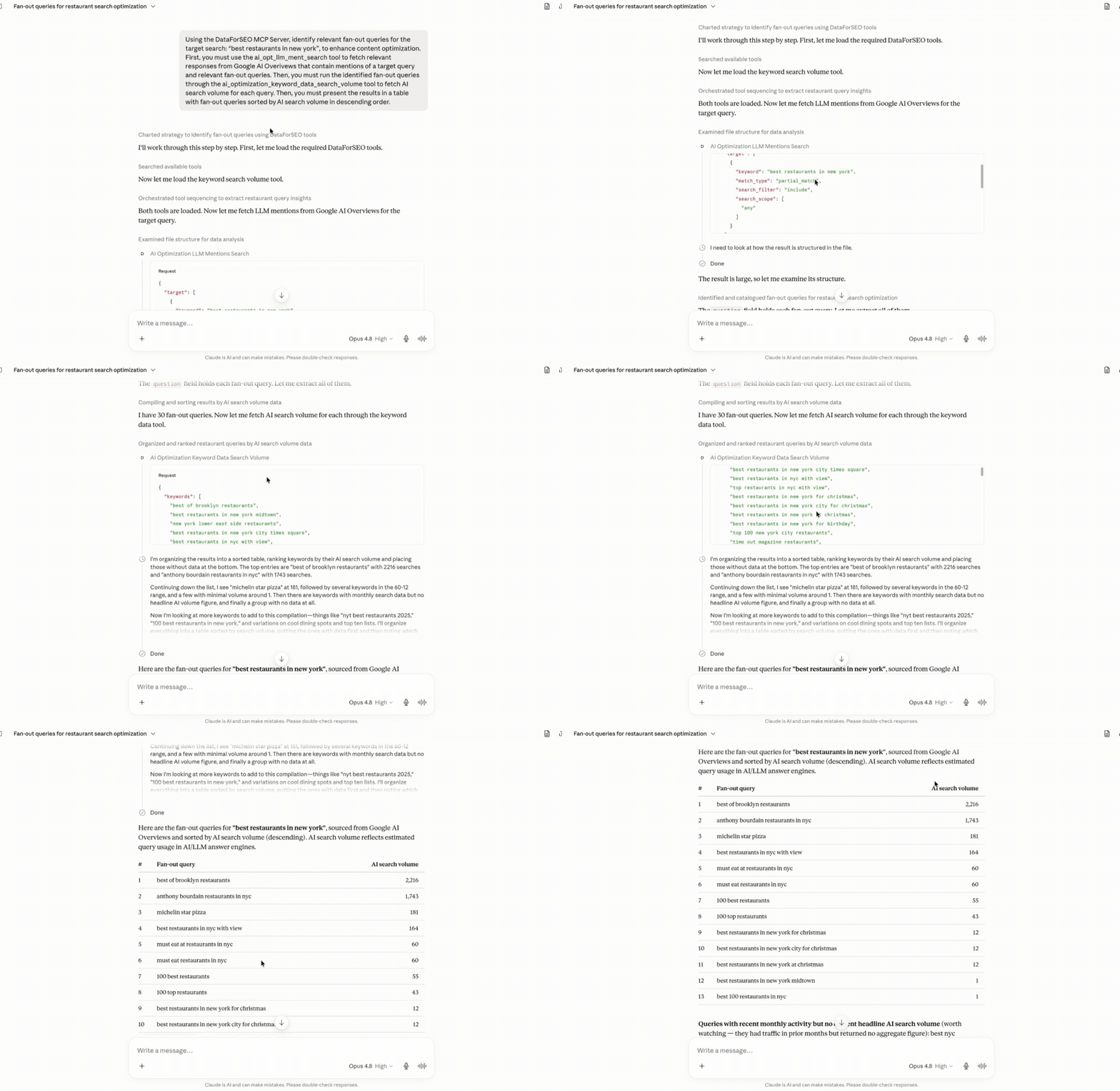
As you can see, using the mentioned endpoints, Claude identified fan-out queries relevant to each seed search term and enriched them with actual AI search volume. Within a couple of minutes, you have a structured list of queries the LLM uses for searching information within a local business niche.
2 Business listings data analysis
This step is essential to keep your local business information on Google Maps and your website comprehensive and up-to-date. For example, you need to publicly display all important information about your services and relevant industry amenities to make your business stand out for LLMs in particular.
This requires analyzing the profiles of numerous local competitors listed on Google Maps, fetching data on their available services, ratings, and more. While you can check competitors individually on Google Maps and other sources, it is neither scalable nor reliable for bulk, comprehensive research.
Our Business Listings Search endpoint of the Business Data API is well-suited for this task. For the target categories, it returns up to 1000 relevant business listings in a single API call, with detailed structured data, from contact information to all available attributes. Moreover, you can specify the location_coordinate parameter to search for relevant businesses only within a specific location, narrowing your search.
Here is an example request to this API for data on pizza restaurants with a rating above 3 in Manchester:
[
  {
    "categories": [
      "pizza_restaurant"
    ],
    "description": "pizza",
    "title": "pizza",
    "is_claimed": true,
    "location_coordinate": "53.476225,-2.243572,10",
    "order_by": [
      "rating.value,desc"
    ],
    "filters": [
      [
        "rating.value",
        ">",
        3
      ]
    ],
    "limit": 2
  }
]
The response returns as follows:
{
"version": "0.1.20260717",
"status_code": 20000,
"status_message": "Ok.",
"time": "0.3045 sec.",
"cost": 0.01272,
"tasks_count": 1,
"tasks_error": 0,
"tasks": [
{
"id": "07221817-1535-0544-0000-ee4d6ca1f4d5",
"status_code": 20000,
"status_message": "Ok.",
"time": "0.2936 sec.",
"cost": 0.01272,
"result_count": 1,
"path": [
"v3",
"business_data",
"business_listings",
"search",
"live"
],
"data": {
"api": "business_data",
"function": "search",
"categories": [
"pizza_restaurant"
],
"description": "pizza",
"title": "pizza",
"is_claimed": true,
"location_coordinate": "53.476225,-2.243572,10",
"order_by": [
"rating.value,desc"
],
"filters": [
[
"rating.value",
">",
3
]
],
"limit": 2
},
"result": [
{
"total_count": 65,
"count": 2,
"offset": 0,
"offset_token": "eyJDdXJyZW50T2Zmc2V0IjoyLCJSZXF1ZXN0RGF0YSI6eyJuYW1lIjoicGl6emEiLCJkZXNjcmlwdGlvbiI6InBpenphIiwiY2F0ZWdvcmllcyI6WyJwaXp6YV9yZXN0YXVyYW50Il0sImNvdW50cnlfY29kZSI6bnVsbCwiY2l0eSI6bnVsbCwiaXNfY2xhaW1lZCI6dHJ1ZSwib25seV9nb29nbGVfYnVzaW5lc3MiOmZhbHNlLCJnZW8iOnsibG9uZ2l0dWRlIjotMi4yNDM1NzIsImxhdGl0dWRlIjo1My40NzYyMjUsInJhZGl1cyI6MTAuMH0sInNlYXJjaF9hZnRlcl90b2tlbiI6bnVsbCwib3JkZXJfYnkiOnsib3JkZXJfZmllbGQiOiJyYXRpbmcudmFsdWUiLCJvcmRlcl90eXBlIjoiRGVzYyIsIm5leHQiOm51bGx9LCJsaW1pdCI6Miwib2Zmc2V0IjpudWxsfSwiUmF3UXVlcnkiOnsiZmllbGQiOiJyYXRpbmcudmFsdWUiLCJ0eXBlIjoiZ3QiLCJ2YWx1ZSI6M30sIlNlYXJjaEFmdGVyRGF0YSI6WzUuMCwiMjM1NzM3ODczNDY0MTE4NTA5NiJdfQ==",
"items": [
{
"type": "business_listing",
"title": "Pizza Mate",
"original_title": null,
"description": "Pizza Mate is the friendly face of hand-stretched pizzas, collaborating in social spaces.Expect quality pizza whilst enjoying a craft beer, or arrange collection or delivery.",
"category": "Pizza restaurant",
"category_ids": [
"pizza_restaurant"
],
"additional_categories": null,
"cid": "10964700581133624142",
"feature_id": "0x487bb328c6bde12b:0x982a7115c6fd234e",
"address": "Project, 53 22 Market Pl, Stockport SK1 1EU",
"address_info": {
"borough": null,
"address": "Project, 53 22 Market Pl",
"city": "Stockport",
"zip": "SK1 1EU",
"region": null,
"country_code": "GB"
},
"place_id": "ChIJK-G9xiize0gRTiP9xhVxKpg",
"phone": null,
"url": "https://pizzamate.co.uk/",
"domain": "pizzamate.co.uk",
"logo": "https://lh4.googleusercontent.com/-pv21SXWW7Mc/AAAAAAAAAAI/AAAAAAAAAAA/4bTVrpABDL0/s44-p-k-no-ns-nd/photo.jpg",
"main_image": "https://streetviewpixels-pa.googleapis.com/v1/thumbnail?panoid=l-fqhq49IdOOC9QVd0O2yw&cb_client=search.gws-prod.gps&w=408&h=240&yaw=317.7895&pitch=0&thumbfov=100",
"total_photos": 6,
"snippet": "Project, 53 22 Market Pl, Stockport SK1 1EU",
"latitude": 53.4115499,
"longitude": -2.1574226,
"is_claimed": true,
"attributes": {
"available_attributes": {
"service_options": [
"has_curbside_pickup",
"has_delivery",
"has_takeout",
"serves_dine_in"
],
"offerings": [
"serves_alcohol"
],
"dining_options": [
"serves_lunch",
"serves_dinner",
"has_catering",
"has_counter_service",
"has_seating"
],
"amenities": [
"has_bar_onsite",
"welcomes_dogs",
"has_restroom",
"has_wi_fi"
],
"crowd": [
"welcomes_families",
"welcomes_lgbtq",
"is_transgender_safespace"
],
"planning": [
"accepts_reservations"
],
"payments": [
"pay_debit_card",
"pay_mobile_nfc"
],
"children": [
"welcomes_children"
]
},
"unavailable_attributes": null
},
"place_topics": null,
"rating": {
"rating_type": "Max5",
"value": 5,
"votes_count": 7,
"rating_max": null
},
"hotel_rating": null,
"price_level": null,
"rating_distribution": {
"1": 0,
"2": 0,
"3": 0,
"4": 0,
"5": 7
},
"people_also_search": [
{
"cid": "14613919956191322904",
"feature_id": "0x0:0xcacf12c5b4c6a318",
"title": "The Fresh Pizza Express",
"rating": {
"rating_type": "Max5",
"value": null,
"votes_count": null,
"rating_max": null
}
},
{
"cid": "16189719147318426038",
"feature_id": "0x0:0xe0ad6fc9a54139b6",
"title": "Tasty Bites Stockport",
"rating": {
"rating_type": "Max5",
"value": 3.8,
"votes_count": 10,
"rating_max": null
}
},
{
"cid": "10027034451293372989",
"feature_id": "0x0:0x8b272eb53bf2023d",
"title": "Stockport Pizza House",
"rating": {
"rating_type": "Max5",
"value": 3.7,
"votes_count": 76,
"rating_max": null
}
},
{
"cid": "14212507464546686832",
"feature_id": "0x0:0xc53cf83ce7e49770",
"title": "SAPORITA",
"rating": {
"rating_type": "Max5",
"value": 4,
"votes_count": 5,
"rating_max": null
}
}
],
"work_time": {
"work_hours": {
"timetable": {
"sunday": null,
"monday": null,
"tuesday": null,
"wednesday": null,
"thursday": null,
"friday": [
{
"open": {
"hour": 17,
"minute": 0
},
"close": {
"hour": 21,
"minute": 0
}
}
],
"saturday": [
{
"open": {
"hour": 16,
"minute": 0
},
"close": {
"hour": 21,
"minute": 0
}
}
]
},
"current_status": "closed_forever"
}
},
"popular_times": null,
"local_business_links": null,
"contact_info": null,
"check_url": "https://www.google.co.uk/maps?cid=10964700581133624142&hl=en&gl=GB",
"last_updated_time": "2023-09-17 10:03:04 +00:00",
"first_seen": "2023-09-17 10:03:04 +00:00",
"services": null
},
{
"type": "business_listing",
"title": "Honest Crust Sourdough Pizza @ Runaway Brewery",
"original_title": null,
"description": "Honest Crust Sourdough Pizza at The Runaway Brewery taproom in Stockport. Seating inside and outside.",
"category": "Pizza restaurant",
"category_ids": [
"pizza_restaurant"
],
"additional_categories": null,
"cid": "2357378734641185096",
"feature_id": "0x487bb392f25d5441:0x20b717781f590148",
"address": "Runaway Brewery, Astley St, Stockport SK4 1AW",
"address_info": {
"borough": null,
"address": "Runaway Brewery, Astley St",
"city": "Stockport",
"zip": "SK4 1AW",
"region": null,
"country_code": "GB"
},
"place_id": "ChIJQVRd8pKze0gRSAFZH3gXtyA",
"phone": null,
"url": "https://www.honestcrustsourdoughpizza.com/",
"domain": "www.honestcrustsourdoughpizza.com",
"logo": "https://lh5.googleusercontent.com/-enW5ItppuYY/AAAAAAAAAAI/AAAAAAAAAAA/CduyW54fWbY/s44-p-k-no-ns-nd/photo.jpg",
"main_image": "https://lh3.googleusercontent.com/gps-cs-s/AHRPTWmFu4hpK_l7_YFAg_sav0yKvYOv8h6HPOEsNO-8PObb406P4BPT694WySUcdbnBfKgCiQ7fFfTpD-ki6R4uveo1U4MsymKvBugKlerrjx8hibRqFjvaxnjkoB2KakiVgyB-5ruQ0g=w408-h408-k-no",
"total_photos": 7,
"snippet": "Runaway Brewery, Astley St, Stockport SK4 1AW",
"latitude": 53.409521999999996,
"longitude": -2.1644972,
"is_claimed": true,
"attributes": {
"available_attributes": {
"service_options": [
"has_takeout",
"serves_dine_in"
],
"highlights": [
"serves_dessert_notable"
],
"popular_for": [
"serves_lunch_popular",
"serves_dinner_popular",
"suitable_for_solo_dining"
],
"offerings": [
"serves_coffee",
"quick_bite"
],
"dining_options": [
"serves_lunch",
"serves_dinner",
"serves_dessert",
"has_seating"
],
"atmosphere": [
"feels_casual",
"feels_hip"
],
"crowd": [
"suitable_for_groups",
"welcomes_lgbtq",
"is_transgender_safespace"
],
"payments": [
"pay_credit_card",
"pay_debit_card",
"pay_mobile_nfc"
],
"children": [
"welcomes_children"
],
"parking": [
"has_parking_garage_paid"
],
"pets": [
"welcomes_dogs"
]
},
"unavailable_attributes": {
"planning": [
"accepts_reservations"
]
}
},
"place_topics": null,
"rating": {
"rating_type": "Max5",
"value": 5,
"votes_count": 2,
"rating_max": null
},
"hotel_rating": null,
"price_level": null,
"rating_distribution": {
"1": 0,
"2": 0,
"3": 0,
"4": 0,
"5": 2
},
"people_also_search": [
{
"cid": "7718354789607041676",
"feature_id": "0x0:0x6b1d1ac99cf66a8c",
"title": "Honest Crust Sourdough Pizza",
"rating": {
"rating_type": "Max5",
"value": 4.3,
"votes_count": 92,
"rating_max": null
}
},
{
"cid": "3590835195181697035",
"feature_id": "0x0:0x31d53595bfc6880b",
"title": "The Runaway Brewery & Taproom",
"rating": {
"rating_type": "Max5",
"value": 4.8,
"votes_count": 388,
"rating_max": null
}
},
{
"cid": "27332300897250232",
"feature_id": "0x0:0x611a9535dfebb8",
"title": "Home Run Pizzas",
"rating": {
"rating_type": "Max5",
"value": 4.5,
"votes_count": 175,
"rating_max": null
}
},
{
"cid": "9159876003991947518",
"feature_id": "0x0:0x7f1e6ab1cc9088fe",
"title": "Dome And Base",
"rating": {
"rating_type": "Max5",
"value": 4.6,
"votes_count": 13,
"rating_max": null
}
}
],
"work_time": {
"work_hours": {
"timetable": {
"sunday": [
{
"open": {
"hour": 13,
"minute": 0
},
"close": {
"hour": 18,
"minute": 0
}
}
],
"monday": null,
"tuesday": null,
"wednesday": null,
"thursday": [
{
"open": {
"hour": 16,
"minute": 0
},
"close": {
"hour": 21,
"minute": 0
}
}
],
"friday": [
{
"open": {
"hour": 13,
"minute": 0
},
"close": {
"hour": 21,
"minute": 0
}
}
],
"saturday": [
{
"open": {
"hour": 13,
"minute": 0
},
"close": {
"hour": 21,
"minute": 0
}
}
]
},
"current_status": "open"
}
},
"popular_times": null,
"local_business_links": null,
"contact_info": null,
"check_url": "https://www.google.com/maps?cid=2357378734641185096&hl=en&gl=GB",
"last_updated_time": "2026-07-12 15:36:49 +00:00",
"first_seen": "2024-06-07 03:38:09 +00:00",
"services": null
}
]
}
]
}
]
}
Within the response’s items array, you’ll find business_listing objects that provide structured data on pizza restaurants in Manchester, including contact details, ratings, and more. The nested attributes objects are crucial for analysis, especially for understanding which services competitors emphasize. Availability and popularity of particular services are factors that LLMs might consider when selecting relevant businesses for a response.
3 Tracking optimization progress
The real impact of the implemented optimization steps can be measured only by tracking changes in target metrics over time. When you can track the results of local SEO relatively easily with traditional tools and metrics, you can’t apply them to GEO. Both optimization paradigms differ significantly and thus require different metrics and KPIs to track.
For the local GEO, it is essential to monitor changes in AI visibility by tracking the number of LLM mentions and the AI search volume rate. The LLM Mentions API has the right tools to track these metrics. First, you can track changes in mentions and AI search volume by making regular requests to the Target Metrics endpoint. By specifying your business website as the target, you can get the total current ai_search_volume, mentions count, and other relevant data.
However, this is just one piece of the complete picture. For comprehensive tracking, you need to analyze the historical data since the start of the optimization campaign. To do that, you can use the LLM Mentions Timeseries Delta and Timeseries New and Lost endpoints. The first shows how many mentions or how much AI search volume the target gained or lost compared to the previous period; the second tracks new and lost mentions in each period, along with their AI search volume.
For example, here is how you make a request to the Timeseries Delta endpoint:
[
  {
    "target": [
      {
        "keyword": "bmw",
        "search_scope": [
          "answer"
        ],
        "search_filter": "include"
      }
    ],
    "platform": "chat_gpt",
    "language_code": "en",
    "location_code": 2840,
    "date_from": "2025-08-01",
    "date_to": "2025-12-01",
    "group_range": "month"
  }
]
The result returns as follows:
{
  "version": "0.1.20260717",
  "status_code": 20000,
  "status_message": "Ok.",
  "time": "1.2036 sec.",
  "cost": 0.105,
  "tasks_count": 1,
  "tasks_error": 0,
  "tasks": [
    {
      "id": "07221818-1535-0663-0000-5b107683034d",
      "status_code": 20000,
      "status_message": "Ok.",
      "time": "1.1863 sec.",
      "cost": 0.105,
      "result_count": 1,
      "path": [
        "v3",
        "ai_optimization",
        "llm_mentions",
        "timeseries_delta",
        "live"
      ],
      "data": {
        "api": "ai_optimization",
        "function": "timeseries_delta",
        "target": [
          {
            "keyword": "bmw",
            "search_scope": [
              "answer"
            ],
            "search_filter": "include"
          }
        ],
        "platform": "chat_gpt",
        "language_code": "en",
        "location_code": 2840,
        "date_from": "2025-08-01",
        "date_to": "2025-12-01",
        "group_range": "month"
      },
      "result": [
        {
          "items_count": 5,
          "items": [
            {
              "date": "2025-08-01",
              "delta_mentions": 24131,
              "delta_ai_search_volume": 643690
            },
            {
              "date": "2025-09-01",
              "delta_mentions": -21815,
              "delta_ai_search_volume": -732631
            },
            {
              "date": "2025-10-01",
              "delta_mentions": 5863,
              "delta_ai_search_volume": 146385
            },
            {
              "date": "2025-11-01",
              "delta_mentions": 6244,
              "delta_ai_search_volume": 116227
            },
            {
              "date": "2025-12-01",
              "delta_mentions": -10221,
              "delta_ai_search_volume": -192280
            }
          ]
        }
      ]
    }
  ]
}
As you can see, the endpoint returned the monthly delta for mentions and search volume for the specified target. By analyzing this data and comparing it with the results from the Timeseries New & Lost endpoint, you can clearly evaluate how the key metrics have grown or declined since the start of the optimization.
Overall, DataForSEO provides a comprehensive toolkit to address key gaps in local business content and optimize it for AI searches. With the LLM Mentions API and Business Data API, in particular, you can:
1. Fetch relevant, high-potential fan-out queries for content optimization.
2. Keep your business information up to date and structured for AI agents.
3. Precisely track the progress of content optimization, down to the smallest changes.
What’s more, you can do all that without spending a fortune. Pricing for all DataForSEO APIs is pay-as-you-go: for the LLM Mentions endpoints, $0.1 per request and $0.001 per response row; for Business Listings Search, $0.012 per request and $0.00036 per item only. Visit the Pricing page for all the details.
Conclusion
For local businesses, AI visibility is now decided inside the answer an LLM assembles, not on a ranked list of results. That answer is built from fan-out queries the user never sees, and food, travel, and hospitality prompts generate more of them than most other categories: 67% of “where” prompts trigger fan-out, and local amplifiers add up to 33% more sub-queries on top of the baseline. Knowing which queries the model runs around your category is what turns local AI optimization from guesswork into a workflow.
Our research of 100,249 fan-out queries covers much more than what fits in this article. Grab the full report here to see how the patterns hold across other verticals and question types, and where the biggest optimization opportunities lie.
The good news is that you don’t need to wait to start working with this data. Everything the optimization workflow in this article calls for is already available through the DataForSEO AI Optimization Data API and Business Data API, from fetching fan-out queries to monitoring how your visibility shifts over time.
Register at DataForSEO now to run your first local GEO audit and make your local business visible to LLM search algorithms.